



Seismic Bracing for Fire Protection Systems: The 2026 Professional Guide
Over 50% of all building-related monetary losses following an earthquake are caused by damage to non-structural systems like fire sprinklers. It's a sobering statistic that proves a building's shell is only as resilient as the life-safety infrastructure inside it. You understand that protecting these systems isn't just about meeting a code; it's about preventing catastrophic water damage and ensuring immediate functionality after the ground stops moving. Navigating the latest 2025 NFPA 13 updates and ASCE 7-22 requirements for seismic bracing for fire protection systems can feel like a moving target, but precision here is non-negotiable.
We've developed this guide to help you master the essentials of seismic restraint so your systems remain fully operational during and after an event. You'll learn how to achieve full compliance with the newest standards, distinguish between the specific needs of rigid and cable bracing, and minimize potential downtime. We'll also provide a clear path to sourcing reliable, UL Listed and FM Approved hardware like ASC seismic bracing to eliminate doubt in your procurement process. From understanding differential movement to final hardware selection, this is your professional roadmap to total system assurance.
Key Takeaways
- Master the physics of differential movement to protect your system from catastrophic ruptures during building sway.
- Evaluate the differences between rigid and cable methodologies to choose the optimal restraint for your facility's layout.
- Navigate the latest NFPA 13 and ASCE 7-22 requirements to ensure your seismic bracing for fire protection systems meets every regulatory standard.
- Break down the anatomy of a bracing assembly to ensure every structural attachment and brace member is engineered for maximum stability.
- Simplify the procurement process by learning how to verify submittals and source pre-approved hardware like ASC components with confidence.
What is Seismic Bracing for Fire Protection Systems?
Seismic bracing for fire protection systems consists of specialized hardware designed to tether piping to the building's structure. While standard hangers are engineered to resist gravity, seismic braces are built to resist the horizontal and longitudinal forces generated during an earthquake. The objective is simple but critical: keep the system intact so it can suppress fires even after a major seismic event. Without these restraints, the pipes that make up fire sprinkler systems are likely to fail when the ground starts to move.
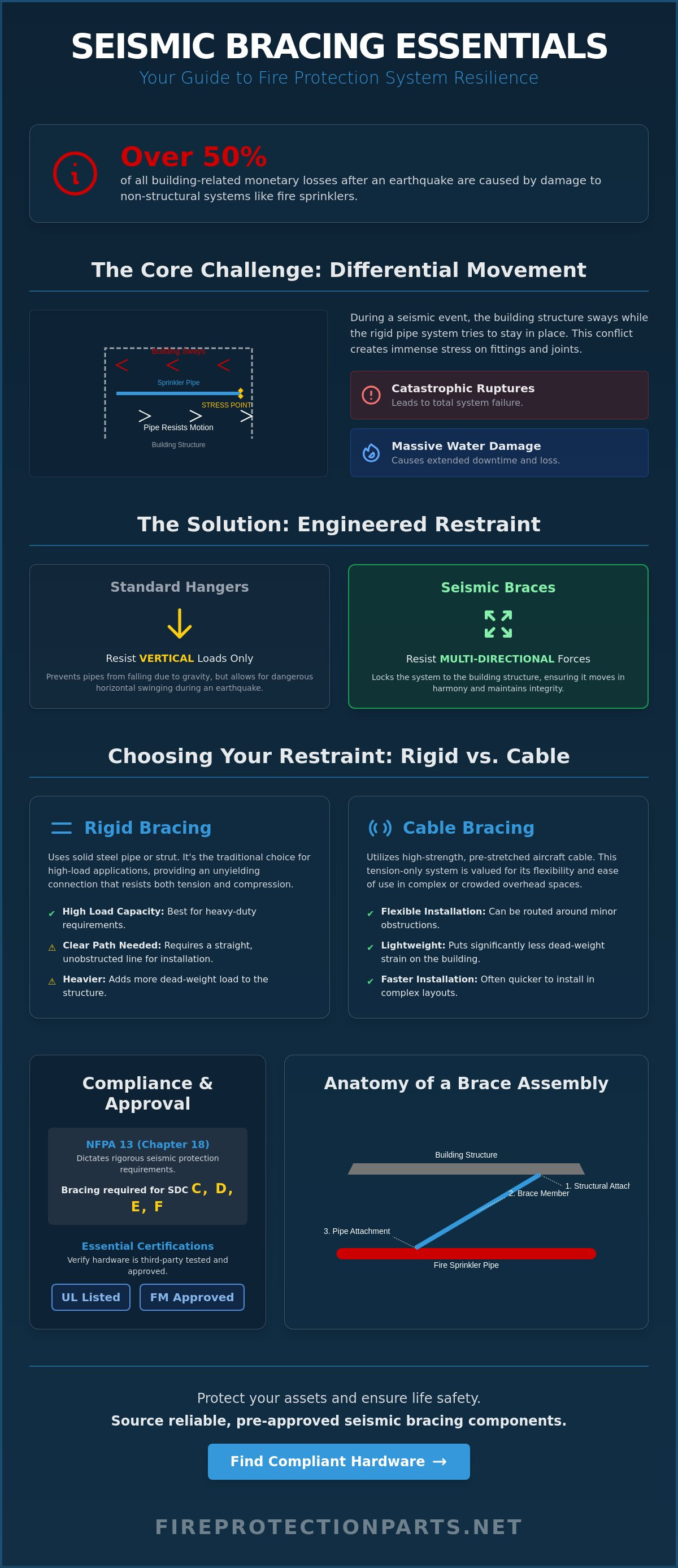
The core challenge in any seismic event is differential movement. Buildings are not rigid blocks; they are flexible structures. During a tremor, various sections of a building shift at different rates and in different directions. This creates a massive amount of stress on any rigid utility system. If the building sways and the pipe stays stationary, or moves at a different frequency, the resulting tension leads to catastrophic ruptures at joints and fittings. Proper bracing ensures the pipe moves in harmony with the building's primary structural members, absorbing energy rather than breaking under it.
The goals of this technology extend beyond mere code compliance. It's about life safety and long-term property protection. A ruptured pipe doesn't just fail to put out a fire; it causes massive water damage that can sideline a facility for months. By securing the system with seismic bracing for fire protection systems, you ensure immediate post-event functionality and eliminate the threat of uncontrolled flooding. It provides the peace of mind that your fire protection will be ready when it's needed most.
The Role of NFPA 13 in Seismic Design
NFPA 13, specifically Chapter 18, dictates the rigorous requirements for seismic protection. It classifies buildings into Seismic Design Categories (SDC) based on their geographic location and occupancy type. Systems in SDC C through F typically trigger the need for robust bracing. A key part of this process is the horizontal force calculation. This formula determines how much "push" the brace must withstand based on the design spectral response acceleration. It is the mathematical foundation that ensures your hardware choice is backed by engineering reality.
Why Standard Hangers Aren't Enough
Standard hangers are designed for vertical loads. They keep pipes from falling, but they don't stop them from swinging. In a high-risk zone, an unrestrained branch line acts like a pendulum, gaining momentum until it strikes other building components or snaps at a joint. Seismic bracing is a proactive safeguard against structural torsion. It locks the system into place, converting chaotic movement into controlled, predictable displacement that preserves the integrity of the entire fire protection network.
Rigid vs. Cable Bracing: Selecting the Optimal Restraint
Choosing the right methodology for swaying restraint is a critical decision that impacts both the safety of the facility and the efficiency of the installation. There isn't a one-size-fits-all solution. Instead, professionals must evaluate the specific structural environment and the calculated horizontal loads. The two primary choices for seismic bracing for fire protection systems are rigid bracing and cable bracing. Each system offers distinct mechanical advantages designed to manage the energy of an earthquake in different ways.
Rigid bracing uses solid steel pipe or strut as the primary brace member. It is the traditional choice for many high-load commercial applications because it provides a fixed, unyielding connection between the fire protection piping and the building structure. Conversely, cable bracing utilizes high-strength aircraft cable. This tension-based system is valued for its flexibility and ease of use in complex overhead environments. Understanding NFPA 13 seismic requirements is the first step in determining which of these two restraints is appropriate for your specific Seismic Design Category.
When selecting your restraint system, consider these three primary factors:
- Clearance: Rigid braces require a clear, straight path for the pipe member, while cables can sometimes be routed around minor obstructions.
- Structural Load: Cables are significantly lighter and put less dead-weight strain on the building's ceiling or roof deck.
- Installation Speed: Cable systems often require less cutting and threading on-site, which can accelerate the construction schedule.
When to Use Rigid Seismic Bracing
Rigid bracing is the standard for heavy-duty commercial projects. Its greatest strength is its ability to handle both tension and compression loads with a single brace. Because the steel pipe doesn't stretch, it offers immediate restraint with zero slack. However, it does require more overhead space and exact field measurements. If you're working with large-diameter mains where horizontal forces are extreme, rigid components like ASC seismic bracing provide the necessary structural rigidity to prevent system failure.
The Advantages of Cable Bracing Systems
Cable systems are the preferred choice for retrofit applications and tight plenum spaces. They are exceptionally lightweight and easy to transport to high work areas. It's important to remember that cables are tension-only restraints. To be effective, they must be installed in pairs to provide protection against movement in both directions. This "paired" installation ensures that no matter which way the building sways, one cable is always under tension, keeping the seismic bracing for fire protection systems secure and functional.
Navigating Compliance: UL Listed and FM Approved Standards
In the field of life-safety engineering, a component that looks right but lacks certification is a catastrophic risk. Generic hardware is a liability you cannot afford to carry. Seismic bracing for fire protection systems must withstand specific G-forces and torsional stresses that standard plumbing or HVAC supports are never designed to handle. Using unlisted components might offer a slight reduction in upfront costs, but it introduces a definitive point of failure that could compromise an entire fire sprinkler network during a seismic event. Verification is the only way to eliminate doubt.
UL Listing serves as a critical baseline for reliability. This mark signifies that the hardware has undergone rigorous testing under simulated earthquake conditions to verify it will not shear or deform when the building sways. For facilities housing high-value assets or critical infrastructure, adhering to FM Global standards is often the mandatory path. FM Approved components meet even stricter criteria for durability and performance. These standards ensure that the system remains functional to prevent property loss, providing a level of assurance that satisfies both engineers and insurance underwriters.
The Legal and Insurance Implications of Non-Compliance
Failure to use certified hardware carries significant legal and financial weight. If a seismic event occurs and a fire protection system fails because of non-listed parts, insurance providers may have grounds to deny property damage and business interruption claims. Furthermore, the local Authority Having Jurisdiction (AHJ) typically requires a "Seismic Certification" document during the final project closeout. This document acts as a professional guarantee that every clamp, rod, and attachment meets the specific seismic requirements of the local building code. Without this verification, you risk failing inspections and delaying the legal occupancy of the building.
Identifying Compliant Seismic Hardware
Verification begins with a physical inspection of the components. High-quality hardware will have the "UL" or "FM" stamp embossed directly into the metal of the brace clamp or structural attachment. However, a physical stamp is only the first step. You must also consult the manufacturer's submittal sheets to verify the specific load ratings for the exact angle and orientation of your installation. Sourcing pre-approved components like ASC Seismic Bracing ensures your submittals are accurate and your installation is fully compliant from day one. Compliance is non-negotiable for life-safety systems.
Key Components of a Seismic Bracing Assembly
A seismic assembly is only as strong as its weakest link. It represents a complete load path that transfers energy from the fire pipe directly into the building's structural bones. To ensure this path remains unbroken during an earthquake, every piece of hardware must be engineered to work in unison. Understanding the individual components of seismic bracing for fire protection systems is the only way to guarantee the system won't pull apart when the building begins to sway.
The assembly begins with the structural attachment. This is the bracket or clamp that connects the brace to the building's steel beams, concrete deck, or wood joists. Next is the brace member, which is the actual pipe or cable that spans the distance between the structure and the sprinkler line. Finally, the system attachment consists of a specialized clamp that grips the fire sprinkler pipe securely. In many rigid installations, rod stiffeners are also required. These small but vital components prevent long "all-thread" rods from buckling under seismic compression, ensuring your vertical supports don't fold like paper during a tremor.
Seismic Restraints for CPVC Systems
Protecting Viking CPVC fire sprinkler pipe requires a different strategy than traditional steel. Because CPVC is more flexible, it's susceptible to pipe-on-pipe abrasion if it's allowed to rub against other building components during an event. Installers must use cushioned clamps and maintain specific spacing to prevent the hard edges of the bracing from wearing through the plastic. You also have to account for how thermal expansion and seismic movement interact. A system that is too rigid can snap the pipe as it tries to expand; a system that is too loose will allow damaging impact. It's a balance of restraint and flexibility.
Branch Line Restraints vs. Main Sway Braces
Not all braces serve the same purpose. Lateral bracing is designed to prevent side-to-side movement of the mains, while longitudinal bracing stops the pipe from sliding forward or backward. For vertical risers, a "four-way" brace is essential. This assembly provides restraint from all directions, locking the riser in place as it passes between floors. Each type of brace is a specific tool used to solve a specific movement problem within the fire protection network.
Essential Hardware and Accessories
The success of your installation often comes down to the quality of your fire protection fittings and accessories. Shear bolts are a prime example. These bolts are designed so the head snaps off once the correct torque is reached, providing a visual cue that the connection is secure. This eliminates the guesswork and ensures that every seismic bracing for fire protection systems installation is consistent across the entire project. You can eliminate procurement errors by sourcing pre-approved seismic components that are guaranteed to fit your specific pipe dimensions and structural substrate.
Procurement and Maintenance: Sourcing Quality Bracing
Procuring the right hardware is the stage where engineering design meets real-world application. A seismic bracing submittal is more than just a list of parts; it's a technical roadmap for system survival. You must verify that the load ratings on the submittal precisely match the specific angles of your field installation. If a brace is rated for a specific horizontal load at 45 degrees, that capacity changes significantly at a 30 or 60-degree orientation. Don't leave these calculations to chance. Sourcing seismic bracing for fire protection systems from a general hardware supplier is a gamble that risks project delays and inspection failures.
Specialized retailers understand the nuances of NFPA 13 and ensure that every item in your order is pre-vetted for compliance. Once the hardware is on-site, the focus shifts to installation precision and long-term integrity. Even the best-engineered system can be compromised by poor maintenance or environmental factors. It's vital to establish a routine that moves beyond the initial "set and forget" mindset. Consistency in procurement and vigilance in upkeep are the two pillars of a resilient fire protection strategy.
Why Source from Fire Protection Parts?
We offer direct access to code-compliant ASC and Viking seismic solutions, ensuring you never have to question the origin or quality of your hardware. Our team provides expert support for contractors navigating high-risk project requirements where there's no room for error. We prioritize fast shipping to keep your project on schedule. We know that in the construction world, a delayed shipment often means a missed compliance deadline. We act as your mission-driven partner, delivering the components that provide unwavering reliability.
Maintaining Seismic Integrity Over Time
Installation isn't the final step in the process. These systems often live in harsh industrial environments where vibration, moisture, and building settling can take a toll. Visual inspections should occur at least annually. During these checks, look for the following signs of compromise:
- Loose Fasteners: Check for bolts or nuts that may have backed out due to building vibration.
- Corrosion: Inspect rigid members and clamps for surface rust that could weaken the metal over time.
- Cable Slack: Ensure tension-based systems haven't developed "sag," which would allow the pipe to gain momentum during a sway.
- Fraying: Look for broken strands in aircraft cables that indicate mechanical wear.
If the building has experienced even a minor seismic event or significant structural settling, a professional re-evaluation of the bracing is essential. Replacing a damaged brace is a minor cost compared to the catastrophic expense of a ruptured main. Stay ahead of the curve by choosing hardware built for longevity and performance. Browse our full inventory of seismic bracing for fire protection systems to secure your facility today.
Securing Your Facility for the Next Seismic Event
Building resilience requires more than meeting the bare minimum; it demands a commitment to verified performance. You now understand that selecting between rigid and cable restraints depends on your specific structural environment, while maintaining UL and FM certifications is the only way to satisfy both AHJs and insurance underwriters. By focusing on the complete load path and sourcing pre-approved hardware, you eliminate the risk of system rupture when the ground moves. Your fire protection system is the final line of defense during a disaster. By implementing the strategies outlined in this guide, you move from simple code adherence to true system assurance.
Ensuring the integrity of seismic bracing for fire protection systems is a critical investment in life safety and property protection. We offer NFPA 13 code compliant hardware and specialized support for high-risk seismic zones. Our solutions are trusted by professional contractors nationwide to deliver results without compromise. Don't leave your facility's safety to chance when expert-vetted components are within reach. Take the next step in your project planning by choosing hardware that stands up to the test.
Shop UL/FM Approved Seismic Bracing for Your Next Project
Frequently Asked Questions
Is seismic bracing required for all fire sprinkler systems?
No, it's not a universal requirement for every building. NFPA 13 and the International Building Code (IBC) base the requirement on the building's Seismic Design Category (SDC). Buildings in SDC A and B typically don't need bracing. However, for categories C through F, seismic bracing for fire protection systems is mandatory to ensure life safety and system functionality post-event. You should always verify the specific SDC of your project before beginning the design phase.
What is the difference between lateral and longitudinal seismic bracing?
Lateral bracing is designed to stop the pipe from swinging side-to-side, perpendicular to the pipe's run. Longitudinal bracing prevents the pipe from sliding along its own axis, or forward and backward. A robust fire protection layout uses a combination of both to lock the system in place. This prevents joints from snapping when the building structure moves in multiple directions during a tremor.
Can I use standard pipe hangers as seismic restraints?
You cannot substitute standard hangers for seismic restraints. Gravity hangers are only tested for vertical loads. Seismic hardware must resist horizontal forces and prevent the pipe from lifting. Using standard hangers as a primary restraint is a code violation and a significant safety risk that can lead to catastrophic system failure. Always use UL Listed or FM Approved components for seismic applications.
How do I know if my building is in a high-risk seismic zone?
You should consult the structural engineer of record or review the building's original design documents. High-risk zones are classified as Seismic Design Categories C, D, E, or F. These ratings are based on the USGS National Seismic Hazard Model. If you're unsure, check with your local Authority Having Jurisdiction (AHJ) to confirm the specific requirements for your site's geographic location.
Are cable bracing systems as strong as rigid pipe bracing?
Cable systems are engineered to handle the same horizontal loads as rigid pipe braces. The main difference is the installation method. Since cables only provide strength under tension, they must be installed in opposing pairs. When properly sized and tensioned, cable systems offer a lightweight, flexible alternative that meets all NFPA 13 performance standards while putting less strain on the building structure.
What are rod stiffeners and when are they necessary?
Rod stiffeners are reinforcing components clamped to the threaded rods that support fire pipes. They are necessary when the vertical rod length exceeds the manufacturer's maximum unbraced length. These stiffeners prevent the rod from buckling under the intense compression forces generated during an earthquake. Without them, the threaded rod can bend, causing the fire pipe to drop or strike other utilities.
Does NFPA 13 require seismic bracing for CPVC fire sprinkler pipes?
Yes, NFPA 13 mandates seismic protection for CPVC systems in applicable seismic zones. While the material is flexible, it still requires restraint to prevent it from striking other building components. It's essential to use listed seismic bracing for fire protection systems that are compatible with plastic piping. This avoids mechanical abrasion on the CPVC surface and ensures the system remains intact during building sway.

