



Seismic Bracing for Fire Sprinkler Systems: The Professional Buyer’s Guide
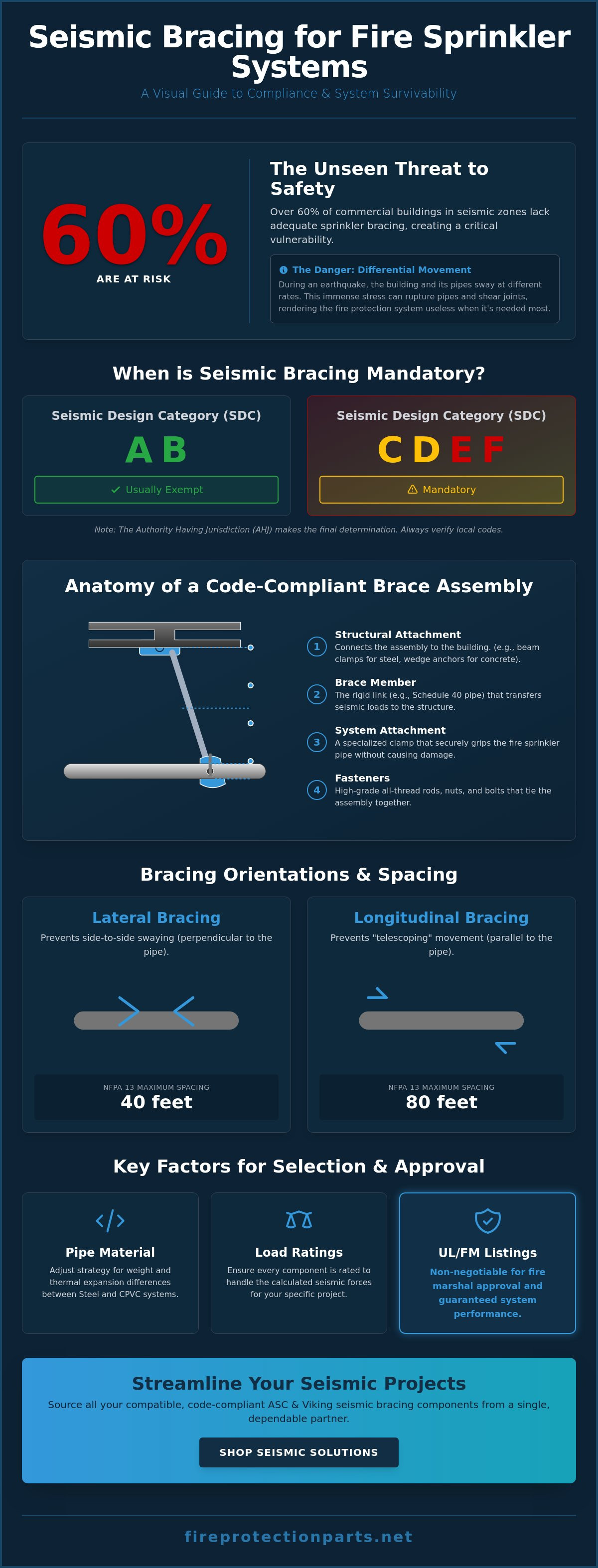
Recent data indicates that over 60% of commercial buildings in seismic zones lack adequate protection, leaving them vulnerable to catastrophic system failure during an earthquake. This gap in safety often stems from the complexity of selecting the right seismic bracing for fire sprinkler systems. It's not just a matter of purchasing parts. It's about engineering a system that maintains integrity under extreme stress.
We know the pressure you face when trying to decode Seismic Design Categories (SDC) while fearing a failed fire marshal inspection due to non-compliant hardware. It's difficult to match specific restraints to materials like CPVC without specialized expertise. This guide simplifies those complexities. It helps you master selection to ensure code compliance and total system survivability in high-risk zones. You'll learn how to align with the 2022 NFPA 13 standards, utilize updated design software like Seis Brace 2.0, and source all your components from a single, dependable partner.
Key Takeaways
- Understand how seismic bracing for fire sprinkler systems prevents pipe rupture and ensures water delivery during and after structural shifts.
- Identify the critical components of a code-compliant assembly, including sway brace attachments and structural brace members.
- Learn to adjust your bracing strategy based on pipe material to account for weight differences and thermal expansion in steel versus CPVC systems.
- Master the selection process by evaluating load ratings and non-negotiable UL Listings to guarantee fire marshal approval.
- Streamline your procurement by sourcing compatible ASC and Viking components in a single, reliable shipment.
The Role of Seismic Bracing in Fire Sprinkler System Integrity
Seismic bracing for fire sprinkler systems isn't just an optional accessory; it's a critical life-safety requirement. At its core, this bracing is a system of specialized hangers, clamps, and rods. These components work together to limit pipe movement during a seismic event. Without these restraints, the lateral and vertical forces of an earthquake would likely cause a fire sprinkler system to fail at its weakest points. When the ground stops shaking, you need the system to remain functional. If pipes rupture or joints shear, the facility is left defenseless against the fires that often follow seismic activity.
The primary goal is ensuring water delivery when it matters most. Regulatory drivers like NFPA 13 and ASCE 7 provide the framework for these installations. These standards address the "differential movement" problem. Differential movement occurs because the building structure and the water-filled piping system have different natural periods of vibration. During a quake, the building might sway one way while the pipes lag behind. This creates massive stress on every elbow, tee, and sprinkler head. High-quality bracing forces the pipe to move in tandem with the building. This synergy is what prevents joints from snapping and prevents catastrophic flooding from broken mains.
Safety isn't a suggestion in high-risk zones. It's a calculated engineering requirement. By installing a robust system, you protect the structural integrity of the piping and the safety of the occupants. Choosing the right hardware is the first step in eliminating doubt and ensuring system survivability.
When is Seismic Bracing Mandatory?
Compliance depends on your building's Seismic Design Category (SDC), which ranges from A to F. Systems in SDC A and B are usually exempt. However, bracing is mandatory for SDC C through F. While some exceptions exist for small pipes or specific mounting heights, the Authority Having Jurisdiction (AHJ) makes the final call. Never assume a system is exempt without verifying local building codes and SDC ratings first.
Lateral vs. Longitudinal Bracing
Lateral bracing stops side-to-side swaying. Longitudinal bracing prevents the "telescoping" effect along the pipe's axis. Both are required for a compliant system. NFPA 13 dictates specific spacing, often 40 feet for lateral and 80 feet for longitudinal braces. Utilizing ASC Seismic Bracing ensures your installation can withstand these specific directional forces without failing. Proper spacing and orientation are non-negotiable for passing your final inspection.
Essential Components of a Code-Compliant Seismic Brace Assembly
A seismic brace assembly is only as strong as its weakest link. Building a compliant system for seismic bracing for fire sprinkler systems requires four specific components to work in unison. These parts ensure that NFPA 13 requirements are met, keeping the system anchored during a tremor. If you miss one detail, you risk failing your inspection or, worse, system failure when it's needed most.
The sway brace attachment serves as the foundation. It's the structural connection to the building, typically utilizing beam clamps for steel or wedge anchors for concrete. Next is the brace member itself. This is usually a length of schedule 40 pipe or a specialized strut that provides the rigid connection between the building and the fire pipe. The third piece is the system attachment. This clamp grips the fire sprinkler pipe without compromising its structural integrity. Finally, you have the fasteners. High-grade all thread rod and heavy-duty nuts tie everything together, ensuring the assembly doesn't vibrate loose.
Selecting the Right Structural Attachments
Your choice of structural attachment depends entirely on the building's material. Beam clamps are the standard for steel structures, while wedge anchors provide the necessary grip in concrete slabs. It's vital to ensure the attachment size matches the brace member. Most contractors prefer "universal" swivel attachments. These allow for easier angle adjustments during installation, saving time and reducing labor costs. When you're sourcing seismic bracing for fire sprinkler systems, prioritize hardware that offers this flexibility and is rated for the specific load requirements of your site.
Pipe Clamps and Adapters
The system attachment is where the brace meets the sprinkler pipe. You can't just use a standard riser clamp here. Seismic pipe attachments are engineered to withstand horizontal forces without crushing the pipe wall. Visual verification is a key part of the process. Look for "break-away" bolt heads. These are designed to snap off once the proper torque is reached. This provides an immediate, visible signal to inspectors that the brace is installed correctly. It eliminates the guesswork and ensures the pipe won't be damaged by over-tightening. Using specialized adapters is also necessary when transitioning between different pipe diameters or materials.
Selecting the right mix of components shouldn't be a struggle. You can find a complete selection of ASC Seismic Bracing components to build a fully compliant assembly from one source, helping you maintain consistency across the entire project.
Selecting Bracing Based on Pipe Material: Steel vs. CPVC
The material you select for your fire protection network dictates the engineering requirements of your bracing system. Steel and CPVC behave differently under stress, and you must account for these physical differences to maintain system integrity. Using the wrong hardware or spacing for a specific material can lead to failure during a tremor, even if the components themselves are high quality. Choosing the right seismic bracing for fire sprinkler systems starts with understanding how your pipe material reacts to seismic forces.
Weight is the most immediate factor. Steel systems, particularly Schedule 40 mains, carry immense mass. When an earthquake hits, that mass creates high horizontal forces. Your bracing must be robust enough to handle these loads without buckling. Conversely, CPVC is much lighter, but it's more flexible. While it creates less seismic force, it requires more frequent support to prevent excessive swaying. You also need to consider thermal expansion. CPVC expands and contracts more than steel. Your bracing must allow for this standard movement while remaining rigid enough to stop seismic sway.
Chemical compatibility is the primary danger when working with CPVC. Many standard metal lubricants or non-compatible plastics used in generic bracing can cause environmental stress cracking. This leads to brittle failure over time. To prevent this, use lined clamps or hardware specifically listed for thermoplastic contact. These lined components also provide vibration dampening, which prevents metal braces from wearing through the pipe wall through constant abrasion.
Bracing Viking CPVC Systems
Viking Plastics CPVC is a high-performance material, but it requires specific handling. Hangers and braces must be listed for use with thermoplastic piping. Sharp edges on metal hardware can create stress points that lead to leaks. Specialized ASC seismic bracing often features beveled edges or protective coatings to safeguard the pipe surface. Always refer to the Viking CPVC fire sprinkler pipe installation manual for exact spacing requirements. Proper spacing prevents sagging and ensures the pipe remains within its design limits during a seismic event.
Steel Pipe Seismic Requirements
Steel pipes provide high strength but come with corrosion risks. In humid or coastal environments, you should opt for galvanized or stainless steel bracing components to prevent structural degradation. Managing the mass of Schedule 40 steel requires hardware with verified load ratings that exceed the calculated horizontal forces. For heavy-duty seismic zones, mechanical attachments are the standard choice. They provide a reliable, rigid connection that can withstand the high-frequency vibrations of a major earthquake without loosening.
Critical Factors to Evaluate When Buying Seismic Restraints
Buying seismic bracing for fire sprinkler systems requires a methodical approach. You can't afford to guess when structural integrity and code compliance are on the line. The first filter for any purchase must be UL Listing and FM Approval. These marks are the non-negotiable gold standard in fire protection. They signify that the hardware has undergone rigorous testing to ensure it won't fail during a seismic event. If a component lacks these certifications, it doesn't belong in your system.
Load ratings are the next critical hurdle. You must understand the horizontal force factor (Fp) assigned to your project. This value dictates the required hardware size and strength. A brace that's too small will buckle under pressure, while one that's too large adds unnecessary cost. Adjustability is another major factor for contractors. Swivel adapters save hours of labor on the job site by allowing for flexible installation angles. This flexibility is vital when field conditions don't perfectly match the original blueprints. Finally, match the finish to the environment. Electro-galvanized coatings work for dry interiors, but hot-dipped galvanized or stainless steel is necessary for corrosive areas like parking garages or coastal sites.
Reading the Submittal Sheets
Submittal sheets are your roadmap to a successful inspection. You must verify that the "Maximum Pipe Size" listed on the brace matches your specific system requirements. Pay close attention to the "Angle Factor." The geometry of force means a brace installed at a 30-degree angle has a different load capacity than one at 90 degrees. If the installation angle changes in the field, you must re-verify the load rating. Additionally, ensure the hardware meets the "Seismic Coefficient" required by the Engineer of Record (EOR). This coefficient accounts for the specific ground acceleration expected at your building's location.
Avoiding Common Procurement Mistakes
Procurement errors lead to failed inspections and project delays. One of the most common mistakes is mixing and matching different brands. For maximum safety and compatibility, buy a complete ASC Engineered Solutions assembly. This ensures every component is designed to work as a unified system. Another danger is ordering the wrong rod diameter. Undersized all-thread rod is a major code violation that compromises the entire assembly. Lastly, never forget the "Four-Way" brace at the top of the riser. It's a specific requirement for stabilizing vertical pipe sections that many buyers overlook until the fire marshal points it out.
Sourcing Viking and ASC Engineered Solutions for Maximum Protection
Consistency is the foundation of a reliable fire safety system. When you source seismic bracing for fire sprinkler systems, mixing components from unrelated manufacturers can create compliance gaps. Fire Protection Parts specializes in the ASC and Viking ecosystem because these brands are engineered to work together. We eliminate the guesswork. By centralizing your procurement, you ensure that every clamp, rod, and attachment fits the specific tolerances of your piping and heads. This unified approach is the only way to guarantee the system survivability promised in high-risk zones.
Bulk procurement offers more than just logistical ease. It provides a single point of accountability for your entire project. Imagine receiving your Viking Plastics CPVC pipe, sprinkler heads, and ASC seismic bracing in one coordinated shipment. This efficiency reduces job site delays and simplifies inventory management. Our collection includes over 8,500 items, ranging from standard hangers to the latest 2026 VGS line of grooved couplings. We provide the expert support needed to navigate this vast inventory, ensuring you find the exact match for your Seismic Design Category.
Peace of mind comes from knowing your hardware is vetted. Every component we sell is verified for code compliance and professional reliability. We don't just move boxes; we act as a mission-driven partner in your safety strategy. With North America holding 38% of the global market share for seismic attachments as of 2024, the demand for high-quality, verified hardware has never been higher. Don't leave your system's integrity to chance with generic alternatives.
Featured Seismic Solutions
Our inventory features ASC Seismic Sway Brace Attachments, which are precision-engineered for rapid installation and maximum load capacity. These attachments integrate seamlessly with our heavy-duty all-thread and clamps, forming the "bones" of your restraint system. For those using the industry's most trusted heads, our Viking-compatible riser bracing is optimized for stability. These solutions are designed to meet the 2022 NFPA 13 standards, providing a level of protection that generic hardware cannot match.
Ready to Secure Your System?
Securing a building against seismic forces is a serious responsibility. You need hardware that stands up to the challenge. Browse our full range of Fire Sprinklers Heads and Components to find the right fit for your next project. For large-scale commercial seismic retrofits, we offer custom quotes tailored to your specific engineering requirements. Protect your investment, your project timeline, and your community with professional-grade bracing. Reach out today to finalize your assembly and ensure your system is ready for whatever the ground throws at it.
Secure Your System with Professional Certainty
Building a resilient fire protection system is a commitment to long-term safety. You've learned that effective seismic bracing for fire sprinkler systems requires more than just high-quality parts. It demands a precise match between your piping material and engineered restraints. Whether you're managing the mass of Schedule 40 steel or the specific chemical requirements of Viking CPVC, compliance is non-negotiable. Precision matters. One wrong component can compromise the entire network during a tremor.
Success in the field depends on verified load ratings and the elimination of procurement errors. Choosing a unified assembly from trusted names like Viking and ASC Engineered Solutions removes the doubt that leads to failed inspections. We provide expert technical support to help you navigate our inventory of over 8,500 fire protection parts. As an authorized distributor, we ensure every component meets the rigorous standards required for your specific Seismic Design Category. Don't leave your project to chance.
Take the guesswork out of your next installation. Shop Code-Compliant Fire Sprinklers and Seismic Components to secure your facility with confidence. Your community and your investment deserve the protection of professional-grade hardware that stays grounded when it counts.
Frequently Asked Questions
Is seismic bracing required for all fire sprinkler systems?
Seismic bracing is mandatory only for systems located in Seismic Design Categories (SDC) C through F. Systems in low-risk zones, specifically SDC A and B, are generally exempt from these requirements under current building codes. You must always verify your project's SDC with the Authority Having Jurisdiction (AHJ). Never assume a system is exempt without a formal determination of the building's specific risk category.
What is the difference between a sway brace and a standard pipe hanger?
Standard pipe hangers are designed solely to support the vertical weight of the piping system. In contrast, seismic bracing for fire sprinkler systems is engineered to resist horizontal and vertical forces during an earthquake. While hangers allow for some movement to accommodate thermal expansion, braces are rigid assemblies that lock the pipe to the building structure to prevent joint shearing.
Can I use standard pipe for the seismic brace member?
Yes, Schedule 40 steel pipe is the industry standard for use as a brace member in seismic assemblies. This pipe acts as the rigid link between the structural attachment and the pipe clamp. It's vital that the diameter of the brace pipe matches the size specified in your engineering calculations. Using a lighter gauge or undersized pipe will compromise the assembly's ability to withstand calculated seismic loads.
How far apart should seismic braces be installed on a fire main?
Maximum spacing for lateral braces is typically 40 feet on center, while longitudinal braces are required every 80 feet. These distances are the standard requirements found in NFPA 13, but they can be reduced based on the calculated horizontal force factor (Fp). Your Engineer of Record will provide a specific spacing plan that accounts for pipe diameter, weight, and local seismic acceleration.
Do I need special seismic bracing for CPVC fire sprinkler pipes?
CPVC systems require bracing that is specifically listed for use with thermoplastic materials to prevent chemical incompatibility or physical abrasion. You must use hardware with beveled edges or protective linings to safeguard the pipe wall. Specialized ASC seismic bracing is often preferred for these installations because it is engineered to avoid the stress cracking risks associated with generic metal hardware.
What does UL Listed and FM Approved mean for seismic hardware?
These marks indicate that the hardware has been independently tested and verified to meet strict performance and safety standards. UL Listing and FM Approval ensure that a component will not fail when subjected to its maximum rated seismic load. For professional buyers, these certifications are non-negotiable requirements for ensuring code compliance and the long-term survivability of the fire protection system.
Can seismic bracing be retrofitted to an existing sprinkler system?
Yes, retrofitting seismic bracing for fire sprinkler systems is a common practice for bringing older buildings up to modern safety standards. Recent data suggests that over 60% of commercial buildings in seismic zones lack adequate protection and require these upgrades. Retrofitting involves adding new sway braces and structural anchors to the existing network to ensure it remains functional after a tremor.
What is a four-way brace and where is it required?
A four-way brace is an assembly that provides stability in all horizontal directions simultaneously. NFPA 13 requires these braces at the top of every riser and at specific intervals on vertical piping sections. They act as a primary anchor point, preventing the vertical pipe from swaying or snapping at the transition to horizontal mains during a seismic event.
