



Fire Sprinkler Backflow Preventer Parts: A 2026 Maintenance & Sourcing Guide
Installing an irrigation-grade seal in a high-hazard fire suppression system isn't just a mistake. It's a liability that could compromise your entire facility's safety. With the 2026 updates to ASSE 1013 and NFPA standards now in full effect, the margin for error in sourcing fire sprinkler backflow preventer parts has disappeared. You've likely felt the pressure of an upcoming inspection or the frustration of trying to identify a specific check valve for a legacy model that hasn't been manufactured in a decade.
We understand that system downtime isn't an option when lives and property are on the line. You need parts that meet the rigorous demands of fire-rated service, not just general plumbing standards. This guide will help you master the technical components of your backflow assembly to ensure 100% code compliance and unwavering system reliability. We'll show you how to identify the exact repair kits for your specific brand and model, ensuring your five-year internal inspections and annual tests meet every local water authority and fire code requirement without unnecessary delays.
Key Takeaways
- Understand why fire-rated assemblies require specialized components to handle high-pressure demands and maintain strict NFPA compliance.
- Identify the essential fire sprinkler backflow preventer parts within your assembly, including the critical rubber goods kits needed for routine maintenance.
- Learn to distinguish between RPZ and DCVA component requirements to ensure the correct level of protection for high-hazard suppression systems.
- Master professional diagnostic techniques to identify internal component wear and resolve common issues like relief valve "spitting" before inspections.
- Ensure long-term system integrity by sourcing code-compliant parts compatible with modern materials like Viking CPVC fire sprinkler pipe.
The Role of Backflow Preventer Parts in Fire Suppression Integrity
A fire suppression system is only as reliable as its weakest link. The Backflow prevention device serves as the final, uncompromising barrier between a building's fire water and the public's drinking supply. Within these heavy iron or stainless steel assemblies, specific fire sprinkler backflow preventer parts do the critical work of managing hydraulic pressure. These aren't just secondary accessories. They're the precision components that ensure water moves in one direction only, even during a massive system surge. In 2026, the industry standard has shifted toward professional assurance. We no longer wait for a failed test to order a repair kit. Proactive component replacement is now the baseline for responsible facility management.
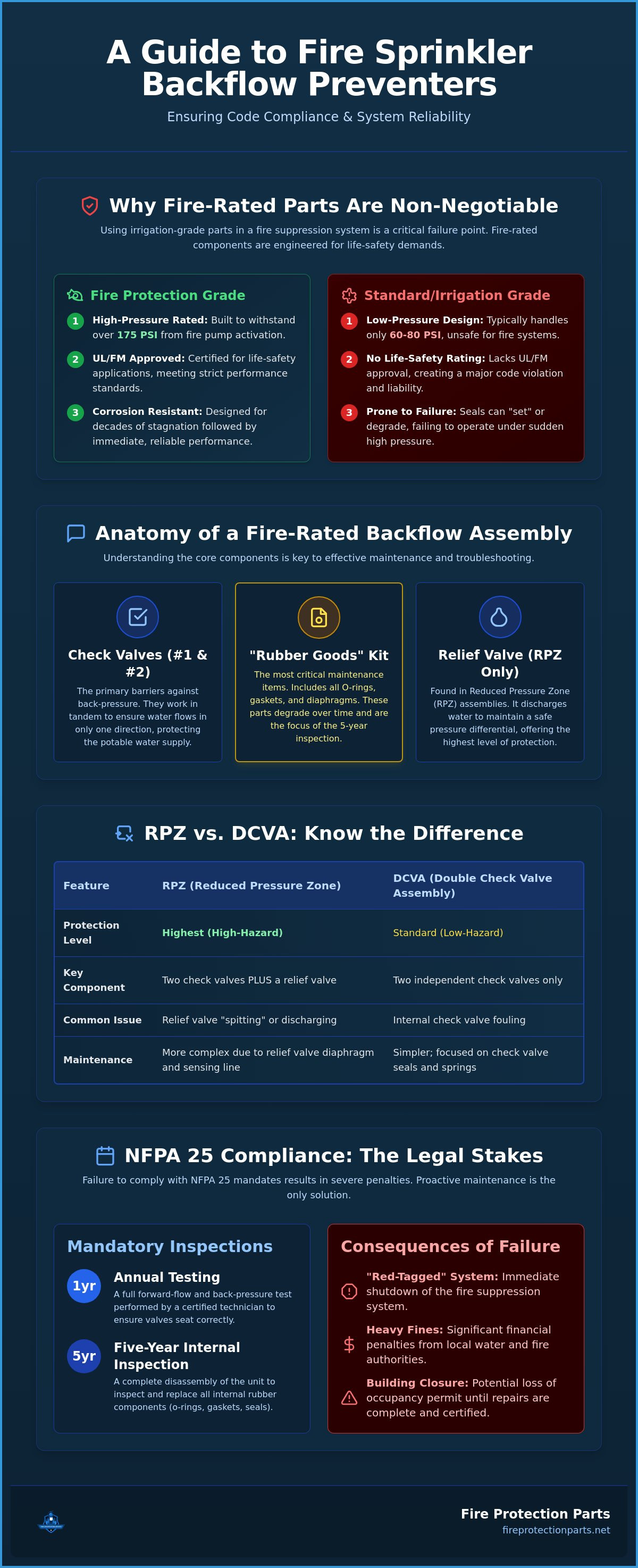
Fire systems require specialized parts because they face unique mechanical stresses. Unlike standard plumbing, a fire system might sit dormant for years before being subjected to the extreme pressure of a fire pump activation. This long period of stagnation can lead to mineral buildup or "setting" in rubber seals. If the internal components aren't specifically rated for fire service, they'll likely fail when they're needed most. Choosing the right fire sprinkler backflow preventer parts means selecting items that have been tested to withstand these specific conditions without compromise.
Why Fire Protection Backflow Parts Differ from Irrigation
You can't swap a residential lawn backflow part into a commercial fire system. Fire protection components must handle significantly higher pressure ratings to accommodate pump-boosted water flow. While an irrigation valve might only see 60 to 80 PSI, a fire system can easily exceed 175 PSI during testing. Materials must also resist corrosion over decades of inactivity. Every internal replacement component in a fire system requires UL/FM approval. These certifications guarantee the part will perform under the life-safety standards mandated by current building codes.
The Legal Stakes: NFPA 25 and Local Water Authority Compliance
Compliance isn't optional. NFPA 25 mandates annual testing for all backflow assemblies, along with a rigorous five-year internal inspection. If a check valve fails to seat properly during a "forward flow" test, your system can be "red-tagged" immediately. This results in heavy fines and potential building closure until the system is repaired. Most failures stem from worn internal rubber parts that have lost their elasticity. Maintaining a stocked inventory of sprinkler system components online ensures you can swap out failing seals before the inspector arrives, keeping your facility compliant and your water supply safe.
Anatomy of a Fire-Rated Backflow Assembly: Key Components Explained
Understanding the physical build of your backflow assembly is the first step in maintaining a code-compliant system. Most professional-grade assemblies are constructed from high-strength stainless steel or epoxy-coated ductile iron. These materials are chosen for their longevity and resistance to the corrosive nature of stagnant water. Inside this housing, the most critical fire sprinkler backflow preventer parts are found within the "Rubber Goods" kit. This kit typically includes the O-rings, gaskets, and diaphragms that create a watertight seal. Because these components naturally degrade over time, they are the primary focus during your mandatory five-year internal inspection.
The interaction between these parts determines the safety of your water supply. In systems utilizing high-pressure fire pumps, the internal components must withstand rapid hydraulic spikes without failing. If you are using specialized materials like Viking Plastics CPVC pipe for your fire protection lines, your backflow parts must be compatible with the specific flow characteristics of that system. Ensuring you have the correct professional-grade backflow preventers and repair kits prevents the costly downtime associated with "red-tagged" systems.
Internal Hardware: Check Valves and Relief Valves
The internal mechanism relies on a series of check valves to create a redundant safety barrier. The first and second check valves work in tandem to prevent back-pressure from pushing contaminated fire-water into the potable main. In a Reduced Pressure Zone (RPZ) assembly, relief valve springs and diaphragms work together to discharge water if a pressure imbalance occurs. The clapper assembly is the spring-loaded hinge that physically blocks reverse flow. For a deeper look at diagnosing these internals, see Troubleshooting and Maintenance: Identifying Failing Backflow Components to understand how these parts perform during a forward flow test.
External Accessories: Test Cocks and Shut-off Valves
External components allow for manual control and diagnostic access during annual certification. Test cocks are small ball valves that serve as the entry points for diagnostic equipment. Unlike standard plumbing valves, fire systems utilize OS&Y (Outside Screw and Yoke) valves. These provide immediate visual confirmation of the valve status, which is vital for emergency responders. For systems installed in high-risk zones, these assemblies must be compatible with ASC seismic bracing to ensure the housing remains secure during a tectonic event. High-hazard environments also rely on sensing lines to monitor pressure differentials between the check valves and the relief valve.
RPZ vs. DCVA: Comparing Parts and Repair Requirements
The choice between a Reduced Pressure Zone (RPZ) assembly and a Double Check Valve Assembly (DCVA) dictates your long-term maintenance strategy. While both units serve to protect the potable water supply, their internal architectures require different fire sprinkler backflow preventer parts for successful repair. Identifying which unit is installed in your riser room is straightforward. An RPZ features a prominent relief valve located between the two check valves, often with a visible discharge port. A DCVA is typically a more compact, straight-line assembly without a relief valve or discharge opening. Knowing these physical differences is the first step in sourcing the correct repair kits for your next inspection.
High-hazard systems require the robust protection of an RPZ. These are mandatory whenever the fire system contains non-potable additives. If your facility uses foam suppressants or anti-freeze for fire sprinkler systems, the local water authority will mandate an RPZ. Because these chemicals pose a significant health risk if they enter the drinking water, the RPZ provides a mechanical "fail-safe" through its discharge port. This complexity means the maintenance schedule is often more demanding. The internal components are subjected to more movement and pressure monitoring, leading to a higher frequency of part replacement compared to simpler assemblies.
The RPZ Advantage: Differential Pressure Relief Components
The defining feature of an RPZ is the differential pressure relief valve. This component acts as a third layer of defense. If either check valve fails, the relief valve senses the pressure change and opens to discharge the potentially contaminated water to the atmosphere. Common fire sprinkler backflow preventer parts for these units include complex diaphragm assemblies and specialized relief valve springs. Because the diaphragm is constantly under tension to monitor pressure changes, it's prone to fatigue. Replacing these internal rubber goods proactively ensures the relief valve doesn't start "spitting" or dumping water unexpectedly, which is a common sign of component failure that can lead to a failed annual certification.
The DCVA Standard: Simplified Reliability
A Double Check Assembly is the standard for low-hazard fire suppression, such as residential wet-pipe systems that use only pure water. The parts list for a DCVA is significantly shorter. You'll primarily focus on the check valve seats, springs, and O-rings. Without a relief valve to monitor, the internal mechanics are simpler and generally more durable over long periods of stagnation. Many facility managers prefer DCVAs for their reliability and lower repair costs. However, they offer no visual indication of a check valve failure. This makes the annual forward-flow test your only way to verify the internal parts are still functioning as intended before a fire occurs.
Troubleshooting and Maintenance: Identifying Failing Backflow Components
Identifying failures in fire sprinkler backflow preventer parts isn't just about passing an inspection. It's about ensuring the system reacts instantly during a life-safety event. A professional diagnostic framework begins with visual observation and ends with precision testing through the assembly's test cocks. By isolating specific zones within the housing, you can determine if a leak is caused by the first check valve, the second check valve, or the relief valve assembly itself. Early detection prevents the emergency repairs that often follow a failed annual certification.
The most frequent symptom of failure is a "spitting" or constantly dripping relief valve in an RPZ assembly. This doesn't always mean the relief valve is broken. Often, it's a signal that the first check valve has failed to seat properly. When debris or mineral scale prevents a tight seal, the pressure differential drops. This forces the relief valve to open as a safety measure to prevent backflow. Ignoring this drip leads to wasted water and eventual system "red-tagging" by the authority having jurisdiction. Secure your system's reliability by sourcing high-quality backflow preventers and repair kits today.
Common Failure Modes in Fire System Backflow
Fire systems face unique environmental challenges that lead to specific failure modes:
- Debris Entrapment: City water mains often carry sediment, pebbles, or rust. These particles can become trapped between the check valve seat and the rubber disc, creating a permanent gap that allows reverse flow.
- Spring Fatigue: Internal springs must maintain a specific tension, usually holding at least 1 or 2 PSI. Over years of stagnation, these springs can lose their "memory" and fail to provide the necessary closing force during a pressure surge.
- Rubber Degradation: Modern water treatments use chloramines, which are aggressive toward older rubber compounds. This causes seals to become brittle, cracked, or gummy, which compromises the airtight seal required for compliance.
When to Repair vs. When to Replace the Full Assembly
Deciding between a repair and a full replacement requires evaluating the labor costs against the price of a complete unit. If the internal valve body is pitted or the housing is cracked, a repair kit won't solve the underlying problem. In these cases, a complete unit swap is the only way to guarantee safety. Once an assembly reaches 10 years of service, facility managers should perform a comprehensive cost-benefit analysis comparing a full internal overhaul with a complete unit replacement. If the cost of specialized fire sprinkler backflow preventer parts and the labor to install them exceeds 60% of a new assembly's price, replacement is often the more reliable choice for long-term protection.
Sourcing Reliable Fire Sprinkler Backflow Parts for Compliance
Procurement of life-safety hardware requires a partner who understands the high stakes of fire protection. General hardware stores or big-box retailers often lack the specialized inventory needed for high-pressure systems. When you source fire sprinkler backflow preventer parts from a dedicated provider, you're buying more than just a rubber seal. You're securing professional assurance that every component meets current NFPA and local water authority standards. Compliance isn't a suggestion. It's the foundation of your facility's safety. Selecting the wrong part can lead to catastrophic system failure or immediate red-tagging during an inspection.
Modern fire suppression systems often utilize advanced materials that require specific flow characteristics. If your facility is equipped with Viking CPVC fire sprinkler pipe, your backflow components must integrate seamlessly with these piping standards. Mismatched or non-rated parts can cause hydraulic imbalances that trigger false alarms or compromise the system's ability to deliver water during a fire. We ensure that our inventory aligns with professional-grade piping and pump systems to eliminate the doubt from your procurement process. This attention to detail ensures your maintenance remains code-compliant and your system remains operational.
The Fire Protection Parts Advantage
We serve as a mission-driven partner for contractors and facility managers who value quality above all else. Identifying legacy fire sprinkler backflow preventer parts for older valves can be a complex task that stalls a repair project. Our team provides expert support to help you find the exact repair kit for models that are no longer in active production. We focus on minimizing your system downtime by offering direct shipping to your job site. This efficient communication flow moves you quickly from identifying a leak to installing a permanent, code-compliant solution without unnecessary administrative delays.
Next Steps for Your System Maintenance
Don't wait for your annual inspector to find a problem. Conduct a proactive audit of your riser room today. Check for visible signs of corrosion on the housing or water pooling near the relief valve discharge. Before you place an order, ensure you have the following information ready to guarantee a perfect fit:
- Brand: The manufacturer of the assembly (e.g., Watts, Ames, Febco).
- Model: The specific series number found on the nameplate.
- Size: The nominal pipe diameter of the assembly.
- Serial Number: Crucial for identifying the correct internal revision for older units.
Keeping a "rubber goods" kit on hand is a professional best practice that prevents emergency shipping costs and building closures. Take control of your compliance schedule now. Browse our full inventory of backflow preventer parts and secure the components you need for unwavering system reliability.
Maintain System Integrity and Life-Safety Compliance
Success in fire protection maintenance depends on the precision of your hardware. You've learned how specialized components differ from standard plumbing and why the 2026 standards demand proactive care. Whether you're managing a high-hazard RPZ assembly or a standard DCVA, identifying the correct fire sprinkler backflow preventer parts is the only way to ensure your system remains operational when it matters most. Using the right diagnostic framework allows you to catch minor leaks before they escalate into major compliance failures; for broader facility needs, you can also learn more about Anton Plumbing Heating & Cooling and their professional mechanical services.
Don't let a worn seal or a fatigued spring compromise your facility's safety. We provide the professional-grade solutions you need to pass every inspection with confidence. With UL/FM approved components, expert technical support, and fast shipping for emergency repairs, we're your partner in uncompromising protection. Secure Your System with Code-Compliant Backflow Parts today and move forward with the peace of mind that comes from professional expertise. Your commitment to quality ensures your system is always ready to protect lives and property.
Frequently Asked Questions
How often should fire sprinkler backflow preventer parts be replaced?
Internal fire sprinkler backflow preventer parts generally require replacement every five years during the mandatory internal inspection mandated by NFPA 25. While external components may last longer, the internal rubber seals and O-rings degrade over time due to water treatment chemicals and stagnation. Replacing these components proactively every five years ensures your system passes annual forward flow tests without unexpected failures or costly emergency repairs.
Can I use irrigation backflow repair kits in my fire sprinkler system?
You cannot use irrigation grade repair kits in a fire suppression system. Fire rated assemblies are subject to significantly higher pressure demands and must use UL/FM approved components to maintain system certification. Using non rated parts voids the equipment safety listing and can lead to mechanical failure during a high pressure fire pump activation. Always source parts specifically designed for fire protection service to ensure compliance.
What is the difference between an RPZ and a Double Check repair kit?
An RPZ repair kit contains additional components for the differential pressure relief valve, such as specialized diaphragms and heavy duty springs. A Double Check Valve Assembly (DCVA) kit is simpler, focusing primarily on the two internal check valve seats and O-rings. Because RPZ units manage high hazard risks like anti freeze, their repair kits are more complex and require precise calibration of the relief mechanism to function correctly.
Why is my fire system backflow preventer leaking from the relief valve?
Leaking or spitting from the relief valve usually indicates that the first check valve is not seating correctly. When debris from the water main becomes trapped in the check valve, it causes a pressure drop that triggers the relief valve to discharge water. It can also signal a ruptured relief valve diaphragm. Both issues require immediate attention and the installation of new fire sprinkler backflow preventer parts to restore system integrity.
Do I need a professional to replace internal backflow parts?
Most local water authorities and fire codes require a certified backflow technician to perform internal repairs and part replacements. While a facility manager can source the hardware, the actual installation must be followed by a formal re test to verify the assembly performance. This ensures the repair meets the safety standards required to protect the public water supply from contamination and maintains your building insurance requirements. For those operating in Central Florida, a certified service such as Alberto Pro Plumbing can provide the professional expertise needed to ensure your backflow assembly is handled correctly and remains fully compliant.
Are backflow preventer parts brand-specific or universal?
Backflow preventer parts are strictly brand specific and model specific. There are no universal kits that work across different manufacturers like Watts, Ames, or Febco. Even within a single brand, internal components often change between different series or generations of the same valve size. You must verify the exact model and serial number before ordering to ensure the replacement parts fit the internal housing perfectly without leaks.
How do I identify the model of my backflow preventer to find the right parts?
Locate the metal nameplate riveted to the side of the assembly main body to identify your specific model. This plate contains the manufacturer name, the model number, the size, and the unique serial number. If the plate is missing or unreadable, you may need to provide photos of the external housing and OS&Y valves to a technical expert to determine the correct replacement components for your specific installation.
What happens if my fire backflow preventer fails its annual test?
If your assembly fails its annual test, the inspector will likely red tag the system and notify the local water authority. This status indicates the system is non compliant and requires immediate repair to avoid fines or potential water service disconnection. You must replace the failing fire sprinkler backflow preventer parts and pass a certified re test to clear the violation and ensure your building remains protected against fire hazards.

