



NFPA 13D: The Definitive Guide to Residential Fire Sprinkler Standards
Did you know that a residential fire sprinkler system reduces the risk of a fatality by 81%? While the data is clear, the path to compliance often feels anything but certain. Many contractors and homeowners feel a sense of anxiety when faced with the technical density of safety codes. It's common to worry about the cost of installation or feel confused about the differences between commercial standards and nfpa 13d. You need protection that works without overcomplicating the build.
This guide provides the professional clarity you need to master the 2025 edition of the standard for one- and two-family dwellings. We'll show you how to ensure life safety through the essential 40 GPM and 10-minute water supply requirements. You'll identify which rooms require coverage and which don't, allowing you to streamline your project. We also help you understand how to select code-compliant hardware like CPVC piping and residential pumps to eliminate any doubt about system reliability. From water flow calculations to final component selection, this is your roadmap to a safer, compliant home.
Key Takeaways
- Distinguish NFPA 13D from commercial standards to avoid over-engineering residential projects and reducing unnecessary installation costs.
- Implement the specific 40 GPM flow and 10-minute water supply rules to ensure your nfpa 13d system provides adequate escape time.
- Identify the essential hardware needed for low-pressure environments, including residential fire pumps and fast-response sprinkler heads.
- Understand the simplified maintenance and owner-led inspection routines required to keep your residential system operational.
- Learn how design density differences between residential and commercial codes directly impact your pipe sizing and material selection.
What is NFPA 13D? Understanding the Life Safety Standard
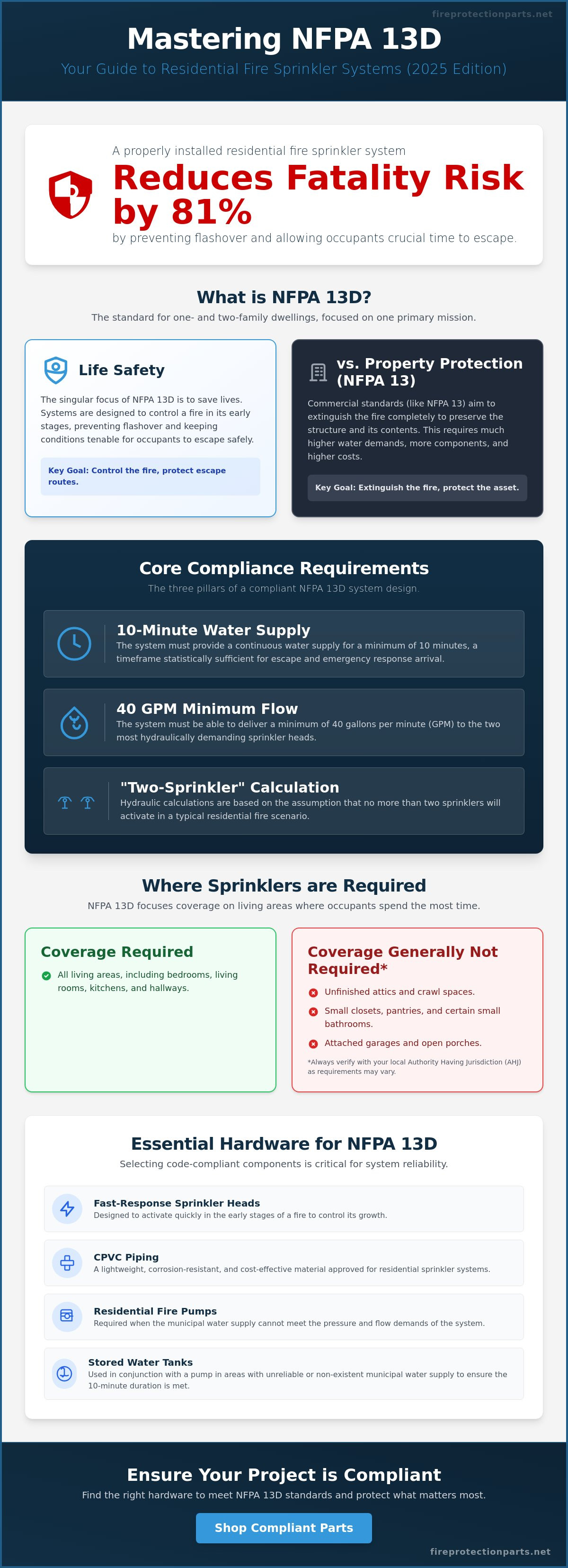
NFPA 13D is the industry standard specifically designed for the installation of sprinkler systems in one- and two-family dwellings and manufactured homes. While commercial codes focus on preserving the structure and its contents, this standard has a singular, focused mission: life safety. It aims to provide occupants with enough time to escape a fire by preventing flashover in the room where the fire starts. Modern fire sprinkler systems have evolved significantly since their inception, leading to the specialized requirements found in the current 2025 edition of the standard. This most recent update explicitly includes rental properties within its scope, reflecting the growing need for protection in all residential settings.
The adoption of these codes is increasing across the United States. Municipalities are updating their building requirements to prioritize resident safety, as seen in cities like Waukegan, Illinois, which recently adopted the 2021 International Residential Code. Statistics from the NFPA confirm that sprinklers reduce the risk of dying in a home fire by 81%. By focusing on the first few minutes of a fire's growth, these systems keep conditions tenable for escape, which is the most critical factor in residential survival rates.
Life Safety vs. Property Protection: Why It Matters
A common misconception is that all fire sprinklers are designed to extinguish a fire completely. In a commercial setting under NFPA 13, that is often the goal. However, an nfpa 13d system is designed to control the fire, not necessarily put it out. By controlling the heat and smoke, the system prevents the fire from spreading beyond the room of origin. This specific focus allows for a more streamlined design with lower water demands and fewer components. This reduction in complexity directly translates to lower installation costs for homeowners and builders. NFPA 13D prioritizes the survival of occupants over the total preservation of the building and its contents.
Where NFPA 13D Applies: Scope and Limitations
The standard applies to single-family homes, duplexes, and manufactured homes. It focuses on "living areas" where residents spend the majority of their time. Because the goal is life safety, the code allows for the exclusion of certain spaces where fires are less likely to trap occupants during the early stages of a blaze. You generally don't need sprinklers in the following areas:
- Unfinished attics and crawl spaces.
- Small closets and pantries.
- Attached garages and open porches.
- Certain small bathrooms.
While the 2025 edition provides a clear baseline, it's important to remember that local jurisdictions may modify these requirements. Always verify the specific amendments with your local Authority Having Jurisdiction (AHJ) to ensure your system meets both national standards and local law.
Core Requirements for NFPA 13D Compliance
Compliance with the nfpa 13d standard is built on a single, non-negotiable factor: time. Unlike commercial systems that might require massive water reserves, a residential system is engineered to provide a 10-minute water supply. This window is statistically sufficient to allow occupants to escape and for emergency services to arrive. Safety is not accidental; it is a result of precise hydraulic calculations and the use of verified hardware. To meet the NFPA 13D Standard, every component from the riser to the sprinkler head must work in perfect unison.
Achieving this level of reliability requires addressing both flow and pressure. If your local municipal supply cannot meet the necessary hydraulic demands, you must bridge the gap with specialized equipment. This often involves integrating residential fire pump systems to boost pressure or installing stored water tanks to ensure the 10-minute duration is met. Every part of the system must be verified to ensure there is no compromise in performance during a crisis.
Water Supply: The 10-Minute and 40 GPM Thresholds
The core of the hydraulic design is the "two-sprinkler" criteria. Calculations assume that in a typical residential fire, no more than two sprinkler heads will activate simultaneously. To satisfy this, the system must deliver a minimum flow of 40 gallons per minute (GPM). Verification starts at the street. You must perform a flow test on the municipal lead-in to determine if the city's pressure can support the 40 GPM threshold. In rural areas or high-elevation builds where municipal pressure is weak, a dedicated pump and tank setup becomes a mandatory functional remedy to maintain compliance.
Piping Standards: Why CPVC and PEX Dominate
Modern residential installations have shifted away from heavy copper and steel. Today, CPVC and PEX are the industry standards due to their corrosion resistance and ease of handling. For professional-grade results, many contractors favor Viking CPVC fire sprinkler pipe. It is lightweight and significantly faster to install than metallic alternatives. However, material choice demands strict adherence to assembly protocols. CPVC requires specific solvent cements and "one-step" glues designed to create a chemical bond. Using the wrong adhesive can lead to system failure or leaks, undermining the integrity of the life safety shield.
Selecting the right materials is the first step toward a system that offers long-term performance and peace of mind. If you are preparing for a new installation, you can browse our selection of code-compliant components to find the exact hardware required for your project.
NFPA 13D vs. NFPA 13 vs. NFPA 13R: Key Differences
Many developers and homeowners find themselves choosing between different levels of protection. Selecting the wrong standard can lead to excessive costs or inadequate safety coverage. NFPA 13 is the gold standard for commercial and industrial properties, prioritizing both life safety and property preservation. NFPA 13R serves low-rise residential buildings up to four stories, balancing cost with higher occupancy risks. In contrast, nfpa 13d is purpose-built for one- and two-family dwellings. It is the most streamlined and cost-effective path to compliance because it targets the specific fire dynamics of a single-family home.
The primary technical difference lies in design density. Commercial systems under NFPA 13 require significantly higher water flow to protect vast areas and high-value assets. This necessitates larger pipe diameters and massive water storage. The NFPA 13D Standard uses a lower design density. This efficiency allows for the use of smaller, more manageable piping like CPVC, which reduces both material costs and labor time.
Exclusion Zones: Where Sprinklers Aren't Required
One of the most significant advantages of the residential standard is the ability to skip certain areas. The code recognizes that fire risks in specific rooms are low enough that they don't threaten the primary escape route. You can typically exclude sprinklers from:
- Bathrooms under 55 square feet.
- Small closets and pantries.
- Unfinished attics and crawl spaces.
- Attached garages and open porches.
The logic is simple. These spaces are rarely occupied for long periods. Omitting them keeps the system focused on living areas while keeping the total head count low. You must always verify local amendments, though. Some jurisdictions require garage coverage regardless of the national code's stance.
Cost and Complexity Comparison
Building a residential system is far less complex than engineering a commercial one. Because the water demand is lower, you don't need the industrial-sized pumps or high-capacity backflow preventors common in commercial builds. Instead, you can rely on residential fire pump systems that fit within a standard mechanical room. This simplicity is intentional. The NFPA designed this standard to be affordable, encouraging wider adoption in new construction. Developers can accurately budget by focusing on the height and occupancy of the building. If it's a single-family home or duplex, 13D is your definitive, low-cost solution.
Essential Hardware for a Compliant Residential System
Compliance with nfpa 13d requires more than a design on paper. It demands hardware that meets rigorous testing standards for residential environments. Every component, from the backflow preventer to the seismic bracing, must function as a cohesive life-safety shield. Using inferior or non-compliant parts isn't just a code violation; it's a compromise on family safety. Reliability is the only metric that matters when a system is called into action.
For homes in high-elevation areas or rural settings, municipal pressure often falls short of the required 40 GPM. In these scenarios, residential fire pump systems are the functional remedy. These pumps, often paired with stored water tanks, ensure the system maintains the necessary pressure for the full 10-minute duration required by the standard. Monitoring is equally critical. Water flow switches and alarms must be integrated to notify occupants the moment a head activates, providing the early warning necessary for a safe exit.
Selecting the Right Sprinkler Heads
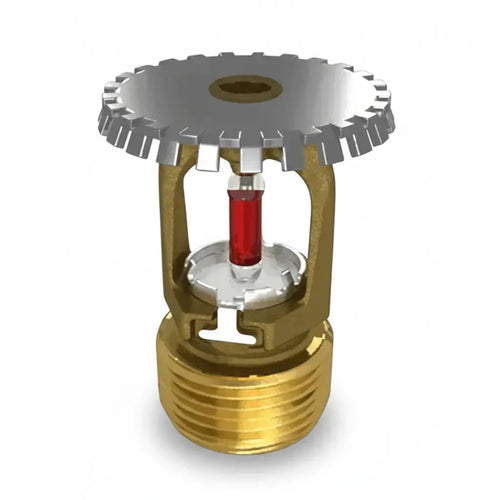
Residential environments require "fast-response" technology. These heads are engineered to activate at lower temperatures and with greater speed than commercial alternatives. This speed is what prevents flashover and buys occupants the time needed to escape. You have several aesthetic choices that don't sacrifice performance. Concealed heads offer a flush finish for modern interiors, while pendent and sidewall heads provide flexible installation options for sloped ceilings or restricted spaces. Refer to our essential residential fire sprinkler parts checklist to ensure you're selecting heads that meet the 2025 edition requirements.
Valves, Gauges, and the Riser Assembly
The riser room is the heart of the system. A compliant riser assembly includes a main drain valve and a test connection to verify flow. You must also include a dedicated pressure gauge. This allows for immediate verification that the system is pressurized and ready for service. Protecting the home's potable water is equally vital. Backflow preventers are mandatory to ensure that stagnant water within the sprinkler lines doesn't migrate back into the drinking water supply.
Compatibility is the key to a reliable installation. Mixing components from different manufacturers can lead to threading issues or hydraulic imbalances. Investing in a pre-configured residential sprinkler system hardware kit eliminates these risks by providing verified, matching parts. This approach simplifies procurement and ensures every valve and gauge meets the specific demands of nfpa 13d. Precision in hardware selection is the only way to eliminate doubt.
Ready to secure your project? Shop our full inventory of NFPA 13D compliant hardware to ensure your system is built for long-term performance and unwavering reliability.
Maintenance and Inspection: Keeping Your 13D System Ready
A residential fire sprinkler system is a silent sentinel. It only works if it's ready. While residential requirements are less rigorous than commercial ones, the nfpa 13d standard still requires a baseline level of vigilance to ensure the system performs when it matters most. Neglect is the primary cause of system failure in an emergency. You must ensure that the mechanical components remain uncompromised by environmental factors or human error. This proactive approach eliminates doubt and maintains the life-safety shield you've invested in.
One of the most critical rules in system maintenance is the "no-paint" rule. Never paint a sprinkler head or its cover plate. Paint acts as an insulator, delaying the thermal response of the heat-sensitive element. It can also physically bond the components, preventing the head from activating at all. If a head is accidentally painted during a home renovation, it's no longer compliant. The only functional remedy is a total replacement of the affected head. Professional assurance comes from knowing your system is clean, unobstructed, and ready to react.
The Homeowner's Maintenance Checklist
Homeowners can perform simple visual inspections without specialized tools. These checks should be conducted monthly to verify system integrity. Follow these three steps to keep your home protected:
- Step 1: Verify that the main control valve is locked in the open position. A closed valve is the most common reason for system failure during a fire.
- Step 2: Check the pressure gauges in the riser room. The reading should match the required system pressure established during the initial installation.
- Step 3: Clear any obstructions within 18 inches of the sprinkler heads. Items like tall furniture, hanging plants, or light fixtures can block the water spray pattern and reduce effectiveness.
When to Replace Components
Residential hardware is built for longevity, but it isn't permanent. Industry standards generally suggest a 50-year rule for sprinkler head replacement or laboratory testing to ensure the triggers remain sensitive. However, environmental factors often accelerate this timeline. If your home has hard water, mineral deposits can build up inside residential valves and backflow preventers, leading to restricted flow or leaks. Corrosion is a silent enemy that requires immediate action.
When a component fails a visual check or shows signs of degradation, don't wait to act. You should source fire protection parts online to find verified, code-compliant replacements that match your existing system's specifications. Using matching hardware ensures that your hydraulic calculations remain valid and your system stays compliant with the latest edition of the standard. Maintaining your system is the final step in securing long-term performance and peace of mind for your family.
Securing Your Next Residential Project with Precision
Mastering the nfpa 13d standard is about more than just checking a box for the local inspector. It's about engineering a system that provides families with the critical time needed to escape a fire. You now understand that a compliant system relies on the 10-minute water supply rule and the strategic use of fast-response technology. By focusing on life safety over property preservation, you can deliver high-performance protection that remains cost-effective for any one or two-family dwelling.
Don't leave your project's safety to chance. As a Viking Plastics Authorized Retailer, we provide the code-compliant hardware and expert technical support contractors need to succeed. From residential fire pumps to CPVC piping, we carry the inventory required to eliminate doubt from your build. Shop Code-Compliant NFPA 13D Residential Sprinkler Parts today to ensure your installation meets the highest industry standards. Your commitment to excellence starts with the right components. You have the knowledge; now get the hardware that backs it up.
Frequently Asked Questions
Is NFPA 13D required for all new homes?
No, the requirement for residential sprinklers depends entirely on your local building codes and the Authority Having Jurisdiction (AHJ). While the NFPA recommends installation in all one- and two-family dwellings, adoption varies by state. Some municipalities mandate them for all new construction, while others only require them for homes over a certain square footage. Always check with your local building department to verify the specific mandates in your area.
Does NFPA 13D require sprinklers in the garage?
No, the national standard generally excludes attached garages from mandatory coverage. The primary focus of nfpa 13d is life safety within the living areas where occupants sleep and spend the most time. However, many local jurisdictions amend this rule to require garage protection. If your local code requires garage sprinklers, you must use dry pendent sprinklers or anti-freeze solutions to prevent the pipes from freezing in unheated spaces.
Can I use PEX piping for an NFPA 13D system?
Yes, PEX is an approved material for residential fire protection when it is specifically listed for fire sprinkler service. It is a common choice for multipurpose systems that integrate with the home's plumbing. For stand-alone systems, many contractors prefer CPVC due to its rigid nature and higher hydraulic efficiency. Both materials offer excellent corrosion resistance, but you must ensure all fittings and solvents are compatible with the specific piping used.
How much water does an NFPA 13D system use during a fire?
A typical residential sprinkler head discharges between 15 and 26 gallons per minute (GPM). This is a fraction of the 150 to 250 GPM used by a single fire department hose. Since 90% of residential fires are controlled by just one or two heads, the total water usage is remarkably low. This targeted approach minimizes water damage while providing the critical cooling needed to prevent the fire from spreading to other rooms.
What is the difference between a stand-alone and a multipurpose 13D system?
A stand-alone system uses a dedicated network of pipes that only serve the fire sprinklers. A multipurpose system integrates the sprinklers with the home's domestic cold-water plumbing. Multipurpose systems offer the advantage of "built-in" monitoring, as using a faucet confirms the water supply is active. Stand-alone systems are often preferred for retrofits or when using specialized nfpa 13d components like CPVC that aren't intended for domestic water lines.
Do I need a fire pump for my home sprinkler system?
You only need a fire pump if your municipal water supply or private well cannot provide the 40 GPM flow and pressure required by the hydraulic design. This is a frequent challenge in rural areas or for homes built on high elevations. A residential fire pump system serves as the functional remedy, boosting pressure from a stored water tank to ensure the system performs with unwavering reliability during an emergency.
Can I install an NFPA 13D system myself?
Most local laws require a licensed fire protection professional to design and install these systems. While a homeowner might be capable of basic plumbing, fire protection involves complex hydraulic calculations that determine pipe sizing and head placement. An error in these calculations can lead to a system that fails to activate or lacks sufficient pressure. You should check with your local AHJ regarding licensing requirements to ensure your system is legally verified.
How often should an NFPA 13D system be inspected?
You should perform a simple visual inspection of your system once a month. This involves checking the riser room to ensure the main control valve is locked open and verifying that the pressure gauges show the correct levels. While residential codes don't require the same rigorous professional testing as commercial buildings, it's a safe practice to have a technician check your backflow preventer and pump annually to ensure long-term performance and peace of mind.

