



Seismic Bracing for CPVC Pipe: The 2026 Professional Compliance Guide
What if the steel hardware designed to save your fire sprinkler system is actually the primary cause of its failure? For many contractors, the fear isn't just the earthquake itself. It's the risk of damaging the pipe during installation or causing long-term failure through Environmental Stress Cracking (ESC). When you're managing seismic bracing for CPVC pipe, you're balancing structural engineering with complex material science. You already know that standard metal braces can be unforgiving. One wrong choice in hardware can lead to a system compromise that costs far more than the initial installation.
We understand the pressure to achieve 100% compliance with the 2025 edition of NFPA 13 while maintaining system longevity. This guide provides the professional assurance you need to navigate the latest ASCE 7-22 standards and the specific nuances of thermoplastic protection. You'll learn how to identify CPVC-safe bracing and master the technical requirements that eliminate doubt. We'll examine the updated horizontal force calculations and provide a clear roadmap for selecting engineered solutions like ASC seismic bracing to reduce labor time and ensure total code adherence.
Achieving total code compliance for fire suppression systems requires more than just following general guidelines; it demands a deep understanding of the 2025 NFPA 13 requirements. This guide clarifies the "regardless of size" rule that mandates bracing for 1-1/2 inch CPVC mains, ensuring your project meets every regulatory hurdle. You will learn to navigate the unique physical challenges of thermoplastic, including how to manage thermal expansion and prevent Environmental Stress Cracking (ESC) caused by incompatible chemicals found in standard metal coatings.
Precision is key when installing seismic bracing for CPVC pipe. We cover the essential spacing standards, such as the 40-foot maximum for lateral braces and 80-foot intervals for longitudinal restraints. You will also discover critical installation techniques, from maintaining the mandatory 2-inch clearance at wall penetrations to applying the correct torque to prevent pipe crushing. By the end of this guide, you will be equipped to select the right ASC seismic bracing hardware and streamline your installation process with professional confidence.
Understanding Seismic Bracing Requirements for CPVC Fire Sprinkler Systems
Seismic bracing is a specialized system of lateral and longitudinal restraints designed to keep fire sprinkler systems operational during and after a seismic event. Unlike standard hangers that support gravity loads, these components resist horizontal forces. For contractors working with thermoplastic, seismic bracing for CPVC pipe requires a specific focus on material compatibility and flexibility. It is not merely about holding the pipe in place; it is about managing energy transfer during structural shifts.
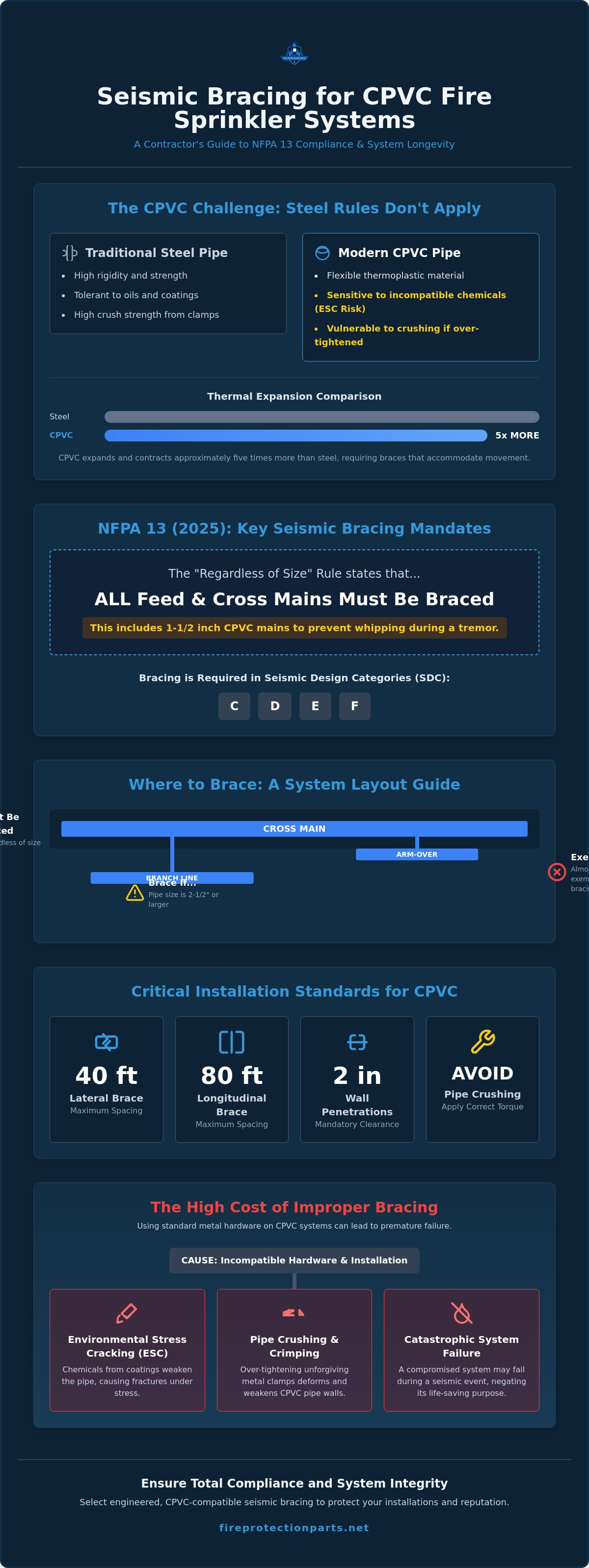
The 2025 edition of NFPA 13 mandates that all feed and cross mains must be braced regardless of their diameter. This means even a 1-1/2 inch CPVC cross main requires seismic protection. Many installers overlook this, assuming that small-diameter pipes are exempt. Implementing seismic bracing for CPVC pipe on these 1-1/2 inch mains prevents the pipe from whipping during a tremor. Because CPVC is a thermoplastic, it lacks the inherent rigidity of steel. Without proper bracing, the differential movement between the building and the pipe can lead to catastrophic fractures at the fittings.
The necessity of bracing is dictated by the building’s Seismic Design Category (SDC). If a structure falls into SDC C, D, E, or F, seismic protection is generally required. While NFPA 13 is the primary driver for commercial systems, residential standards like NFPA 13R and 13D often follow different rules. For instance, NFPA 13D systems in one- and two-family dwellings typically don't require seismic bracing unless specified by local jurisdictions. Always verify the SDC before finalizing your bill of materials to avoid unnecessary costs or compliance failures.
Feed Mains vs. Branch Lines: Where Bracing is Mandatory
In a CPVC layout, a cross main is any pipe that supplies the branch lines. Under NFPA 13, these mains must be braced. Branch lines only require bracing when they reach 2-1/2 inches or larger. Most CPVC branch lines are smaller than this threshold, which reduces the overall bracing count. Arm-overs, the short segments connecting a branch line to a sprinkler head, are almost always exempt from bracing requirements. This distinction helps focus your labor on the critical infrastructure of the system.
The Goal of Seismic Restraint in 2026
The primary objective is to protect system integrity during differential building movement. When an earthquake occurs, the building moves at a different frequency than the water-filled pipes inside it. Effective restraint ensures the system remains operational for life safety long after the shaking stops. Seismic restraint for thermoplastic piping is the engineered control of pipe displacement to prevent fracture-inducing stress while accommodating the material’s unique thermal expansion properties. Utilizing specialized ASC seismic bracing fire protection hardware ensures that your restraints provide the necessary strength without compromising the chemical integrity of the CPVC pipe.
The CPVC Challenge: Why Traditional Bracing Can Fail Plastic Piping
Traditional steel bracing methods don't translate directly to thermoplastic systems. Steel is forgiving of external oils and rigid enough to handle aggressive clamping. CPVC is a high-performance material, but it requires a specialized approach to avoid structural failure. The physical properties of plastic mean that seismic bracing for CPVC pipe must account for flexibility and chemical sensitivity that metal pipes simply don't have. If you apply steel-pipe logic to a CPVC installation, you risk system failure long before an earthquake even occurs.
The first major hurdle is thermal expansion. CPVC’s coefficient of thermal expansion is significantly higher than IPS steel. In fact, CPVC expands and contracts roughly five times more than steel. If a seismic brace is too restrictive, it prevents the pipe from moving during normal temperature fluctuations. This creates internal stress at the fittings. Mechanical stress from over-tightening is equally dangerous. Metal clamps can easily "crush" or crimp the pipe wall if torqued to steel-pipe standards. This creates a weak point that will likely fracture under the high-frequency vibrations of a seismic event.
Environmental Stress Cracking (ESC) is perhaps the most overlooked threat. Many standard steel braces are finished with oils, lubricants, or coatings that are chemically incompatible with CPVC. When these substances migrate into the pipe wall, they weaken the molecular bonds of the plastic. This chemical attack makes the pipe brittle. You can learn more about the technical nuances of these interactions in the Seismic Bracing of CPVC Pipe technical review. To ensure your system remains resilient, it's vital to source high-quality seismic components that are specifically listed for use with thermoplastic.
Chemical Compatibility and Hardware Coatings
Identifying CPVC-friendly finishes is a non-negotiable step for any professional installer. You must avoid using non-listed rubber or plastic inserts for cushioning, as these often contain plasticizers that trigger ESC. It's best practice to source your Viking CPVC fire sprinkler pipe alongside hardware that has been verified for compatibility. This eliminates the guesswork and protects the system from silent chemical degradation.
Managing Thermal and Seismic Movement Simultaneously
In vertical riser environments, CPVC moves considerably. Braces must be designed to allow for this axial movement while strictly restricting lateral sway. Effective seismic bracing for CPVC pipe avoids "point loading" by distributing the restraint forces across a wider surface area of the pipe. This prevents the hardware from shearing through the plastic when the building begins to move. Proper design ensures the pipe remains held in place without being strangled by its own safety hardware.
Lateral vs. Longitudinal Bracing: Designing for CPVC Stability
Effective seismic bracing for CPVC pipe requires a dual-axis strategy to manage the intense forces of a seismic event. Lateral bracing is your primary defense against side-to-side movement. NFPA 13 dictates that these braces must be installed at a maximum interval of 40 feet. This spacing ensures that the pipe doesn't bow or whip during horizontal acceleration. For longitudinal bracing, which restrains end-to-end movement, the maximum interval is 80 feet. While these are the maximums, actual site conditions often require tighter spacing to ensure the system remains anchored.
Risers present a different challenge. This is where four-way bracing becomes essential. These restraints provide protection in all directions, essentially locking the vertical pipe in place at critical junctions. You must also account for the 'Last Branch Line' rule. This requirement ensures that the end of a cross main is properly restrained, preventing the final segment from acting as a lever that could snap fittings during a building's shift. Adhering to these Seismic Design Requirements for Nonstructural Components is what separates a compliant installation from a liability.
Bracing Spacing and NFPA 13 Tables
The spacing for 1-1/2 inch CPVC differs from 2-1/2 inch spans because of the material's rigidity and the weight of the water it carries. Water-filled weight is a critical factor in seismic load calculations; a larger pipe carries more mass, which translates to higher kinetic energy during an earthquake. In high-hazard zones or areas with a high Seismic Design Category (SDC), these standard 40 and 80-foot intervals often face mandatory reductions. You don't want to guess these values; always consult the specific load tables to ensure your seismic bracing for CPVC pipe is rated for the local seismic hazard model.
Hardware Selection for CPVC Support
Choosing the right hardware is just as important as the spacing. Many contractors rely on all thread rod for both vertical support and diagonal bracing members. It's a versatile solution that allows for precise height adjustments. When selecting sway brace attachments, you must distinguish between the structural connection and the pipe-side connection. The pipe-side component must be specifically listed for CPVC to avoid chemical incompatibility. Sourcing all your sprinkler system components online from a specialist ensures that every rod, clamp, and brace works together in a unified, code-compliant plan.
Installation Best Practices: Spacing, Torque, and Clearance Standards
Precision is the difference between a compliant system and a catastrophic failure. When installing seismic bracing for CPVC pipe, you must account for the physical space the pipe needs to survive a building's shift. NFPA 13 requires a minimum 2-inch clearance for any pipe passing through walls, floors, or partitions. This gap isn't optional; it prevents the structure from acting as a giant pair of shears that could sever the CPVC during a seismic event. If a wall or floor is fire-rated, you must use an approved flexible firestop system that maintains this clearance while sealing the penetration.
Alignment is equally critical. Every brace must be installed perpendicular to the pipe to ensure the load is transferred correctly to the structure. A brace installed at an off-angle cannot meet its rated capacity. Before you finalize any connection, verify the "Listed" status of every component. Mixing non-listed hardware with professional-grade CPVC is a liability that no contractor should accept. You can buy listed seismic bracing components to ensure every part of your system meets the rigorous testing standards required for fire protection.
Step-by-Step Seismic Brace Installation
- Marking: Use the project submittal to mark exact locations for structural and pipe attachments.
- Structural Attachment: Secure your beam clamp or concrete anchor first. Ensure the substrate is capable of handling the calculated seismic load.
- Pipe Attachment: Attach the sway brace to the Viking CPVC. Use a torque wrench to meet the manufacturer's specific inch-pound requirements.
Relying on the old "hand-tight plus a quarter turn" method is a dangerous practice for CPVC because it ignores the precise torque limits required to prevent mechanical stress fractures in thermoplastic pipe walls.
Common Installation Mistakes to Avoid
One of the most frequent errors is the use of "homemade" bracing solutions. Field-fabricated braces lack the engineering data and NFPA 13 compliance needed for life-safety systems. Another risk is galvanic corrosion in moist riser rooms. When you mix incompatible metals, such as certain steel rods with copper-based components, the resulting corrosion can weaken the brace over time. Finally, always account for flexible couplings at seismic separation joints. Bracing across these joints without allowing for the intended movement defeats the purpose of the flexible coupling and will likely cause the pipe to snap during a tremor. Stick to engineered solutions to maintain the integrity of your Viking Plastics installation.
Sourcing NFPA-Compliant Seismic Bracing and CPVC Components Online
Procuring the right hardware isn't a simple transaction; it's a verification process. While general plumbing stores offer convenience for standard fittings, they often lack the specialized technical knowledge required for high-stakes life-safety systems. When you're sourcing seismic bracing for CPVC pipe, the stakes are too high for "off-the-shelf" solutions that aren't verified for chemical compatibility. A fire protection specialist understands that the brace and the pipe must be tested as a unified system to guarantee performance during a seismic event. This system-listed approach is the only way to ensure the hardware won't cause silent degradation over time.
The industry benchmark for this level of reliability is ASC seismic bracing fire protection hardware. These components are engineered specifically to accommodate the unique physical properties of Viking Plastics CPVC. By choosing system-listed components, you're ensuring that the brace won't cause Environmental Stress Cracking or mechanical crushing. In 2026, the demand for these specialized parts is rising as the global CPVC market maintains a compound annual growth rate of 11.7%. This makes reliable logistics essential. You need a partner that provides fast shipping for both critical repairs and fast-tracked new construction projects to keep your timeline intact.
Why Fire Protection Parts is the Professional Choice
We provide more than just parts; we provide certainty. Every contractor has access to UL Listed and FM Approved seismic bracing for sprinkler systems through our platform. We include technical specifications for every CPVC fitting and brace, allowing you to verify load capacities and chemical compatibility before you buy. For large-scale commercial or multi-family residential projects, we offer bulk ordering options to keep your project on schedule. Our focus remains on eliminating the doubt that comes with sourcing high-stakes safety hardware.
Final Compliance Checklist for Procurement
Before you finalize your order, run through this final verification to ensure 100% code compliance:
- Verify Site SDC: Ensure the project site's Seismic Design Category matches your hardware's load ratings and spacing requirements.
- Check 'Listed' Status: Confirm that the sway brace is specifically listed for use with thermoplastic piping to avoid ESC risks.
- Review Torque Specs: Ensure your team has the equipment to meet the specific torque requirements for the chosen ASC hardware.
Don't leave your system's integrity to chance or settle for generic plumbing components that don't meet NFPA standards. Shop our full inventory of ASC Seismic Bracing and Viking CPVC today.
Securing Your System’s Future
Compliance with the latest fire safety standards is more than a regulatory hurdle; it's a commitment to life safety. By mastering the 2025 NFPA 13 requirements and the specific nuances of thermoplastic movement, you protect both the structure and the system's operational integrity. Successful implementation of seismic bracing for CPVC pipe relies on two critical factors: choosing chemically compatible hardware and adhering to precise standards like the 2-inch clearance rule. These steps eliminate the risk of Environmental Stress Cracking and mechanical failure.
Don't leave your project's success to chance with generic hardware. As an authorized distributor of ASC Engineered Solutions, we provide the UL Listed and FM Approved components required for high-hazard zones. Our team offers expert technical support to ensure your procurement meets every NFPA 13 mandate. Shop NFPA-Compliant Seismic Bracing for CPVC Systems and build with professional confidence. You have the tools and the knowledge to ensure your system stands firm when it matters most.
Frequently Asked Questions
Is CPVC pipe exempt from seismic bracing requirements?
CPVC pipe is not exempt from seismic bracing requirements; its necessity is determined by the building's Seismic Design Category (SDC). For structures in SDC C, D, E, or F, bracing is generally mandatory for all mains. These rules ensure that the thermoplastic system can withstand horizontal acceleration without fracturing. Always consult the project’s structural submittals to confirm the specific SDC before assuming any part of the system is exempt from these safety standards.
Do 1-1/2 inch CPVC mains require seismic bracing?
Yes, 1-1/2 inch CPVC mains require seismic bracing under the "regardless of size" rule found in NFPA 13. This mandate applies specifically to feed and cross mains. While branch lines under 2-1/2 inches are often exempt, the mains must be restrained to prevent the entire system from shifting. Ignoring this requirement for smaller mains is a frequent source of inspection failure and can lead to significant structural stress at the fittings.
What is Environmental Stress Cracking (ESC) in CPVC bracing?
Environmental Stress Cracking (ESC) is a permanent structural failure caused by the contact of CPVC with chemically incompatible substances. In the context of seismic bracing for CPVC pipe, this often occurs when oils, lubricants, or coatings from metal hardware migrate into the plastic. This chemical attack makes the material brittle, leading to fractures under pressure. Selecting listed, compatible hardware is the only way to eliminate this invisible threat to system longevity.
Can I use standard steel sway braces on Viking CPVC pipe?
You should never use standard steel sway braces on Viking CPVC pipe unless they are specifically listed for thermoplastic use. Standard metal hardware often carries cutting oils or antimicrobial coatings that trigger chemical degradation. Additionally, traditional clamps are designed for the rigidity of steel and can easily crush or crimp the thinner walls of CPVC pipe. Using listed ASC seismic bracing ensures the hardware respects the physical and chemical limits of the pipe.
What is the maximum spacing for lateral bracing on CPVC pipe?
The maximum spacing for lateral bracing on CPVC pipe is 40 feet according to NFPA 13 standards. This interval is designed to prevent side-to-side movement that could snap joints or fittings. However, this is a maximum limit, not a universal rule. In areas with higher seismic hazards, engineers often require shorter intervals. You must check the specific load tables for your project’s Seismic Design Category to ensure the spacing provides adequate restraint.
Does NFPA 13R require seismic bracing for residential CPVC?
NFPA 13R typically requires seismic bracing for residential CPVC systems when the building is located in a high-risk Seismic Design Category. While NFPA 13D for single-family homes often provides more flexibility, 13R systems in multi-family dwellings are held to higher safety standards. If the local building code references ASCE 7 for nonstructural components, you must install bracing on all mains to maintain compliance and ensure the safety of the residents during an event.
How do I know if a seismic brace is 'CPVC-friendly'?
A seismic brace is 'CPVC-friendly' if it carries a specific listing for use with thermoplastic fire sprinkler systems. Manufacturers like ASC Engineered Solutions design these components to distribute loads across the pipe wall, preventing point loading. You can also verify compatibility by checking the manufacturer's chemical compatibility list. This ensures the hardware's finish or cushioning materials won't cause Environmental Stress Cracking. Always look for UL Listed or FM Approved markings on the hardware.
What is a seismic separation joint and when does CPVC need one?
A seismic separation joint is a flexible pipe assembly installed where the sprinkler system crosses a building's structural expansion joint. CPVC systems need these joints to allow for independent movement between two sections of a building. Without a separation joint, the rigid pipe would be forced to bridge the gap during a tremor, leading to immediate failure. These assemblies use flexible couplings and specific seismic bracing for CPVC pipe to manage this differential movement safely.

