



Seismic Bracing for Fire Sprinkler Systems: The 2026 Compliance Guide
Seismic bracing is not about locking your pipes into a rigid, immovable state; it is about managing differential movement so your system doesn't rupture when the ground starts to shake. If you are struggling to reconcile the conflicting language between NFPA 13 and ASCE 7, you are not alone. Many facility managers and contractors fear a failed inspection because of non-compliant hardware or a misunderstanding of seismic design categories. It is a high-stakes environment where the wrong component choice leads to more than just a red tag; it compromises the safety of the entire building.
This guide helps you master the essentials of seismic bracing for fire sprinkler systems to ensure your suppression system remains operational during and after an earthquake. We provide the professional assurance you need to eliminate doubt and source the correct UL/FM approved components, including ASC Seismic Bracing. You will gain a clear understanding of the 2026 compliance standards, learn how to identify necessary bracing hardware, and verify your system against the latest codes. Let's move from confusion to a verified, safety-first solution that protects your assets and provides total peace of mind.
Key Takeaways
- Understand the principle of differential movement to ensure your fire suppression system moves with the building structure rather than against it.
- Identify the specific Seismic Design Category (SDC) for your project to meet the rigorous 2026 standards of NFPA 13 and ASCE 7.
- Learn the functional differences between lateral, longitudinal, and 4-way restraints to properly secure every axis of your piping network.
- Master the strategic application of flexible couplings and clearance requirements in seismic bracing for fire sprinkler systems to prevent pipe rupture.
- Eliminate the risk of inspection failure by sourcing verified, UL/FM approved components like ASC Seismic Bracing for all critical restraint points.
What is Seismic Bracing for Fire Sprinkler Systems?
Seismic bracing for fire sprinkler systems is a specialized network of structural supports designed to manage the forces generated during an earthquake. It is not a secondary safety feature; it is a fundamental requirement for system survival. In a seismic event, buildings don't just sit still. They sway, twist, and vibrate. If your fire suppression piping is rigidly fixed or, conversely, allowed to swing uncontrollably, the resulting stress will cause the system to fail exactly when it is needed most. Professional-grade bracing ensures that the piping moves in unison with the building's structure, protecting the integrity of every joint and sprinkler head.
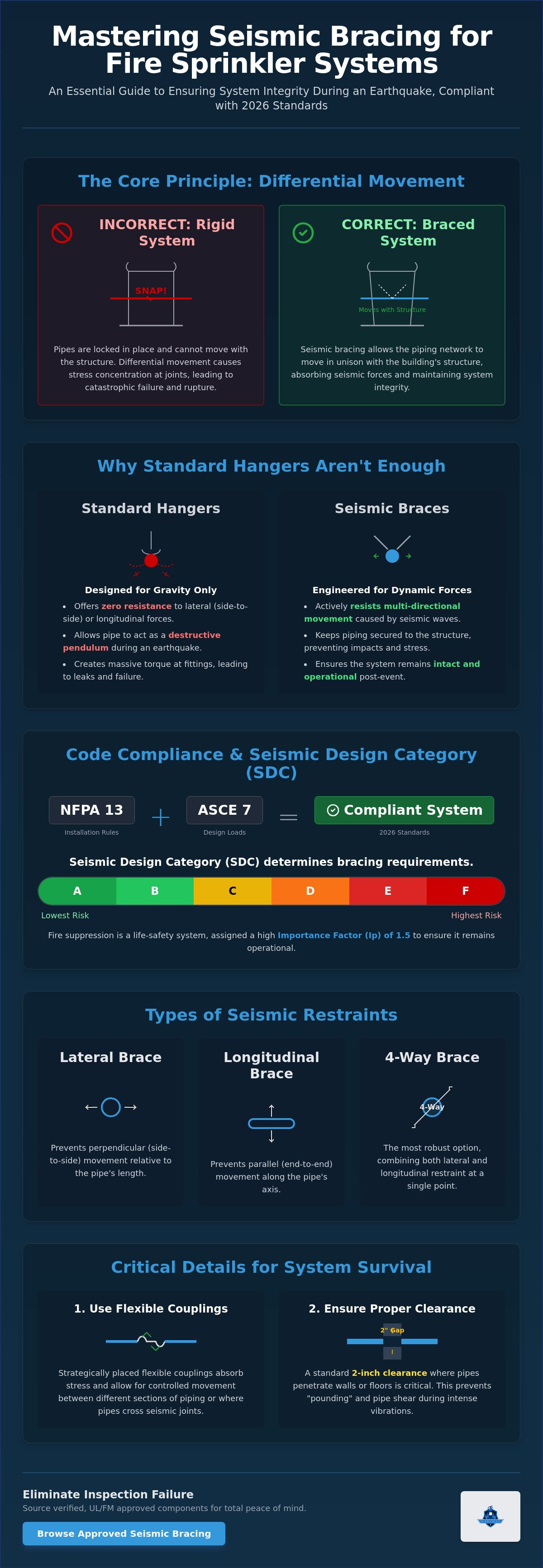
The core philosophy behind these systems is the "Differential Movement" principle. This concept dictates that piping must move with the specific structural member it is attached to, but it must also have the flexibility to account for different parts of the building moving at different rates. Without this balance, the sheer force of an earthquake can snap pipes at their connections. The primary goals are clear: prevent pipe rupture, protect individual sprinkler heads from hitting structural components, and ensure that the water supply remains continuous for fire suppression. Key components used to achieve this include sway braces, restraint wires, and flexible couplings.
The Anatomy of a Seismic Event and Pipe Failure
When an earthquake occurs, both horizontal and vertical acceleration put immense strain on pressurized fire lines. Water is heavy, and its momentum during a shake can be devastating. Common failure points include threaded joints, elbows, and wall penetrations. If a pipe is forced through a wall without the required clearance, it will experience "pounding" against the structural member. This repetitive impact often leads to immediate fracturing. Maintaining a standard 2-inch gap around pipe penetrations is a critical defensive measure that allows the pipe to survive these intense vibrations without snapping.
Why Standard Hangers Aren't Enough
Standard hangers are designed for one thing: gravity. They keep the pipe off the floor and support its weight under static conditions. However, they offer almost zero resistance to lateral or longitudinal loads. During an earthquake, a pipe supported only by standard hangers becomes a giant pendulum. This uncontrolled swinging creates massive torque at the fittings. Transitioning to dynamic resilience requires the addition of dedicated seismic restraints. While gravity hangers handle the vertical load, components like ASC Seismic Bracing are engineered to stop the side-to-side and end-to-end movement that leads to catastrophic system failure. It is the difference between a system that holds its weight and a system that holds its ground.
Code Compliance: NFPA 13 and ASCE 7 Requirements
Compliance isn't a suggestion; it's a legal and safety mandate. In the world of fire protection, two primary documents dictate your design: NFPA 13 and ASCE 7. While NFPA 13 provides the specific installation rules for seismic bracing for fire sprinkler systems, ASCE 7 establishes the Minimum Design Loads for Buildings and Other Structures. You can't have one without the other. ASCE 7 tells you how hard the earthquake will push, and NFPA 13 tells you how to push back. They work in tandem to ensure the structural integrity of your fire suppression network.
The 2026 compliance landscape introduces more precise force factor calculations. These updates refine how we calculate the horizontal seismic force (Fp) acting on fire protection components. It's a shift toward greater accuracy, ensuring that systems in high-risk zones aren't under-engineered. However, exemptions still exist to keep projects manageable. For instance, small-diameter piping, typically 1 inch or smaller, may be exempt from certain bracing requirements depending on the Seismic Design Category and the type of hangers used. Understanding these nuances saves time and prevents over-spending on unnecessary hardware.
Determining Your Seismic Design Category (SDC)
Your project's SDC is the primary trigger for bracing requirements. It ranges from A, representing the lowest risk, to F, representing the highest risk. This category is determined by the soil site class and spectral acceleration values, known as Ss and S1, which are specific to your building's geographic coordinates. Because fire suppression is a life-safety system, it's assigned an Importance Factor (Ip) of 1.5. This high rating means the system must remain operational even after the design earthquake occurs. Seismic Design Category is the intersection of geography and building occupancy.
NFPA 13 Chapter 18: The Contractor's Bible
Chapter 18 of NFPA 13 contains the technical requirements that keep systems intact. It mandates bracing for all main lines and branch lines over certain diameter thresholds. It also dictates the use of flexible couplings at building expansion joints to prevent the pipe from snapping as different building segments move independently. For a deep dive into these specific hardware requirements, review our verification guide for seismic bracing for sprinkler systems. Ensuring your hardware meets these rigorous standards is easier when you source UL/FM approved components like ASC Seismic Bracing. Compliance is about more than passing an inspection; it's about guaranteeing the system performs under pressure.
Types of Seismic Restraints: Lateral, Longitudinal, and 4-Way
Not all seismic forces act on your piping in the same way. To build a resilient system, you must address movement from every possible angle. Effective seismic bracing for fire sprinkler systems relies on three primary restraint types, each serving a specific structural purpose. Using the right combination is the only way to ensure the system remains intact when the building begins to sway.
- Lateral Bracing: These braces prevent side-to-side movement. They are installed perpendicular to the pipe axis. Most sway braces in a standard system are lateral, as they counteract the primary horizontal forces that cause piping to swing like a pendulum.
- Longitudinal Bracing: This type stops the pipe from sliding or "telescoping" along its own axis. Without longitudinal restraints, a long run of pipe can act like a battering ram, shearing off branch lines or crashing through walls during a seismic event.
- 4-Way Bracing: Essential for risers and vertical drops, 4-way bracing provides 360-degree protection. It combines lateral and longitudinal resistance to ensure vertical sections stay centered within the building's structure.
Calculating the "tributary load" is a critical step in the design process. Every brace has a specific zone of influence. You must determine the total weight of the water-filled pipe and all attached components within that zone. This ensures the brace you select can handle the specific seismic force calculated for that section. Overloading a brace is just as dangerous as not having one at all.
Sway Brace Components and Hardware
A complete seismic assembly is only as strong as its weakest link. The attachment to the pipe typically involves specialized seismic clamps rather than standard clevis hangers. Clevis hangers are designed for gravity, not the dynamic grip required for seismic loads. The brace member itself usually consists of a schedule 40 pipe or angle iron acting as a strut. Finally, the structural attachment must be verified for the specific building material. Whether you use beam clamps for steel or concrete anchors, each piece must be part of a tested, compatible assembly.
Cable vs. Rigid Bracing Systems
Choosing between cable and rigid bracing depends on your specific environment. Tension-only cable restraints are ideal for tight plenum spaces where existing ductwork or electrical trays make rigid struts impossible to install. They're lightweight and easy to adjust in the field. However, rigid pipe bracing remains the standard for high-load requirements because it can handle both tension and compression. Regardless of the method, ensure all hardware is UL Listed or FM Approved. Using generic hardware is a liability that leads to catastrophic failure and legal repercussions.
Design Principles for Earthquake-Resistant Piping
Designing for seismic resilience requires a delicate balance between absolute rigidity and necessary flexibility. While the primary goal of seismic bracing for fire sprinkler systems is to limit movement, the system must still accommodate the natural shifting of a building frame during a quake. NFPA 13 Section 18.2 outlines the strategic use of flexible couplings to achieve this balance. If a system is too rigid, it will snap. If it is too loose, it will collide with structural elements. You must engineer for both scenarios to maintain system integrity.
One critical error in the field is "short-circuiting" the system. This occurs when a rigid brace is installed in a way that bypasses a flexible coupling, effectively nullifying the coupling's purpose. The system must be designed so that the bracing protects the pipe while the couplings allow for the building's differential movement. Additionally, proper clearance is non-negotiable. You must maintain a 2-inch gap around all pipe penetrations through walls or floors. Without this space, the pipe will experience pounding forces that lead to immediate failure when the building sways.
The role of all thread rod in seismic hangers is equally vital. It provides the vertical support while acting as the mounting point for seismic components. However, the length and diameter of the rod must be carefully selected to prevent buckling under upward seismic forces. A rod that is too long or too thin will fail under the dynamic vertical loads of a seismic event.
Flexible Couplings and Differential Movement
Flexible couplings are essential at every floor level and building seismic joint. They allow for "racking," which is the horizontal displacement of the building frame. In grooved pipe systems, these couplings provide inherent flexibility. Threaded systems, however, require specific flexible fittings to achieve the same result. Proper placement ensures that as the building twists, the piping remains intact. You don't want the pipe to fight the building; you want it to move with it.
The Importance of Proper Anchoring
Anchoring is where the system meets the structure. For post-installed anchors in concrete, you must use hardware rated for cracked concrete. Earthquakes cause concrete to crack, and standard anchors can lose their grip instantly. You also need to respect edge distance and spacing requirements to prevent the concrete from spalling or the anchor from pulling out. A resilient system also considers the water source; ensuring your backflow preventer fire protection is correctly secured is a key part of overall site safety.
To ensure your project meets these rigorous standards, source UL/FM approved seismic components from a trusted industry partner.
Selecting UL/FM Approved Seismic Bracing Components
Using unverified hardware in a high-seismic zone is a gamble you can't afford to take. Generic clamps and anchors lack the rigorous testing required to withstand dynamic earthquake forces. When the ground moves, these components often fail at the point of attachment, rendering your entire system useless. For 2026 projects, sourcing UL Listed and FM Approved seismic bracing for fire sprinkler systems is the only way to guarantee performance and pass inspection. It eliminates the liability of non-compliant hardware and ensures your suppression system stays where it belongs.
ASC Seismic Bracing stands as the industry benchmark for reliability. These engineered solutions are designed to meet the precise requirements of NFPA 13 and ASCE 7 without the guesswork. When you source your fire protection parts online, prioritize components that offer verified load ratings and compatibility with your specific pipe schedule. A mismatch between pipe size and bracing hardware is a common cause of field failure.
- Load Ratings: Ensure the brace can handle the calculated tributary load for its specific zone of influence.
- Pipe Size Compatibility: Verify the clamp fits the outside diameter of your specific piping to prevent slippage.
- Finish: Choose galvanized finishes for corrosive environments or plain steel for standard indoor applications.
The Role of ASC Engineered Solutions
ASC Engineered Solutions provides a streamlined approach to commercial fire protection. Their pre-assembled components significantly reduce field labor, which is a major advantage for large-scale 2026 developments. These systems integrate seamlessly with Viking CPVC fire sprinkler pipe, ensuring that even non-metallic piping remains secure during a seismic event. This level of compatibility removes the doubt often associated with multi-vendor installations.
Final Inspection: What the AHJ Looks For
The final hurdle is the Authority Having Jurisdiction (AHJ). Inspectors look for precision, not just presence. They'll verify the torque on every concrete anchor to ensure it meets the manufacturer's specification. They also check the alignment of brace members; these must fall within the 0 to 90 degree allowed angles to function as designed. Don't let paperwork be the reason you fail. Keep your UL/FM certificates on-site and ready for review. An organized, verified system is the hallmark of a professional installation.
Securing Your System for the Future
Protecting a facility from earthquake damage requires more than just meeting a checklist; it requires a commitment to engineering excellence. You now understand how to balance flexibility and rigidity while adhering to the rigorous NFPA 13 and ASCE 7 requirements. By mastering the application of lateral, longitudinal, and 4-way restraints, you ensure that your fire suppression network remains a dependable safeguard during critical moments. Verification is the key to passing inspections and achieving long-term performance.
Choosing the right seismic bracing for fire sprinkler systems doesn't have to be a source of confusion. We eliminate the guesswork by stocking ASC Seismic Bracing solutions and code-compliant hardware designed specifically for 2026 standards. Our team provides the expert technical support contractors need to navigate complex safety requirements with confidence. Don't compromise on safety with generic alternatives that might fail under pressure.
Browse UL/FM Approved Seismic Bracing Components today to secure your next project. With the right hardware and a clear design strategy, you can build with the peace of mind that your system is ready for whatever the ground brings.
Frequently Asked Questions
When is seismic bracing required for fire sprinkler systems?
Seismic bracing for fire sprinkler systems is generally required for buildings assigned to Seismic Design Categories C, D, E, and F. NFPA 13 mandates these supports to ensure life-safety systems remain functional during and after an earthquake. While SDC A and B are typically exempt, you must verify the specific project requirements based on pipe diameter and building occupancy. It's a critical safety step that prevents the system from becoming a hazard.
What is the difference between lateral and longitudinal seismic bracing?
Lateral bracing is designed to prevent side-to-side movement perpendicular to the pipe's axis. Longitudinal bracing stops the pipe from sliding or "telescoping" along its own length. Both are necessary because earthquakes generate forces in multiple directions. Lateral braces are usually spaced more frequently than longitudinal ones. Together, they ensure the piping network moves in unison with the building's structure rather than crashing against it.
Are all thread rods acceptable for seismic bracing applications?
All thread rods are acceptable, but they must be part of an engineered seismic assembly. Standard hangers only support gravity loads, whereas seismic restraints must handle horizontal and vertical acceleration. If the rod is long, you may need a rod stiffener to prevent buckling under compression. Always ensure your rod and attachment hardware are rated for the specific seismic loads calculated for your fire suppression system.
Does NFPA 13 require seismic bracing for residential systems?
NFPA 13 requires seismic bracing for fire sprinkler systems in multi-family residential buildings if they fall into Seismic Design Category C or higher. While NFPA 13D systems for single-family homes often have exemptions due to smaller pipe sizes, larger residential projects must comply with full seismic standards. It's essential to verify the specific SDC of your building to determine if your residential suppression system needs these specialized structural supports.
What is a 'Zone of Influence' in seismic design?
The Zone of Influence (ZOI) is the specific section of piping that a single seismic brace is responsible for protecting. To calculate the load on a brace, you must sum the weight of all water-filled pipes and fittings within its ZOI. If the calculated load exceeds the brace's rated capacity, you'll need to reduce the spacing between braces or upgrade to higher-capacity hardware. Accurate ZOI calculations are vital for compliance.
Can I use standard pipe clamps for seismic bracing?
Standard pipe clamps are insufficient because they lack the verified load ratings needed for dynamic seismic forces. You must use UL/FM approved components like ASC Seismic Bracing hardware to ensure the system remains secure. These specialized clamps are engineered to provide a tight, mechanical grip that won't slip when the building sways. Using generic hardware is a liability that often leads to failed inspections and compromised safety.
How do I determine the seismic design category for my building?
You determine the Seismic Design Category by identifying the building's geographic location, soil site class, and occupancy type. Engineers use spectral acceleration values from USGS maps to calculate the design response. This data is then cross-referenced with the building's occupancy category to assign a letter from A to F. Your project's structural engineer of record usually provides this information during the initial design phase of the project.
What are the clearance requirements for pipes passing through walls?
NFPA 13 requires a 2-inch clearance around pipes passing through walls, floors, or foundations. This gap is vital to prevent the structure from pounding against the pipe during an earthquake. If the pipe passes through a fire-rated wall, you must use a flexible, UL-listed firestop material. This ensures the building's fire rating remains intact while allowing the pipe to move independently of the wall without causing a rupture.

