



Seismic Bracing for Fire Sprinkler Systems: The 2026 Professional Guide
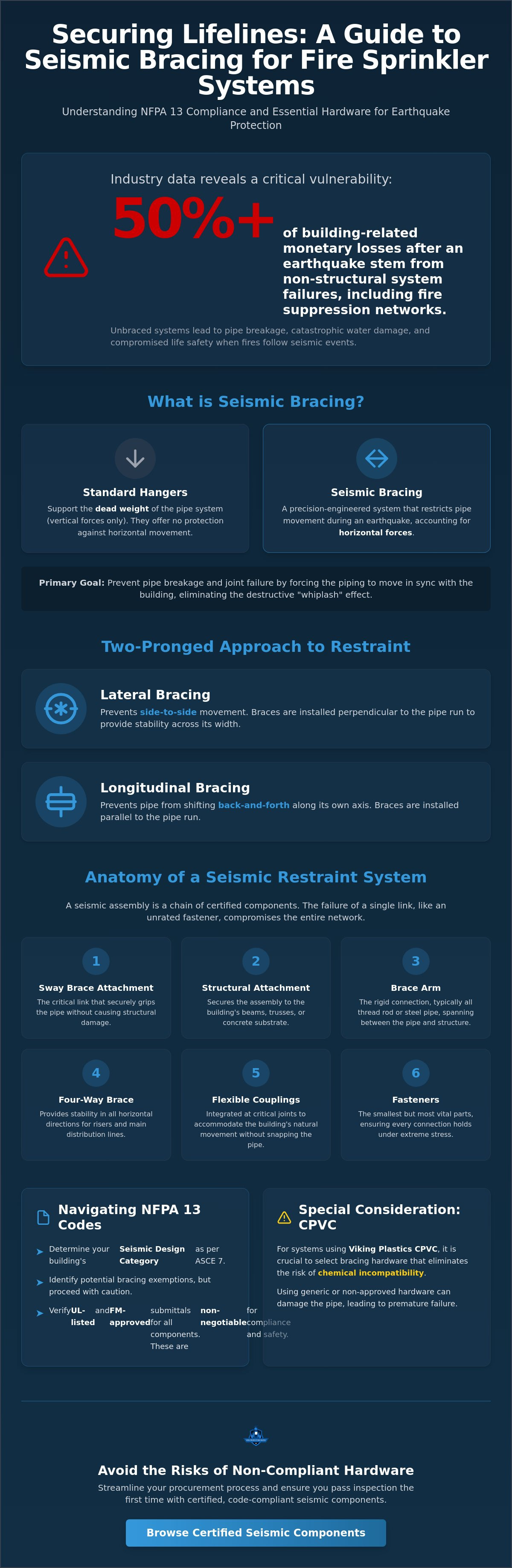
Over 50% of building-related monetary losses after an earthquake stem from non-structural system failures, according to recent industry data. This includes critical fire suppression networks. When the ground shakes, a standard pipe hanger isn't enough to prevent catastrophic water damage or total system failure. You need robust seismic bracing for fire sprinkler systems that adheres to the 2025 NFPA 13 standards and ASCE 7 requirements. It's often difficult to navigate shifting regulations while trying to procure hardware that's both compatible and compliant. You want to pass your inspection without the headache of sourcing non-compliant parts.
This guide simplifies the technical noise. You'll master the complexities of seismic compliance and identify the exact UL-listed and FM-approved components, such as ASC seismic bracing, required to secure your network. We'll walk through the specific hardware needed for a code-compliant installation, ensuring your procurement is efficient and your facility remains protected against earthquake damage.
Key Takeaways
- Understand how specialized supports prevent pipe breakage and joint failure during a seismic event.
- Identify the essential components of seismic bracing for fire sprinkler systems, including sway brace and structural attachments.
- Navigate NFPA 13 codes by determining your building's Seismic Design Category and identifying potential bracing exemptions.
- Protect Viking Plastics CPVC systems by selecting bracing hardware that eliminates the risk of chemical incompatibility.
- Streamline procurement by learning how to verify UL-listed submittals and avoid the risks of non-compliant, generic hardware.
What is Seismic Bracing for Fire Sprinkler Systems?
Seismic bracing isn't just an extra bracket or a redundant support. It's a precision-engineered safeguard. A Fire sprinkler system must stay intact when a building moves. Seismic bracing for fire sprinkler systems refers to a network of specialized components designed to restrict the movement of piping during an earthquake. While standard hangers support the dead weight of the pipe, they don't account for the horizontal forces generated by seismic activity. Buildings move. Pipes break. Water destroys.
The primary goal of these systems is the prevention of pipe breakage, joint failure, and catastrophic water damage. When the ground shakes, unbraced pipes can swing violently. This leads to impact with other structural elements or excessive stress at fittings. Seismic bracing ensures the suppression network remains functional so it can perform its primary job: putting out fires that often follow seismic events. Engineers often debate rigid versus flexible designs. Rigid systems use sway braces to force the piping to move in sync with the building. Flexible designs use loops or joints to allow the building to move around the pipe. Both methods aim to eliminate the "whiplash" effect that snaps connections.
The Consequences of Seismic Failure
Differential movement is the primary enemy of fire protection. Buildings don't move as a single rigid block; different sections sway at different frequencies. If your piping is rigidly attached to one part of the structure but passes through another that moves differently, the pipe will snap. Data shows over half of building-related monetary losses after an earthquake come from non-structural system failures. Water damage from a single broken main can cost hundreds of thousands of dollars. Beyond the financial impact, life safety is at risk. If the suppression system fails during an emergency, the building is defenseless against post-earthquake fires.
Lateral vs. Longitudinal Bracing
Compliance requires a two-pronged approach to restraint. Lateral bracing prevents side-to-side movement. You'll typically see these installed perpendicular to the pipe run. Longitudinal bracing prevents the pipe from shifting back and forth along its own axis. These are installed parallel to the pipe. A fully compliant system uses both to ensure the piping moves with the building structure. Using high-quality components, such as ASC seismic bracing, ensures that these restraints meet the rigorous performance standards required by modern codes. These aren't just suggestions; they're rigid requirements for a system to pass inspection and provide real-world protection.
Essential Components of a Seismic Restraint System
A seismic assembly is a chain. If one link fails, the entire suppression network is compromised. Building a compliant system requires a specific inventory of hardware designed to withstand lateral and longitudinal forces. Every component must work in unison to keep the pipe stable when the structure sways. Using the wrong fastener or an unrated bracket isn't just a code violation; it's a liability.
The sway brace attachment serves as the critical link between the pipe and the brace arm. It must grip the pipe securely without causing structural damage, which is particularly vital for plastic systems. On the opposite end, structural attachments secure the assembly to the building's beams, trusses, or concrete. These must be rated for the specific load and the substrate they're biting into. The brace arm provides the rigid connection between these two points. It is typically made from all thread rod or steel pipe, depending on the length of the span and the weight of the system. For risers and main distribution lines, four-way bracing kits provide stability in all horizontal directions simultaneously. Finally, flexible couplings are integrated at critical joints to allow for the building's natural movement without snapping the pipe.
ASC Seismic Bracing Solutions
ASC Engineered Solutions provides a comprehensive range of hardware for fire protection. When selecting components for seismic bracing for fire sprinkler systems, UL Listing and FM Approval are non-negotiable. These certifications prove the hardware has been tested under simulated earthquake conditions. High-quality sway braces from ASC simplify installation through ergonomic designs that require fewer tools and less time on a ladder. They reduce labor costs while eliminating technical doubt. You can browse certified seismic components to ensure your project meets these rigorous performance standards.
The Role of All Thread Rod and Fasteners
Fasteners are the smallest but most vital parts of the system. Calculating the required diameter for seismic loads is a precise engineering task. You can't guess here. Standard hardware store fasteners are insufficient because they lack the verified tensile strength and metallurgy required for life safety applications. Corrosion resistance is another factor. Zinc-plated options offer standard protection, but stainless steel is often required for longevity in high-humidity environments. Adhering to FM Global seismic bracing requirements often means choosing hardware with specific coatings to prevent degradation over decades. Always verify that your fasteners match the load requirements specified in your seismic design submittals.
NFPA 13 Requirements and Seismic Design Categories
Compliance isn't a suggestion. It's a legal requirement defined by the Seismic Design Category (SDC). This category, assigned by the project's structural engineer, dictates the level of protection needed for your suppression network. While systems in SDC A and B are generally exempt from seismic bracing for fire sprinkler systems, those in categories C through F must meet stringent restraint standards. You don't want to discover a compliance gap during a final inspection when the cost of retrofitting is at its peak.
NFPA 13 Section 18 serves as the definitive roadmap for seismic restraint design. It provides the specific formulas and tables necessary to calculate horizontal forces. You can't simply install braces and hope for the best. Every seismic calculation requires a Professional Engineer (PE) stamp to verify that the system can withstand the predicted ground acceleration. This seal eliminates doubt and ensures the system remains operational when it's needed most. It's the standard that separates a professional installation from a liability.
Determining Your SDC Rating
Your building's SDC isn't arbitrary. It's based on geographic location and soil type. A building on bedrock in a low-risk zone has a different profile than one on soft soil near a fault line. The 'Importance Factor' also plays a major role. For fire suppression systems, this factor is typically 1.5 because the system is critical for life safety after an event. Always consult with the local Authority Having Jurisdiction (AHJ). They often have regional amendments that may be more strict than the national code, especially in high-risk coastal or volcanic regions.
Bracing Spacing and Load Calculations
The physical layout of your braces depends on the size of the pipe and the weight of its contents. NFPA 13 defines maximum allowable distances between lateral and longitudinal braces. Larger pipes generate more momentum, requiring closer spacing or heavier-duty hardware like ASC seismic bracing. Consider these factors during your design phase:
- Lateral spacing: Usually required at maximum intervals of 40 feet.
- Longitudinal spacing: Typically required at maximum intervals of 80 feet.
- Pipe diameter: Larger pipes require more robust structural attachments to handle the increased mass.
- Water weight: Calculations must use the weight of the pipe when fully charged.
Brace loads must be calculated based on the weight of the water-filled pipe plus a safety factor. This precise math ensures that the structural attachments won't pull out of the ceiling when the building begins to sway. It's about protecting the integrity of the joints so that the system doesn't become a source of damage itself.
Bracing Considerations for CPVC vs. Steel Piping
Material selection dictates the engineering of your restraint network. You cannot apply steel bracing logic to a plastic system without risking catastrophic failure. Steel is heavy, rigid, and prone to corrosion. CPVC is lightweight and flexible but demands extreme caution regarding chemical exposure and thermal movement. When designing seismic bracing for fire sprinkler systems, you must first identify the physical limits of the pipe itself.
Chemical incompatibility is a silent killer for plastic piping. Many standard seismic components use oils, lubricants, or rubber pads that contain chemicals that cause environmental stress cracking in CPVC. If a brace pad leaches these substances into the pipe wall, the system will eventually burst. Additionally, CPVC expands and contracts significantly more than steel. Your seismic restraints must allow for this longitudinal growth while still providing the necessary lateral support during an earthquake. If a brace is too tight, the pipe will buckle as temperatures fluctuate.
Viking Plastics CPVC Seismic Best Practices
Integrating Viking CPVC fire sprinkler pipe requires hardware that respects these material properties. Use specialized hangers and braces that feature smooth contact surfaces to prevent abrasion. In seismic zones, 'Bevel-End' fittings are often preferred because they provide a more robust seat for the solvent cement. This helps the joints withstand the whiplash of a seismic event. Support spacing is also tighter for CPVC; because the material is less rigid than steel, it requires more frequent bracing points to prevent sagging and excessive swaying during ground movement.
Rigid Bracing for Steel Systems
Steel systems, particularly Schedule 10 and Schedule 40, present a different challenge: mass. Large diameter steel mains carry immense weight when filled with water. This inertia requires heavy-duty hardware like ASC seismic bracing to keep the system anchored. For steel, the primary concern is the strength of the structural attachment. If the beam clamp or concrete anchor isn't rated for the specific load of a 6-inch steel main, the brace will pull out during the first tremor. In high-humidity environments, ensure all steel bracing components are hot-dipped galvanized or stainless steel to prevent corrosion from compromising the assembly's integrity over time.
Ready to secure your project with the right hardware for your piping material? You can order code-compliant seismic bracing components here to ensure your installation meets every safety standard.
Sourcing Code-Compliant Seismic Bracing Hardware
Procurement is the final hurdle in achieving a safe installation. Choosing generic hardware for life safety applications is a gamble you won't win. Non-rated components lack the metallurgical verification required to survive the stresses of an earthquake. If a brace snaps or a fastener shears, the entire suppression network fails. When sourcing seismic bracing for fire sprinkler systems, your focus must remain on verified performance rather than the lowest bid. This ensures your project passes inspection and provides the protection your facility requires.
Reading manufacturer submittals is a vital skill for any contractor or facility manager. These documents provide the data you need to satisfy the Authority Having Jurisdiction (AHJ). Look for specific load ratings and material certifications that match your design calculations. For large-scale commercial projects, bulk sourcing through a reliable partner simplifies the process. It ensures consistency across the entire building and reduces the risk of installing incompatible parts. Sourcing your sprinkler system components online is efficient, provided you verify that every item meets the specific standards of your local region.
Quality Assurance: UL and FM Marks
A UL Listing is more than a sticker. It's proof that the seismic brace has undergone rigorous, independent testing to confirm it handles the loads it claims. Many insurance providers go a step further, requiring FM Approved components for high-value properties. These marks are the universal language of reliability in fire protection. Verify these certifications before the hardware arrives on site. An inspector will look for these marks immediately. If they aren't there, the work stops. Using ASC Seismic Bracing provides that professional assurance, as these parts are engineered to meet and exceed these industry benchmarks.
Next Steps for Your Project
A successful installation starts with a complete inventory. Use this checklist to ensure you have the necessary components on hand before the crew arrives:
- Sway Braces: Both lateral and longitudinal braces rated for your specific pipe size.
- Structural Attachments: Rated anchors designed for your building's concrete, steel beams, or trusses.
- All-Thread Rod: The correct diameter and finish, such as zinc-plated or stainless steel, for your environment.
- Flexible Couplings: Specified joints to manage building movement and reduce pipe stress.
If your design is complex, consult with a fire protection professional to review your seismic calculations. Precision at this stage prevents costly rework later. Ready to secure your facility? Shop our full selection of ASC Seismic Bracing and fire protection parts to find the exact components you need for a code-compliant, reliable system.
Secure Your Infrastructure Against Seismic Risk
Seismic events are unpredictable; however, your system's response shouldn't be. You've seen how precision-engineered seismic bracing for fire sprinkler systems bridges the gap between a standard installation and a life-saving network. By understanding your building's specific Seismic Design Category and selecting material-specific hardware, you eliminate the risk of structural failure and catastrophic water damage. Whether you're managing the unique thermal expansion of CPVC or the heavy inertia of steel mains, the right components provide the peace of mind that comes with total compliance.
Don't leave your facility's safety to chance with generic, unrated hardware. Professional contractors rely on verified performance to pass inspections and protect assets. We provide UL Listed and FM Approved components, including trusted ASC Engineered Solutions, to ensure your project meets every safety standard. Our expert support is available to help you navigate complex design requirements with confidence. Secure Your System with Code-Compliant Seismic Bracing from Fire Protection Parts today. Taking these steps now ensures your fire suppression network remains standing when the ground starts to move. Your commitment to quality is the ultimate protection for the future.

