



Wilkins Backflow Valve Guide: Selection & Specs 2026
A single incorrect valve choice can turn a million-dollar fire protection system into a code-compliance nightmare before the first drop of water ever flows. You know that keeping a facility safe requires more than just hardware; it requires absolute precision. Choosing the right Wilkins backflow preventer valve often feels like a gamble between complex NFPA standards and the physical realities of your riser room. It's frustrating to face the choice between a Double Check or an RPZ assembly while worrying if your monitoring setup meets the latest fire codes.
We're here to eliminate that doubt. This guide helps you master the technical specifications of the Wilkins line to ensure your system remains secure and fully compliant through 2026. You'll learn how to select the exact valve for your hazard level, compare OS&Y versus Butterfly valve configurations for monitoring, and find grooved or flanged matches that slash your installation time. We also cover the latest 2026 product updates and regulatory shifts to keep your infrastructure ahead of the curve.
Key Takeaways
- Identify the specific hazard level of your system to choose between Double Check and Reduced Pressure Zone assemblies.
- Select the correct wilkins backflow preventor valve configuration to meet visual monitoring standards for fire riser rooms.
- Minimize installation downtime by matching grooved or flanged connections for seamless replacements in aging infrastructure.
- Maintain code compliance by verifying 2026 NFPA monitoring requirements and state-specific certification mandates.
What is a Wilkins Backflow Preventor Valve in Fire Protection?
A wilkins backflow preventor valve is a specialized mechanical assembly engineered to protect public health. Its primary function is to prevent stagnant water from a fire suppression system from flowing backward into the potable water supply. Water sitting in fire lines can become contaminated with bacteria, minerals, or chemical additives. Without a reliable backflow prevention device, pressure changes could force this non-potable water into the pipes used for drinking and bathing.
Wilkins, a brand under Zurn Elkay Water Solutions, has provided decades of reliability in commercial and industrial fire suppression environments. These valves are built to withstand the high-pressure demands and infrequent use cycles typical of fire protection. Maintaining compliance with NFPA 13 and local water authority mandates isn't just about passing inspections; it's about system integrity. The Wilkins product line offers a complete range of solutions, from small-diameter pressure vacuum breakers for irrigation to massive 10-inch assemblies for industrial fire mains.
The Mechanics of Backpressure and Back-Siphonage
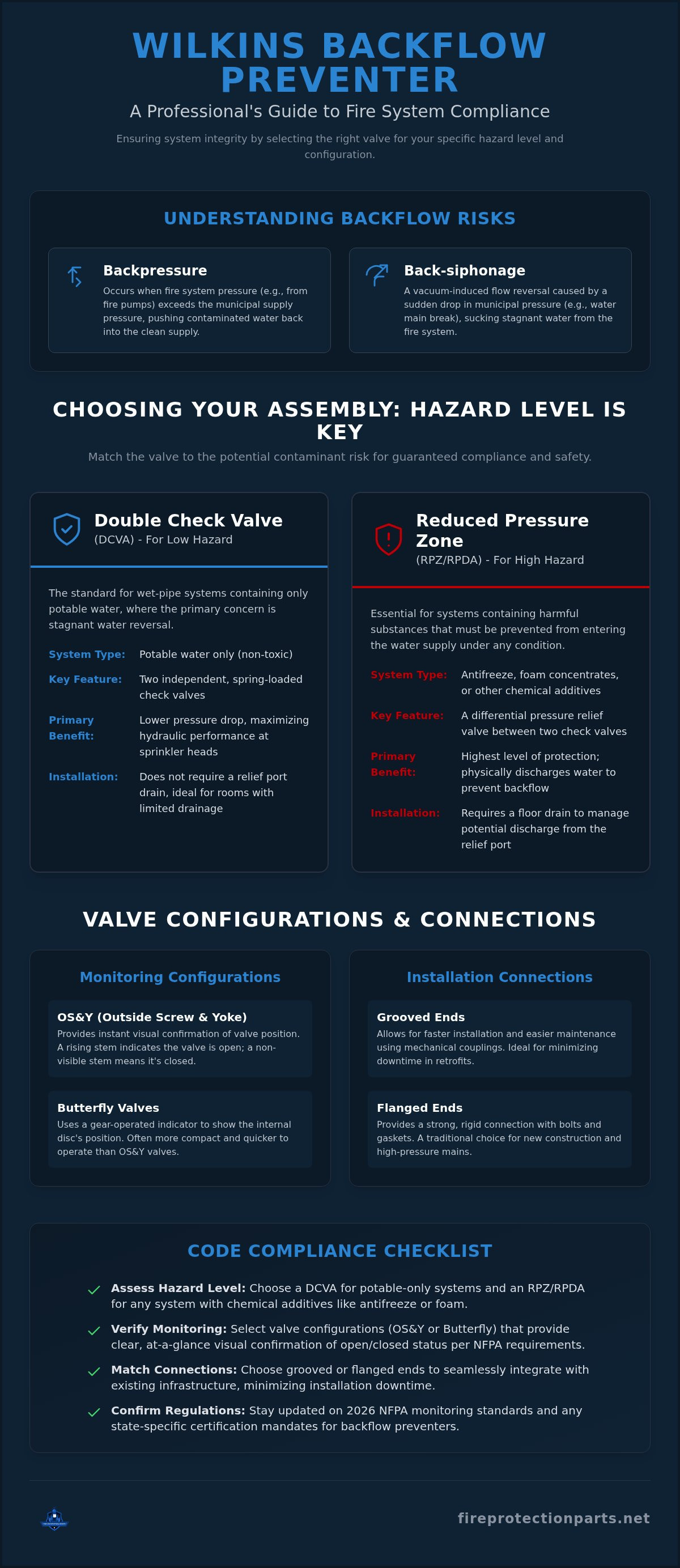
Understanding how water reverses flow is the first step in selecting the right protection. Backpressure occurs when the pressure within the fire system exceeds the supply pressure, often caused by the activation of high-capacity fire pumps. This differential can push stagnant water back through the service connection. In multi-use commercial buildings, these cross-connections represent a significant risk if not properly managed.
Back-siphonage is a vacuum-induced reversal of flow. This happens when a drop in municipal pressure, perhaps due to a nearby water main break or heavy fire department usage, creates a vacuum that sucks water out of the building. Using a high-quality wilkins backflow preventor valve ensures that neither pressure spikes nor vacuum events compromise the water supply.
Why Fire Protection Requires Specialized Backflow Solutions
Standard plumbing valves don't meet the rigorous demands of life safety systems. Fire-rated assemblies must provide minimal hydraulic friction. Every pound of pressure lost across a valve is a pound of pressure that isn't available at the sprinkler head. Maintaining these hydraulic calculations is vital for system performance during a fire event. You can find essential sprinkler system components online to ensure every part of your riser room works in harmony.
Beyond hydraulics, fire-rated Wilkins valves are designed for easy monitoring. They often feature OS&Y (Outside Screw and Yoke) or butterfly valve configurations that allow inspectors to verify the valve's position at a glance. This visibility is a core requirement for modern fire codes, ensuring that the water supply to the sprinklers is never accidentally shut off.
Wilkins DCVA vs. RPZ: Comparing Backflow Assembly Types
Choosing the right wilkins backflow preventor valve starts with a clear assessment of your system's hazard level. In fire protection, this typically falls into two categories: low hazard and high hazard. Low-hazard systems contain only potable water without additives. High-hazard systems contain substances that could be harmful if ingested, such as chemical foam or antifreeze. Regulatory guides like the Maricopa County backflow prevention resources categorize these hazards to ensure local water supplies remain untainted. Understanding these distinctions is vital for code compliance.
The 350AST and 375A series are the workhorses of the Wilkins fire protection line. While they look similar, their internal mechanics serve different safety thresholds. Selecting the wrong one doesn't just risk a failed inspection; it risks public safety. You must match the assembly type to the specific fluids present in your sprinkler lines to ensure total system security.
When to Choose a Double Check Assembly (DCA)
Double Check Valve Assemblies (DCVA) are the standard for wet-pipe systems that use only potable water. These assemblies consist of two independently acting, spring-loaded check valves. The Fire Protection Double Check Valve Zurn Wilkins DCV is favored for its lower pressure drop, which is critical for maintaining hydraulic performance at the sprinkler head. Unlike other models, a DCVA doesn't require a dedicated relief port drain. This makes it easier to install in riser rooms where floor drainage is limited. It's an efficient, reliable solution for non-toxic environments where the only concern is stagnant water reversal.
The Necessity of Reduced Pressure Detector Assemblies (RPDA)
Systems utilizing anti-freeze for fire sprinkler systems or foam concentrates require the highest level of protection. This is where the Reduced Pressure Zone (RPZ) assembly becomes mandatory. The Zurn Wilkins 375A Reduced Pressure Detector Assembly features a hydraulic relief valve positioned between two check valves. If either check valve fails, the relief valve opens to discharge water, ensuring that backflow cannot occur. This fail-safe mechanism provides an extra layer of security in high-hazard zones where contamination would be catastrophic.
When sourcing these components, you must account for the specific monitoring requirements of your local fire code. You can explore our full inventory of Wilkins backflow assemblies to find the exact configuration for your project, whether you need a 2-1/2 inch or a 10 inch industrial main valve.
Valve Configurations: OS&Y vs. Grooved Butterfly Valves
In fire protection, a valve's status is just as critical as its function. Code requirements dictate that control valves must be monitored to ensure they remain in the open position. If a wilkins backflow preventor valve is accidentally closed, the entire sprinkler system is rendered useless. To meet these standards, Wilkins assemblies are configured with either Outside Screw and Yoke (OS&Y) gate valves or Butterfly valves. Both provide clear, tamper-proof signaling for fire panels and physical inspections. Adhering to ASSE International product standards ensures these configurations meet the rigorous safety benchmarks required for life-safety infrastructure.
The Role of OS&Y Valves in Visual Inspection
The OS&Y configuration is the traditional gold standard for fire riser rooms. Its primary advantage is the rising stem. When the valve is open, the threaded stem is visible; when closed, it disappears into the yoke. This provides an immediate, foolproof visual confirmation for facility managers and fire marshals. For large-scale industrial projects, variants like the 10" Reduced Pressure Backflow Valve With Flange OSY are common choices for protecting main water lines. They offer the durability needed for heavy-duty service.
- Reliability: Heavy-duty construction designed for decades of service.
- Monitoring: Easily fitted with tamper switches for electronic supervision.
- Maintenance: You should regularly clean and lubricate the rising stem to prevent corrosion-related seizing. This ensures smooth operation during mandatory annual testing.
Grooved Butterfly Valves for Modern Riser Rooms
Modern construction often leaves little room for sprawling utility setups. Grooved butterfly valves offer a compact alternative to bulky OS&Y gate valves. They're significantly lighter and take up less linear pipe space, making them ideal for tight retrofits or high-rise riser rooms. A popular choice for these applications is the 4" V Pattern RP Grooved Butterfly Valve for Fire Protection. Beyond the space savings, these valves utilize grooved couplings. This allows for a much faster installation compared to traditional flanged connections, reducing labor costs on the job site.
Whether you're performing a new installation or sourcing fire protection parts and hardware for system repairs, choosing the right shut-off configuration is essential. OS&Y valves offer unmatched visual clarity, while butterfly valves provide the agility needed for complex, space-constrained designs. Ensuring your Wilkins backflow assembly matches your specific riser room layout will save time during installation and simplify all future inspections.
How to Select the Right Wilkins Valve for Your Project
Selecting the right wilkins backflow preventor valve involves more than just matching pipe size. It requires a methodical approach to ensure long-term performance and code adherence. A systematic selection process prevents costly installation errors and ensures your facility remains compliant with local fire codes through 2026. Follow these five steps to identify the perfect assembly for your specific application.
- Step 1: Confirm Pipe Diameter. Fire mains typically range from 2-1/2 inch to 10 inch. Selecting the correct size is the foundation of hydraulic efficiency.
- Step 2: Determine Hazard Level. Identify if the system uses only potable water or contains chemical additives. This choice dictates whether you need a DCVA or an RPZ assembly.
- Step 3: Select the Material. Choose between standard epoxy-coated ductile iron or the premium stainless steel (AST) series for enhanced corrosion resistance.
- Step 4: Verify End Connections. Match your existing infrastructure with flanged, grooved, or flange-by-groove (FxG) configurations to minimize labor.
- Step 5: Check for Detector Assemblies. Integrated detector assemblies are essential for identifying water theft or hidden leaks in fire lines.
The Wilkins AST Advantage: Stainless Steel Performance
Corrosive environments demand superior materials that won't scale or degrade over time. The 350AST series utilizes stainless steel to significantly reduce maintenance costs and prevent internal buildup. Beyond durability, these models offer massive weight reduction compared to traditional ductile iron. This makes large-diameter valve installation safer for contractors and easier to manage in elevated riser rooms. AST models utilize a patented 'short-lay' length for easier retrofits in tight spaces where every inch counts.
Sizing and Hydraulic Calculations
Oversizing a backflow preventer is a common mistake that often leads to low-flow fouling and internal debris buildup. You must factor in pressure loss using Wilkins flow charts to ensure the system meets its design pressure at the furthest sprinkler head. This calculation is especially critical when integrating air compressors for dry sprinkler systems. In dry-pipe setups, the air-to-water transition relies on precise pressure differentials. A poorly sized wilkins backflow preventor valve can disrupt this balance and cause system delays during an emergency.
Eliminate the guesswork from your procurement process. You can browse our full range of Wilkins backflow valves to find the exact size and configuration for your next project.
Top Wilkins Backflow Solutions for Fire Safety Professionals
Matching high-performance hardware to your specific facility environment is where engineering theory meets real-world protection. A wilkins backflow preventor valve provides the necessary versatility to handle everything from standard commercial wet-pipe systems to complex industrial mains. Professionals choose these assemblies because they eliminate the guesswork during procurement and provide a reliable barrier against contamination. Whether you're securing a high-rise standpipe or a sprawling warehouse, selecting a model that aligns with your hydraulic demands is the only way to ensure long-term code compliance.
Featured Large-Diameter Wilkins Valves
Large-scale infrastructure requires robust solutions that can handle massive flow volumes without compromising safety. For industrial mains, the 10" Double Check Valve Non Rising Stem Flange stands as the industrial powerhouse. It provides the durability needed for the most demanding supply lines. In more complex systems where space and precision are paramount, the 8" Vpat Reduced Pressure Detector Assembly with OSY Valve offers a streamlined profile without sacrificing monitoring capabilities.
Commercial retrofits often present unique challenges, such as aging pipework and restricted riser rooms. The 6" Reduced Pressure Detector with Grooved Valve has become the go-to solution for these scenarios. Its grooved connections allow for faster assembly in tight spaces, while the integrated detector assembly ensures that any water movement is accounted for. These models provide the flexibility needed to modernize fire protection infrastructure without the need for extensive pipe reconfiguration.
Detector Assemblies for Leak and Theft Prevention
Fire systems often sit dormant for years, making small leaks or unauthorized water usage difficult to identify. Specialized detector assemblies, such as the Zurn Wilkins Fire Double Detector Check Valve Grooved Butterfly, solve this problem. These units feature a bypass meter that records low-flow water usage. This helps facility managers identify small leaks before they compromise system pressure or lead to significant water damage. Using these assemblies provides an extra layer of cost control and system oversight that standard valves cannot offer.
Every component in your riser room must work in harmony to meet life-safety standards. This includes ensuring your valve selection is compatible with your fire sprinkler head temperature ratings and overall system pressure requirements. Using the wrong valve can lead to hydraulic imbalances that prevent sprinklers from performing as intended. To ensure you have the right hardware for your specific project, you should browse the full Wilkins Backflow Preventor Valve Collection for all available size and valve variants.
Securing Your Fire Protection Infrastructure for 2026
You now have the technical foundation to select a wilkins backflow preventor valve that balances hydraulic efficiency with strict code compliance. Whether you are managing high-hazard systems requiring RPZ protection or standard wet-pipe configurations, the right hardware ensures your facility remains secure. It's essential to match your valve configuration to your specific riser room layout. Choosing OS&Y for visual clarity or Butterfly valves for space savings is critical for long-term monitoring and maintenance.
We provide a comprehensive range of code-compliant assemblies for NFPA 13 systems. Our inventory includes sizes from 2-1/2 inch to 10 inch in stock, featuring multiple configurations like OS&Y, Butterfly, and NRS to meet any engineering specification. Don't leave your system's integrity to chance.
Shop the Complete Wilkins Backflow Preventor Valve Collection to secure your facility today. Take the guesswork out of fire safety procurement and build a system that stands the test of time.
Frequently Asked Questions
What is the difference between a Wilkins 350 and 375 series valve?
The primary difference is the level of hazard protection they provide. The 350 series is a Double Check Valve Assembly (DCVA) suited for low-hazard applications where no toxic chemicals are present. The 375 series is a Reduced Pressure Zone (RPZ) assembly designed for high-hazard environments. It includes a hydraulic relief valve that discharges water if a check valve fails. This makes the 375 mandatory for systems using antifreeze or foam.
Does my fire sprinkler system require a Reduced Pressure Zone (RPZ) assembly?
Your system requires an RPZ if it contains high-hazard substances like chemical foam or antifreeze. These additives pose a significant health risk if they backflow into the potable water supply. Standard wet-pipe systems using only water typically require a Double Check Valve Assembly instead. You should consult your local water authority and NFPA 13 guidelines to confirm the specific wilkins backflow preventor valve required for your building's hazard classification.
Can I replace an old Wilkins backflow preventer with a new 350AST model?
You can certainly use the 350AST as a drop-in replacement for older assemblies. It's specifically engineered with a 'short-lay' length to match the footprint of many legacy ductile iron models. The stainless steel body provides exceptional corrosion resistance and is significantly lighter than older versions. This weight reduction makes the installation process safer and faster for contractors working in tight riser rooms or elevated mechanical spaces.
Why are OS&Y valves required on fire protection backflow assemblies?
Fire codes require OS&Y valves because they provide an immediate visual confirmation of the water supply status. The rising stem design allows facility managers and inspectors to see from a distance whether the valve is open or closed. If the threaded stem is visible, the system is ready for service. This physical indicator is more reliable than internal mechanisms and ensures that the water supply to sprinklers is never accidentally left shut.
How often should a Wilkins backflow preventer be tested in a fire system?
You must have your wilkins backflow preventor valve tested at least once per year. Annual testing is a standard requirement for NFPA compliance and local water authority regulations. These tests must be conducted by certified professionals to verify that the check valves and relief ports are functioning correctly. Regular inspections are the only way to identify internal fouling or spring fatigue before they lead to a system failure or water contamination event.
What is a 'V-Pattern' backflow preventer and when should I use one?
A V-Pattern assembly is a specialized configuration where the check valves are arranged in a vertical 'V' shape. This design is ideal for space-constrained riser rooms where horizontal space is limited. It provides the same high level of protection as standard assemblies but takes up much less linear pipe distance. You should choose this pattern when working in tight mechanical closets or high-rise buildings where utility space is at a premium.
Are Wilkins backflow valves lead-free for potable water connections?
Wilkins manufactures these valves to meet all current lead-free standards for potable water connections. This compliance ensures that the materials used won't leach harmful substances into the drinking water supply. It's a critical feature for assemblies installed in multi-use commercial buildings where fire lines and domestic water lines often share the same municipal main. Choosing lead-free hardware satisfies both health department requirements and the Safe Drinking Water Act.
What is the benefit of a Double Detector Check Valve (DDCV) over a standard DCA?
The main benefit is the ability to monitor for water theft and small leaks. A Double Detector Check Valve features a bypass assembly with a small water meter. This meter records any low-flow water movement that occurs while the system is supposed to be dormant. While a standard DCA only stops backflow, the detector version provides facility managers with the data needed to identify hidden system leaks or unauthorized water usage before they become costly.

