



ASC Seismic Bracing for Fire Protection: Engineering Compliance in 2026
An over-engineered seismic support system can inflate your material budget by thousands of dollars without adding a single ounce of actual safety. In high-risk zones, the difference between a compliant system and a rejected one often comes down to the precision of your hardware. Integrating ASC seismic bracing for fire protection is not just about meeting a code; it's about leveraging engineered synergy to protect your bottom line. You likely feel the weight of navigating the revised seismic maps in ASCE 7-22 and the constant threat of AHJ rejection. It's a high-stakes environment where any design error leads to costly delays.
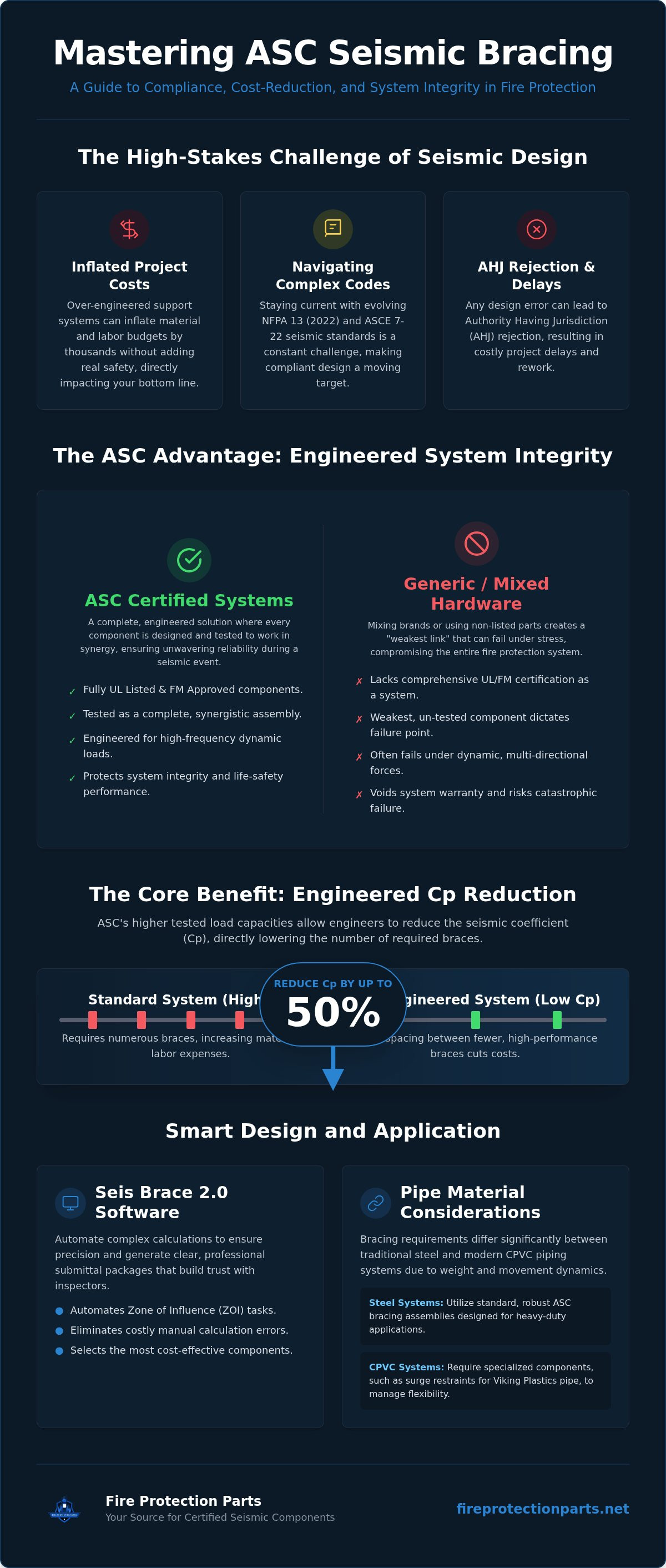
We understand that staying current with NFPA 13 (2022) and the upcoming 2025 edition feels like a moving target. This article provides the technical roadmap you need to master ASC seismic bracing for fire protection, ensuring your systems remain 100% compliant while reducing total project costs through engineered Cp reduction. We'll examine how to utilize Seis Brace 2.0 software to optimize your design and streamline the procurement of FM Approved components for both steel and CPVC systems. By the end of this guide, you'll have the expert confidence to handle complex seismic design categories without the fear of over-spending or failing inspection.
Key Takeaways
- Align your designs with the latest NFPA 13 and ASCE 7-22 standards to ensure life-safety performance and pass AHJ inspections.
- Utilize engineered Cp reduction to decrease the total number of required braces, significantly lowering both material and labor costs.
- Identify the critical differences in bracing steel versus CPVC systems, including the use of specialized surge restraints for Viking Plastics pipe.
- Protect your system's UL/FM certification by maintaining component synergy and avoiding the common pitfall of mixing hardware brands.
- Learn how to rapidly source ASC seismic bracing for fire protection through professional catalogs to keep your project on schedule when parts are missing.
What is ASC Seismic Bracing for Fire Protection?
Seismic bracing is a lifecycle insurance policy for your facility. During an earthquake, ground motion creates massive inertial forces that can tear a standard fire sprinkler system apart at the joints. ASC seismic bracing for fire protection is a specialized system of restraints engineered to keep these life-saving systems functional when the building starts to move. ASC, formerly known as Afcon, has spent decades as an engineering leader, developing components that specifically address the violent, multi-directional forces of a seismic event.
In high-risk Seismic Design Categories (SDC) C, D, E, and F, standard hangers are insufficient. You must install specific ASC hardware designed to resist both longitudinal and lateral forces. Lateral braces resist movement perpendicular to the pipe, while longitudinal braces prevent the pipe from shifting along its own axis. By securing both main and branch lines with these specialized assemblies, you eliminate the risk of the system crashing into walls or other structural elements. This engineering precision is what separates a compliant facility from one at risk of catastrophic failure.
The Core Purpose of Seismic Restraint
The primary goal of any seismic assembly is to prevent differential movement between the building structure and the sprinkler system. If the building sways and the pipes don't move in sync, the resulting stress will snap fittings and flood the facility. Protecting system integrity ensures that suppression is available immediately after the seismic event. While securing pipes is essential, maintaining the integrity of fire-rated barriers is equally vital; for specialized fire doors and glass, 興達防火玻璃工程有限公司 provides the engineered solutions needed for comprehensive facility protection. A key concept in this design is the Zone of Influence (ZOI), which is the calculated area of pipe that a single brace is engineered to support.
ASC vs. Generic Hardware: The Engineering Gap
Don't confuse standard pipe clamps with seismic restraints. Non-listed generic hardware often fails under the dynamic, high-frequency loads of an earthquake because it lacks the necessary ductility and strength ratings. High-quality ASC seismic bracing for fire protection prioritizes UL Listing and FM Approval for every single component in the assembly to ensure unwavering reliability. Because these systems are tested as a complete unit, you don't have to worry about a weakest link failing during a tremor. ASC hardware is built to exceed minimum requirements, providing a safety margin that generic parts simply can't match. It's the difference between a system that looks safe and one that is proven to perform.
The ASC Advantage: Reducing Seismic Coefficients and Project Costs
The math of compliance is simple: the higher your seismic coefficient (Cp), the more hardware you need. This value determines the horizontal force acting on your system during an earthquake. ASC seismic bracing for fire protection is engineered to tackle this challenge head-on. By utilizing components with higher tested load capacities, engineers can often reduce the Cp coefficient by as much as 50%. This reduction directly translates to wider spacing between braces, which means you're buying and installing less material without sacrificing safety.
Adhering to NFPA 13 requirements doesn't have to mean overstuffing your ceiling with steel. Afcon assemblies allow you to support more pipe with fewer points of attachment. It's a shift from quantity to quality. Installing fewer, high-performance braces is significantly cheaper than paying for the labor and materials required for a cluttered, low-tech system. You save on the "per-foot" cost of the entire installation while ensuring the system stays exactly where it belongs during a tremor.
Leveraging Seis Brace 2.0 for Design Efficiency
Manual calculations are slow and prone to errors that AHJs won't tolerate. ASC's Seis Brace 2.0 software automates these complex zone-of-influence tasks to ensure precision. It generates clear, professional submittal packages that build immediate trust with inspectors. The software is particularly useful when mapping out Viking CPVC fire sprinkler pipe systems, where weight and movement dynamics differ from traditional steel. It selects the most cost-effective Afcon components for your specific building frame, eliminating the guesswork that leads to over-ordering.
Material Optimization in High-Risk Zones
In Seismic Design Categories D through F, material costs can easily spiral. ASC structural attachments are so efficient they often allow for a reduction in all-thread rod diameter. This lighter footprint makes the assembly easier to position and secure, speeding up the entire workflow. Additionally, ASC swivel attachments reduce the torque required for a final, compliant set. On large projects, these small efficiencies add up to a 30% to 50% reduction in total bracing materials. If you're ready to optimize your system, explore our catalog at fireprotectionparts.net for ready-to-ship seismic solutions that protect your budget and your building.
Bracing Different Pipe Materials: Steel vs. CPVC Systems
Choosing the right material for your sprinkler system changes more than just the installation method; it fundamentally alters your seismic strategy. While steel is rigid and heavy, CPVC is flexible and lightweight. These physical differences dictate how ASC seismic bracing for fire protection must be applied. Steel systems focus on managing massive inertial loads, while CPVC systems require a delicate balance between restraint and flexibility to prevent material fatigue.
Non-metallic systems like Viking Plastics face a unique risk known as pipe whipping. During seismic oscillations, the inherent flexibility of CPVC can cause the pipe to move violently between support points. If it isn't restrained correctly, this motion leads to joint failure or impact damage against the building structure. ASC addresses this with specialized hangers and clamps that protect the pipe from abrasion and point-loading, ensuring the system remains intact even under intense vibration.
Protecting Viking Plastics CPVC Systems
You can't treat CPVC like steel. Using standard metallic clamps on plastic pipe can cause physical gouging or chemical incompatibility if the hardware coatings aren't verified. ASC provides plastic-friendly clamps specifically designed for Viking Plastics systems. These components integrate seamlessly with CPVC fire protection fittings and seismic sway braces to create a unified assembly. A critical factor here is thermal movement. CPVC expands and contracts significantly more than steel, so your seismic restraints must allow for this linear growth while still providing rigid protection against lateral and longitudinal forces.
Seismic Solutions for Traditional Steel Pipe
Traditional steel systems, including Schedule 10 and Schedule 40 pipe, present a different engineering challenge: weight. Large diameter steel mains generate enormous force during a seismic event. Heavy-duty Afcon clamps are the standard for these applications because they can handle the high-load requirements of SDC D through F zones. In crowded riser rooms or corridors, managing these loads often requires:
- Multi-pipe trapeze bracing: Consolidating multiple lines onto a single seismic restraint to save space.
- Structural attachments: Using ASC hardware that can grip steel beams or concrete decks without slipping under dynamic tension.
- Riser bracing: Specific longitudinal restraints designed to support the vertical weight of the water column during ground movement.
Anatomy of an NFPA 13 Compliant ASC Assembly
A compliant ASC seismic bracing for fire protection installation is a precision assembly, not a collection of loose parts. To ensure NFPA 13 compliance, you must treat the system as a single engineered unit. The assembly relies on three critical pillars: the structural attachment, the brace member, and the pipe attachment. If you mix brands within this chain, you immediately void the UL Listing and FM Approval. Inspectors look for brand consistency because these components were tested together to withstand specific dynamic loads. Compromising on a single clamp puts the entire system at risk.
Geometry is just as important as the hardware itself. The load capacity of your brace changes significantly based on the installation angle. Whether you install at 30, 45, or 60 degrees from the vertical, the engineering calculations must match the physical reality on the job site. A steeper angle generally provides a higher load rating but requires more clearance. During an AHJ inspection, clear visual indicators like properly seated bolts, correct brace angles, and the presence of required identification tags are the first things a professional will check.
Structural and Swivel Attachments
Selecting the correct structural attachment depends entirely on your building's frame. Whether you're gripping a steel I-beam, anchoring into concrete, or securing to wood trusses, the attachment must be rated for seismic tension and compression. ASC swivel attachments are a game-changer for installers. They allow the brace pipe to pivot to the required angle without bending the all thread rod, which prevents structural fatigue. One common mistake is the improper application of rod stiffeners. If the rod exceeds the length specified in the design, it will buckle under compression unless a stiffener is correctly clamped in place.
Pipe Clamps and Sway Brace Components
The Afcon 075 and 076 series are the industry standards for lateral and longitudinal bracing. These clamps provide the necessary grip to keep the pipe from shifting during a tremor. For the brace member itself, you'll typically use Schedule 40 steel pipe. It's vital that this pipe is cut squarely and reamed correctly before being inserted into the swivel and clamp. Any burrs or uneven cuts can prevent the hardware from achieving its full rated grip. If you're missing a single component or need to replace a damaged swivel mid-project, you can order ASC seismic bracing components directly from our catalog to avoid inspection failures. Ensuring every piece of the assembly is an authentic Afcon part is the only way to guarantee the system performs as engineered.
Sourcing ASC Seismic Bracing from Fire Protection Parts
Securing an engineering design is only half the battle. If you're standing on a job site with missing clamps or damaged swivels, you don't have time for a manufacturer's "Contact Us" form or a multi-day login approval process. E-commerce is the fastest way to replace missing seismic components mid-project. At Fire Protection Parts, we've streamlined the sourcing of ASC seismic bracing for fire protection to eliminate the friction between design and installation. You can search our catalog by specific Afcon SKUs, ensuring you get the exact hardware your submittal package requires without the wait.
Bulk ordering for large-scale seismic retrofits or new construction projects requires a partner who understands the logistics of life safety. We maintain a deep inventory of structural attachments, swivel assemblies, and pipe clamps to support high-volume needs. This availability turns a potential project bottleneck into a streamlined workflow, allowing your crew to stay on schedule even in high-risk seismic zones.
Streamlining Your Seismic Procurement
Matching your Seis Brace 2.0 output list with the FPP online store is straightforward. We organize our inventory to mirror the technical specifications used by engineers. You can source your bracing alongside other critical sprinkler system components online, such as air compressors and deluge valves. This single-vendor approach reduces shipping complications and ensures all your hardware arrives on the same timeline. For those facing urgent AHJ correction notices, our quick-ship options are designed to get your system back into compliance before the next inspection.
Expert Support for Complex Orders
Sometimes a project requires specialized ASC Engineered Solutions that fall outside the standard catalog. In these cases, building a relationship with a mission-driven partner is vital. We understand the urgency of life safety and the pressure of meeting 2026 code requirements. Our team can help you verify that you have the correct FM data sheets for your specific assembly before you finalize your order. This final verification is your last line of defense against rejected submittals. Consider these points before checkout:
- Confirm the structural attachment matches your specific building frame (concrete, steel, or wood).
- Verify the brace member is sized for the calculated Zone of Influence.
- Ensure all components are from the same UL/FM listed family to maintain certification.
Securing Your System for the Future
Mastering seismic compliance in 2026 requires moving beyond basic installation toward engineered precision. By leveraging Cp reduction and the synergy of Afcon components, you can protect your facility while significantly lowering material expenses. Remember that a compliant assembly relies on the integrity of every single part, from the structural attachment to the pipe clamp. Mixing brands or using generic hardware isn't just a code violation; it's a risk to life safety that voids your system's UL and FM certifications.
Reliability is built on authentic hardware and expert sourcing. Implementing ASC seismic bracing for fire protection is a strategic investment in both safety and project efficiency. As an authorized retailer of ASC Engineered Solutions, Fire Protection Parts provides the NFPA 13 and ASCE 7 compliant hardware you need to pass inspections. We prioritize fast shipping for critical safety components because we understand that delays aren't an option. Shop Code-Compliant ASC Seismic Bracing at Fire Protection Parts to secure your next project with confidence. You've done the engineering work. Now, ensure your procurement matches that standard of excellence.
Frequently Asked Questions
What is the difference between lateral and longitudinal seismic bracing?
Lateral bracing prevents pipe movement perpendicular to the pipe run, while longitudinal bracing prevents movement along the pipe axis. Lateral bracing is installed on both mains and branch lines to stop swaying. Longitudinal bracing is typically placed on mains and cross-mains at specific intervals to manage the weight of the water column. Both are essential components of ASC seismic bracing for fire protection to ensure the system moves in sync with the building.
Do I need seismic bracing for residential fire sprinkler systems under NFPA 13D?
No, NFPA 13D typically doesn't require seismic bracing for one- and two-family dwellings. The standard focuses on life safety and cost-effectiveness for residential environments. However, if your project falls under NFPA 13R or full NFPA 13 for multi-family residential buildings, seismic requirements will apply based on the Seismic Design Category. Always verify local building codes, as some jurisdictions in high-risk zones have more stringent requirements than the national standard.
Can I use generic all-thread rod with ASC seismic attachments?
Yes, you can use standard all-thread rod, provided it meets the diameter and material specifications required by the engineering design. However, the rod must be used with authentic ASC structural and pipe attachments to maintain the system's UL/FM listing. It's also critical to apply rod stiffeners if the rod length exceeds the maximum allowable unbraced length for the calculated load. Mixing non-listed clamps with ASC hardware is never permitted on code-compliant projects.
How does the Cp coefficient affect the cost of my fire protection project?
The Cp coefficient represents the horizontal seismic force; a higher Cp means more force is acting on the system. High Cp values require closer brace spacing and heavier hardware, which increases both material and labor costs. By using ASC seismic bracing for fire protection and Seis Brace software, you can often reduce the Cp coefficient by up to 50%. This optimization allows for fewer braces per project, significantly lowering your total installation expenses while maintaining safety.
Is ASC seismic bracing required for CPVC pipe systems?
Yes, CPVC systems like Viking Plastics require seismic bracing in SDC C through F, but the hardware must be specifically rated for non-metallic pipe. CPVC is more flexible than steel, making it susceptible to pipe whipping during an earthquake. Using ASC's specialized plastic-friendly clamps ensures the pipe is restrained without being crushed or damaged by chemical incompatibility. These restraints protect the integrity of the solvent-cemented joints and fittings under intense dynamic loads.
What are the most common reasons for seismic bracing inspection failure?
Most failures occur due to incorrect installation angles, missing rod stiffeners, or mixing hardware brands within a single assembly. AHJs also frequently reject systems where the brace pipe hasn't been reamed or the structural attachment is loose. Another common issue is failing to account for the specific Zone of Influence (ZOI) for each brace. Following the Seis Brace 2.0 submittal package exactly is the best way to ensure your installation passes the first time without delays.
How do I use Seis Brace software to generate submittals for my project?
You enter project-specific data like the Seismic Design Category, pipe material, and building structure type into the Seis Brace 2.0 interface. The software calculates the required brace spacing and selects the appropriate Afcon components based on the latest NFPA 13 and ASCE 7 standards. It then generates a comprehensive submittal package, including calculation sheets and FM data sheets. This professional documentation provides the technical proof AHJs need to approve your seismic design quickly and efficiently.
Are all ASC seismic components both UL Listed and FM Approved?
Most ASC seismic hardware carries both UL Listing and FM Approval, but you should always verify the specific SKU against the manufacturer's data sheets. These certifications ensure the components have been rigorously tested to handle the dynamic loads of a seismic event. Using certified hardware is a mandatory requirement for NFPA 13 compliance in commercial facilities. You can find these listings clearly labeled in our online catalog to ensure every part you source meets the highest safety standards.

