



4000B-2 Ames Backflow Preventer: The 2026 Guide to Specs, Repair, and Compliance
Installing the wrong repair kit on a backflow preventer isn't just a minor maintenance error. It's a liability that compromises your entire fire suppression system. When managing complex riser configurations, you face the constant pressure of maintaining compliance with ASSE 1013-2026 standards. You must know exactly how your components integrate with seismic bracing for fire sprinkler systems to prevent failure during a seismic event. It's frustrating when you can't distinguish between a check valve kit and a relief valve kit, or when you're unsure if a Watts 009 part will actually seat correctly in your Ames 4000B-2 assembly.
We know that downtime isn't an option when lives and property are on the line. This guide promises to eliminate the guesswork by providing a masterclass on the technical specifications and maintenance requirements of the Ames 4000B-2. We'll break down the internal similarities to the Watts 009 series, clarify pressure drop concerns, and ensure you identify the exact code-compliant parts needed for a successful repair. We are going to cover everything from July 2026 USC FCCCHR approvals to lead-free SKU variations, giving you the confidence to keep your fire riser room fully operational.
Key Takeaways
- Understand the performance limits of the 2-inch bronze RPZ, including its 175 psi maximum working pressure and wide operating temperature range.
- Simplify your maintenance schedule by identifying the specific components within a 4000B-2 Rubber Total kit required for annual service.
- Ensure full code compliance by mastering the installation orientation and clearance rules that affect seismic bracing for fire sprinkler systems.
- Leverage parts interchangeability between Ames and Watts models to maintain a flexible and cost-effective repair inventory.
- Evaluate the long-term cost-benefit of individual component repairs versus full assembly replacements for high-hazard fire suppression lines.
Understanding the Ames 4000B-2 Reduced Pressure Zone Assembly
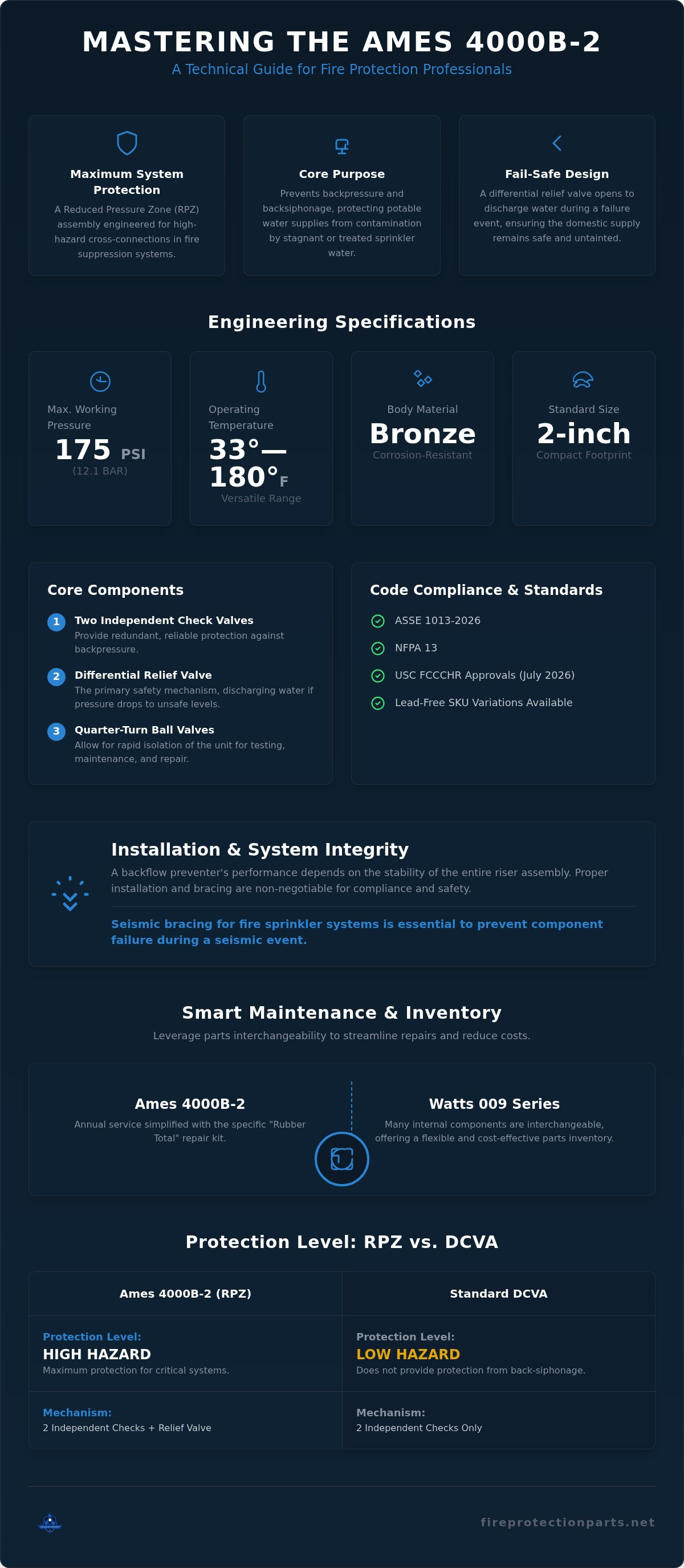
The Ames 4000B-2 is a 2-inch bronze powerhouse engineered for one purpose: total system protection. It operates as a Reduced Pressure Zone Assembly, specifically designed to handle high-hazard cross-connections where the risk of backflow into the potable water supply is high. In the fire protection industry, reliability isn't a luxury. It's a code requirement. This assembly features two independent check valves and a relief valve that work in tandem to provide maximum safety against backpressure and backsiphonage. If a pressure differential occurs, the relief valve opens to discharge water, ensuring the domestic supply remains untainted.
Maintenance shouldn't be a struggle for facility managers or contractors. The 4000B-2 is equipped with quarter-turn ball valve shutoffs, allowing technicians to isolate the unit quickly for testing or repair. While the valve itself is robust, its performance depends on the integrity of the entire riser. This is where seismic bracing for fire sprinkler systems becomes essential. A backflow preventer can only do its job if the surrounding piping remains stable during a seismic event. Ensuring your 4000B-2 is part of a braced, code-compliant assembly is the only way to guarantee long-term protection and peace of mind.
Core Components of the 4000B-2 Series
The bronze body construction isn't just about weight. It's about surviving decades of service without succumbing to corrosion. Inside, the check modules are optimized for high flow and low pressure drop. This is critical because every pound of pressure matters in a fire suppression scenario where flow rates must meet strict hydraulic calculations. The integrated sensing line and relief valve mechanism ensure that any failure is met with an immediate atmospheric discharge. It's a fail-safe design that prioritizes safety over everything else. These internal components are designed for easy access, making it simple to replace rubber parts without removing the entire unit from the line.
Typical Applications in Fire Protection
You'll primarily find the 4000B-2 isolating fire sprinkler systems from domestic water lines. It's a staple in commercial riser rooms and residential high-hazard zones where chemical additives or stagnant water pose a risk to the public. Successful integration requires a complete strategy for sourcing sprinkler system components online. When you combine this assembly with the correct seismic bracing for fire sprinkler systems, you create a resilient infrastructure that meets both NFPA 13 and local health department standards. Whether you're outfitting a new build or retrofitting an existing riser, this assembly provides the professional assurance that your water supply is protected against the unexpected.
Engineering Specifications and Performance Data
The Ames 4000B-2 is built for high-stakes environments where failure isn't an option. It supports a maximum working pressure of 175 psi (12.1 bar), making it a reliable choice for high-pressure fire risers. It handles operating temperatures ranging from 33°F to 180°F. This versatility ensures consistent performance in both unheated mechanical rooms and high-temperature industrial settings. Its compact footprint is a major advantage for modern construction. When space is limited in a riser closet, every inch matters. It's the foundation of a safe, space-efficient installation.
Pressure Drop and Flow Characteristics
In fire suppression, every PSI counts. The 4000B-2 is engineered to minimize friction loss while maintaining a high-volume output. Analyzing the pressure drop across the assembly is critical for accurate hydraulic calculations. At high GPM flow rates, this RPZ maintains efficiency that often exceeds standard double check valve assemblies (DCVA). While a DCVA might offer lower initial pressure loss, it doesn't provide the same level of protection for high-hazard cross-connections. The 4000B-2 ensures that even during a peak demand event, the system delivers the necessary water volume to the sprinkler heads. When designing these systems, you must also account for the structural integrity of the piping. Utilizing ASC seismic bracing secures the riser against mechanical stress and ensures the valve remains seated correctly during an emergency.
Material Standards and Lead-Free Compliance
Reliability starts with the metallurgy. The standard 4000B-2 features a heavy-duty bronze body designed to withstand years of pressurized service. However, for systems tied to potable water lines, the LF4000B-2 lead-free model is the industry standard. These units adhere to strict industry standards for backflow prevention, including AWWA C511 and ASSE 1013. Verification of UL and FM approvals is non-negotiable for fire service applications. These certifications confirm the device can withstand the rigorous demands of a fire event without compromising flow. Beyond the valve itself, ensure the entire assembly is supported by seismic bracing for fire sprinkler systems to meet NFPA 13 requirements. This holistic approach to compliance eliminates doubt and protects your facility from both water contamination and structural failure during an earthquake.
Maintenance and Repair: Selecting the Right Kits
Annual maintenance is the frontline of fire safety. For the Ames 4000B-2, this process begins with the Rubber Total kit. This comprehensive package includes all the diaphragms, O-rings, and disc assemblies needed to refresh the entire unit. Using a total kit instead of piecemealing repairs ensures that every seal is pressurized at the same lifecycle. It eliminates the risk of a secondary failure just weeks after a partial repair. When you perform these services, you aren't just swapping rubber. You're ensuring the assembly meets the rigorous demands of NFPA standards.
Troubleshooting relief valve discharge is a common challenge for facility managers. If you see intermittent dripping, it's often caused by a small piece of debris caught in the first check valve. However, a constant, heavy discharge usually signals a relief valve seal failure or a significant pressure fluctuation. Before ordering parts, flush the system to rule out simple sediment. If the discharge persists, it's time for a rebuild. While the valve is open for service, it's also the ideal time to inspect the seismic bracing for fire sprinkler systems that supports the riser. Vibrations from unbraced pipes can lead to premature wear on internal valve components.
Essential 4000B-2 Repair Kits
Specific failures require targeted solutions. The ARK 4000B-CK1 and CK2 kits focus on the internal check modules. These kits replace the seals that prevent backflow between the zones. If your testing reveals an external leak, the problem is often a compromised cover O-ring or a cracked retainer. For relief valve issues, the ARK 4000B-RV kit provides the specific rubber parts needed to stop unwanted atmospheric discharge. Always use genuine factory parts. Third-party components lack the verified tolerances required to maintain UL and FM approvals during a high-pressure fire event.
The Ames and Watts Interchangeability
One of the biggest advantages of the Ames 4000B-2 is its internal architecture. It's identical to the Watts 009M2 series. This means the internal repair modules and rubber kits are completely interchangeable. This cross-compatibility is a lifesaver when you're facing tight deadlines. If an Ames-branded kit is out of stock, a Watts 009M2 kit will seat perfectly and maintain the same performance specifications. Standardizing your inventory with these interchangeable parts reduces downtime and simplifies procurement. For rapid response, sourcing your fire protection parts online allows you to keep the necessary kits on hand before an emergency occurs. Combining this inventory strategy with compliant seismic bracing for fire sprinkler systems ensures your entire fire riser remains a reliable, immovable safety barrier.
Installation Requirements for Fire Riser Rooms
Proper layout in a fire riser room prevents future maintenance headaches. The Ames 4000B-2 requires specific placement to function correctly and remain accessible for mandatory inspections. Maintain a minimum of 12 inches of clearance from walls and other obstructions. This space is essential for technicians to connect differential pressure gauges and perform annual testing without restriction. While the 4000B-2 is typically installed in a horizontal orientation, always verify local code requirements if your project considers a vertical configuration. Improper orientation can lead to relief valve malfunctions or trapped air pockets that compromise system integrity.
Management of the relief valve discharge is a safety priority. In a high-pressure event, the relief valve will discharge significant volumes of water to protect the potable supply. This line must be piped to a floor drain with an appropriate air gap. Never hard-pipe the discharge directly into a sewer line. An air gap prevents cross-contamination and allows for visual monitoring of the valve health. If you see water in the drain, you know the system needs attention. Integrating this assembly with the main fire system riser and control valves creates a cohesive safety barrier that protects both the building and the public water supply.
Supporting the Assembly: Hangers and Bracing
Secure mounting is the only way to prevent structural failure. Use heavy-duty all-thread rod for overhead support in mechanical rooms. This hardware prevents the weight of the water-filled bronze body from putting undue stress on the pipe joints. The entire riser must also adhere to strict standards for seismic bracing for sprinkler systems. In seismically active zones, unbraced piping can swing during an earthquake, shearing the backflow preventer right off the line. Implementing robust seismic bracing for fire sprinkler systems ensures the assembly stays fixed. It protects the mechanical integrity of the riser when it's needed most.
Testing and Commissioning
Installation is only complete once the unit is commissioned according to NFPA 25. This standard mandates annual testing to verify that the check valves and relief valves operate within specified pressure ranges. Technicians utilize the four integrated test cocks to measure pressure differentials during field tests. Once the test is successful, the unit must be tagged and documented for fire marshal inspections. Accurate record-keeping ensures system uptime and confirms your facility remains in full compliance. For those outfitting a new riser room, you can find code-compliant backflow preventers and mounting hardware ready for immediate dispatch.
Sourcing the 4000B-2 and Replacement Components
Choosing between a repair kit and a full assembly replacement is a strategic decision for any facility manager. For most annual service cycles, a high-quality rubber kit is sufficient to restore the 4000B-2 to factory specifications. However, if the internal bronze seating is pitted or the body shows signs of external stress, a full replacement is the only safe choice. Maintaining a consistent maintenance schedule is easier when you order bulk repair kits for multi-facility portfolios. This proactive approach minimizes per-unit costs and ensures you always have the necessary hardware on hand for an emergency rebuild. Always verify that any new unit matches the existing 2-inch pipe size and hydraulic flow requirements to avoid system imbalances.
When to Replace the Entire Assembly
Irreparable damage often comes from hard water scaling or severe internal erosion that prevents check modules from seating correctly. If your facility is moving toward lead-free compliance, upgrading to the LF4000B-2 model is a logical step during a major system overhaul. While focusing on the backflow preventer, don't overlook adjacent safety components. Ensuring you have the correct fire sprinkler head temperature ratings for your specific environment is just as critical as the valve itself. A failed backflow preventer or an incorrectly rated head can both lead to catastrophic system failure. If the valve body shows signs of structural fatigue or stripped threads, stop the repair and replace the entire assembly to maintain the integrity of the riser.
Professional Procurement at Fire Protection Parts
Fire Protection Parts serves as an authorized master distributor and a mission-driven partner for contractors. We provide verified, code-compliant hardware that eliminates the risk of using counterfeit or substandard components. Our inventory includes everything from the 4000B-2 assembly to the specific seismic bracing for fire sprinkler systems required by NFPA 13. We understand that downtime represents a significant life-safety risk. That's why our fulfillment process is designed for speed and accuracy. You get the right parts the first time, backed by professional technical support that understands the granular details of fire suppression hardware.
Our team provides punchy, direct support for technical product inquiries and troubleshooting. We don't just sell parts; we provide the professional assurance that your system is built to last. By combining high-performance Ames assemblies with robust seismic bracing for fire sprinkler systems, you eliminate doubt and ensure your facility remains in full compliance. Whether you are managing a single residential riser or a massive commercial complex, our rapid fulfillment keeps your life safety systems operational and your building protected.
Securing Your Fire System’s Long-Term Reliability
Maintaining a fire suppression system is about eliminating variables. The Ames 4000B-2 stands as a primary defense for your water supply, but its effectiveness depends on your commitment to code-compliant maintenance. You now have the technical roadmap to identify specific repair kits, leverage the interchangeability of Watts 009M2 parts, and ensure your installation meets strict clearance standards. Remember that a backflow preventer is only as strong as its foundation. Integrating your assembly with proper seismic bracing for fire sprinkler systems is the final step in securing a resilient riser that survives both pressure surges and seismic activity.
Don't leave your facility's safety to chance. As an Authorized Distributor of Ames Fire & Waterworks, we provide the expert technical support and in-stock inventory you need for immediate repairs. Whether you're performing an annual rebuild or a full system upgrade, we have the hardware ready to ship. Order Ames 4000B-2 Repair Kits and Assemblies Now to keep your life safety systems operational and compliant. You've done the hard work of mastering the specs; now take the final step to protect your building with confidence.
Frequently Asked Questions
Is the Ames 4000B-2 the same as the Watts 009M2?
Yes, the Ames 4000B-2 and the Watts 009M2 share identical internal architectures. Because Ames is a subsidiary of Watts, these models use the same check modules and rubber repair kits. This interchangeability allows you to source parts from either brand to maintain your system. Always verify the specific model suffix, such as M2, to ensure exact fitment during a rebuild. This cross-compatibility simplifies inventory management for large facilities.
Why is my 4000B-2 relief valve constantly dripping or discharging?
Constant discharge usually indicates debris is trapped in the first check valve or the relief valve seat is compromised. If the first check fails to close tightly, the zone pressure drops, triggering the relief valve to open. Intermittent dripping might be caused by supply pressure fluctuations. Clean the internal seats first. If the leaking continues, replace the rubber components using a genuine Ames repair kit to restore the safety seal.
Can I install the Ames 4000B-2 in a vertical orientation?
The Ames 4000B-2 is primarily designed for horizontal installation to ensure the relief valve functions correctly. Vertical installation is only permitted if the specific model is UL or FM approved for that orientation. Check the identification plate or submittal sheet before mounting. Regardless of orientation, the assembly must be supported by seismic bracing for fire sprinkler systems to prevent structural failure during an earthquake or high-pressure event.
How often does NFPA require testing for the 4000B-2 backflow preventer?
NFPA 25 requires backflow preventers to be tested at least annually by a certified technician. This field test ensures the check valves hold against backpressure and the relief valve opens at the correct differential. You must also test the unit immediately after any repair or internal maintenance. Keep detailed records of these tests for fire marshal inspections to prove your facility remains in full compliance with local safety codes.
What is the difference between the 4000B and the 4000B-LF?
The "LF" designation stands for Lead-Free. While the standard 4000B uses a traditional bronze alloy, the LF version is manufactured with lead-free materials to meet potable water standards. Most modern building codes require the LF model for any system connected to a domestic water supply. The internal repair kits are often the same, but the body construction differs to adhere to the strict 0.25 percent lead requirement for safe drinking water.
Do I need special tools to replace the check valves in a 2-inch Ames assembly?
You don't need proprietary tools to service a 2-inch Ames 4000B-2. The assembly features a single access cover that can be removed with standard wrenches. The check modules are designed for easy removal, and the relief valve is accessible without specialized equipment. This user-friendly design minimizes downtime during annual maintenance. Ensure the piping is secured with seismic bracing for fire sprinkler systems so the valve body doesn't shift while you apply torque.
What is the maximum pressure rating for the 4000B-2?
The Ames 4000B-2 has a maximum working pressure of 175 psi (12.1 bar). This high rating makes it suitable for most commercial fire suppression systems and municipal waterworks. Operating the unit above this limit can damage internal seals and lead to relief valve failure. Always verify your system's peak pressure during hydraulic calculations to ensure it stays within the safety tolerances of this assembly to prevent catastrophic leaks.
Where can I find the serial number on my Ames backflow preventer?
You can find the serial number on the metal identification plate located on the side of the bronze body. This plate also lists the model number, size, and pressure ratings. Having the serial number ready is essential when ordering specific repair kits or verifying the manufacturing date for warranty claims. If the plate is missing or unreadable, you can often identify the unit by its distinct single-cover design and relief valve configuration.

