



ASC Seismic Bracing: A Buyer’s Guide to NFPA-Compliant Hardware (2026)
A single engineering oversight in your seismic bracing layout does more than just risk a failed inspection. It risks a catastrophic system rupture when the ground starts moving. Selecting the right asc seismic bracing components is the difference between a setup that merely looks compliant and one that actually performs under extreme lateral loads. Safety is not a place for compromise, and your hardware choices must reflect that reality.
You likely understand the headache of calculating complex prying factors or interpreting the dense requirements of NFPA 13 and ASCE 7. It's a high-stakes process where long lead times from generic suppliers only add to the project pressure. You need hardware that eliminates doubt and meets strict safety standards without unnecessary delays. Reliability in the field starts with technical precision during the procurement phase.
This guide simplifies that technical selection. You'll learn how to identify ASC components that can reduce Cp seismic coefficients by up to 50 percent while ensuring your installation is both fast and UL/FM approved. We provide a clear look at the hardware needed to master your zone of influence calculations and protect your fire sprinkler system for the long term.
Key Takeaways
- Differentiate between lateral and longitudinal bracing to provide comprehensive protection against multi-directional seismic forces.
- Navigate a professional-grade collection of 62 specialized components designed for maximum durability in high-stress environments.
- Ensure full NFPA 13 compliance by selecting the correct asc seismic bracing hardware for your specific zone of influence.
- Match your hardware precisely to pipe materials like steel or CPVC to maintain system integrity and avoid common installation errors.
- Simplify procurement by identifying high-efficiency swivel fittings and braces that reduce labor time without compromising safety.
Understanding the Role of ASC Seismic Bracing in Fire Protection
Seismic bracing isn't just about keeping pipes in place; it's about ensuring life safety systems remain operational when they're needed most. During a seismic event, fire sprinkler systems are subjected to intense lateral and vertical forces. Without proper restraint, these systems can sway, rupture, or collapse. Utilizing asc seismic bracing provides the essential rigid connection between the sprinkler pipe and the building structure, absorbing energy and preventing the mechanical failure of the system.
The industry recognizes ASC Engineered Solutions as a primary benchmark for seismic restraint. This reputation was built on the legacy of Afcon, a brand that pioneered many of the standards used today. Choosing ASC means you're investing in decades of engineering refinement. This hardware ensures your project adheres to NFPA 13 (2016, 2019, and 2022 editions) and ASCE 7 standards. Compliance isn't just a legal checkbox; it's a financial safeguard. High-quality bracing prevents the catastrophic water damage and prolonged facility downtime that follow a system breach.
The Importance of UL Listing and FM Approval
Using unlisted bracing components is a significant liability for fire protection contractors. If a component hasn't been rigorously tested, there's no guarantee it'll hold under the specific horizontal and vertical loads of an earthquake. ASC components carry UL Listing and FM Approval, meaning they've undergone standardized testing to verify their performance. This includes detailed analysis of prying factors for swivel components. These factors account for the additional stress placed on fasteners when the brace is installed at various angles, ensuring the anchor doesn't pull out of the concrete or steel structure.
Seismic Zones and System Integrity
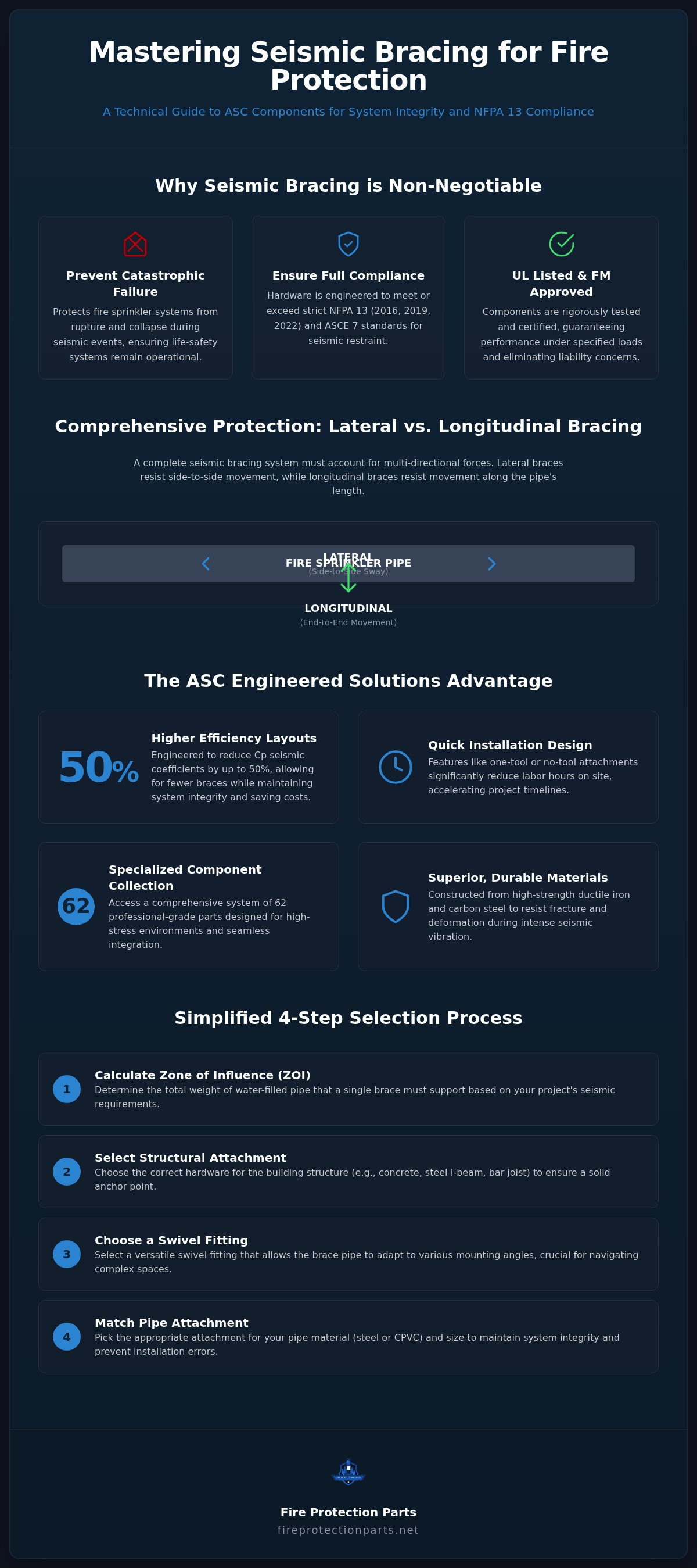
The necessity for bracing depends largely on your project's Seismic Design Category (SDC). In high-risk geographic regions, the building code mandates robust restraint systems. Selecting the right hardware requires "Zone of Influence" (ZOI) calculations. This process determines the total weight of the water-filled pipe that a single brace must support. Because ASC hardware is engineered to reduce Cp seismic coefficients by up to 50 percent in some configurations, it allows for more efficient layouts. This efficiency reduces the total number of braces required while maintaining total system integrity.
Core Components of the ASC Seismic Bracing Collection
Fire Protection Parts provides a curated selection of 62 specialized items within the asc seismic bracing collection. This isn't just a random list of hardware; it's a comprehensive system designed for high-stress environments where failure isn't an option. The core of this line relies on professional-grade materials like ductile iron and carbon steel. These materials are chosen for their superior durability and resistance to fracture during intense seismic vibrations. Most components are engineered specifically for 1-inch brace ends and standard hole sizes, ensuring they integrate seamlessly with standard field pipe and structural members.
Efficiency on the job site is a priority for every contractor. ASC designs focus on a "Quick Installation" advantage. This often translates to one-tool or even no-tool attachment mechanisms that significantly reduce labor hours. When you're managing a large-scale commercial project, the time saved per brace adds up to substantial cost reductions. You don't have to sacrifice safety for speed because the engineering ensures a secure, code-compliant fit every time. You can explore the full range of these high-performance parts at fireprotectionparts.net to find the exact configuration for your project.
Sway Brace Attachments and Swivel Fittings
Swivel fittings are the backbone of a versatile seismic layout. They allow the brace pipe to adapt to various mounting angles, which is critical when you're navigating tight plenum spaces or complex utility runs. ASC offers both rigid and flexible bracing options to suit different structural needs. Rigid braces are the standard for most fire protection applications, while flexible options solve specific vibration or alignment challenges. The ASC 1-inch sway brace components are particularly popular because they offer a high load capacity while maintaining a compact profile that fits where other hardware won't.
Structural Attachments for Concrete and Steel
The strength of a brace is only as good as its connection to the building's skeleton. Whether you're attaching to bar joists, I-beams, or concrete decks, the structural attachment must be rated for the expected seismic load. You'll typically choose between pre-installed anchors, set before concrete is poured, and post-installed solutions for retrofitting existing structures. These structural attachments directly influence the overall load-bearing capacity of the brace. If the structural connection fails, the entire seismic restraint system is compromised, which is why ASC prioritizes heavy-duty carbon steel and ductile iron in these critical parts.
Lateral vs. Longitudinal Bracing: Selecting the Right Sway Support
Understanding the technical difference between lateral and longitudinal support is vital for any field installation. Lateral braces protect your fire sprinkler system from side-to-side movement, which occurs perpendicular to the pipe run. Longitudinal braces prevent movement along the axis of the pipe itself. Both are required by NFPA 13 to ensure the system doesn't tear itself apart at the joints during a seismic event. Selecting the correct asc seismic bracing components for each application ensures your layout meets the specific force requirements of your project's seismic design category without over-engineering the solution.
NFPA 13 provides strict guidelines for the spacing and placement of these restraints to maintain system integrity. For most systems, lateral braces are required at maximum intervals of 40 feet on all feed and cross mains. Longitudinal braces are typically spaced at 80-foot intervals on the same lines. For a deeper look at how these regulations impact your overall design, see our article on Seismic Bracing for Sprinkler Systems: A Comprehensive Guide to Compliance and Safety. Proper placement isn't just about meeting code; it's about ensuring the system remains functional when the building's structure is under stress.
When to Use Lateral Sway Braces
Lateral sway braces are the most frequent restraint type found in fire protection systems. You must place them on all feed and cross mains, as well as branch lines 2.5 inches and larger. ASC manufactures specialized lateral fittings that clamp securely to the pipe while providing a rigid connection to the building structure. A common mistake in the field is placing braces too far from a change in direction. NFPA 13 requires a lateral brace within 6 feet of the end of a main. Failing to account for this distance often leads to failed inspections and costly mid-project corrections that delay your timeline.
Optimizing Longitudinal Sway Brace Layout
Longitudinal bracing is critical for managing the momentum of water-filled pipes during an earthquake. Because these pipes carry significant mass, the axial force can easily overwhelm standard hangers and cause coupling failure. ASC longitudinal fittings are often used to create 4-way bracing points. These points combine lateral and longitudinal support at a single location, usually at the top of a riser or at major junctions where the system is most vulnerable. Integrating these braces requires careful planning to avoid interference with HVAC ducts or electrical trays. Using the compact swivel fittings from the ASC collection allows for tighter installations without compromising the required load ratings.
Technical Selection Criteria: Load, Material, and Pipe Type
Selecting asc seismic bracing requires more than a visual check of the parts. You must calculate the required horizontal force (Fp) for your project. This calculation considers the weight of the water-filled pipe, the seismic acceleration for your site, and the importance factor of the building. Once you have the load requirements, you must match the hardware to the specific pipe material. Steel pipe and CPVC pipe have different physical properties and expansion rates. Using the wrong attachment can lead to pipe failure during thermal expansion or a seismic event.
CPVC systems require a specialized approach to restraint. Because plastic is more flexible than steel, the bracing must secure the pipe without creating localized stress points that could cause a fracture. ASC components are engineered to provide the necessary support while maintaining compatibility with thermoplastic materials. This is why ASC is considered the industry standard for installations using Viking CPVC Fire Sprinkler Pipe. These components distribute the load evenly, ensuring the pipe remains intact when the building sways.
Bracing CPVC Fire Sprinkler Systems
Protecting CPVC pipe from damage during a seismic event is a primary concern for contractors. Standard metal clamps can sometimes bite into plastic or create friction points that lead to leaks over time. ASC offers specialized products designed to cradle the pipe, preventing the brace from becoming a point of failure. These parts ensure that movement is controlled without sacrificing the integrity of the plastic line. It's a technical solution that provides peace of mind for residential and light commercial projects where CPVC is the material of choice.
Evaluating Load Capacity and Prying Factors
The "Brace Angle" is a critical variable in your selection. As the angle between the brace pipe and the vertical plane changes, the allowable load on the component also changes. You'll find that load tables for ASC hardware provide different ratings for 30, 45, and 60-degree installations. Generally, a shallower angle allows for a higher horizontal load capacity but increases the stress on the structural anchor. It's essential to account for the prying factor as the additional force applied to an anchor due to the geometry of the brace attachment. This factor can significantly reduce the effective capacity of your concrete or steel anchors. You can browse our full technical inventory to find the exact load-rated hardware required for your engineering calculations.
Top ASC Seismic Bracing Products for Your Next Project
Selecting hardware shouldn't be a guessing game. The ASC Seismic Bracing collection provides a streamlined path to building a complete and accurate bill of materials. The ASC 1-inch Sway Brace Swivel Fitting remains a bestseller for its sheer versatility. It adapts to various mounting angles while maintaining the high load ratings required for NFPA 13 compliance. For large-scale commercial risers, the ASC Longitudinal Sway Brace is an essential component. It provides the axial restraint necessary to keep high-mass piping systems stable during ground motion. These parts are crafted from ductile iron and carbon steel to ensure they don't fracture under the sudden, violent stresses of an earthquake.
Structural attachments are often where projects slow down. Multi-fit beam clamps from ASC solve this by adapting to various flange thicknesses on the fly. This reduces the number of unique SKUs you need on-site. Instead of searching for a specific clamp for every I-beam, your crew can move faster with hardware designed for flexibility. This "one-tool" philosophy mentioned earlier is what makes this line a contractor favorite. When you use asc seismic bracing, you're choosing parts that have been rigorously tested to meet UL and FM standards. This verification eliminates the doubt that often comes with generic hardware.
Sourcing Professional Hardware from Fire Protection Parts
Sourcing professional hardware through a dedicated e-commerce store like Fire Protection Parts offers distinct advantages. You get immediate inventory transparency, which is vital for time-sensitive projects. You can't afford to wait for a manufacturer's callback when a project deadline is looming. We ensure you have access to all the sprinkler system components online to complement your seismic layout. This centralized procurement reduces errors and simplifies logistics. Our platform acts as a mission-driven partner, guiding you through complex safety requirements with a no-nonsense approach to business and a commitment to excellence.
Final Checklist for ASC Bracing Procurement
Before you finalize your order, run through this final checklist for procurement. Accuracy here prevents field modifications that can compromise system safety. Our goal is to provide the peace of mind that comes with professional expertise and verified hardware.
- Verify the pipe size and schedule: Ensure the clamps and fittings fit the pipe dimensions perfectly to avoid slippage.
- Confirm the structural attachment point: Identify if you're attaching to concrete, steel, or wood, as this dictates your anchor choice.
- Match the seismic load: Ensure the hardware ratings meet or exceed your calculated seismic load requirements for the specific zone.
- Check for UL/FM markings: Confirm that every component carries the necessary third-party certifications for your jurisdiction.
Shop the full ASC Seismic Bracing collection here to secure the hardware you need for a code-compliant installation.
Secure Your Fire Protection System for the Future
Mastering seismic restraint requires a commitment to technical precision and high-quality hardware. You've learned how to navigate the differences between lateral and longitudinal support and how to account for critical prying factors in your engineering calculations. Using asc seismic bracing ensures that your fire sprinkler system remains operational during a seismic event; protecting both the building's infrastructure and its occupants. Safety isn't a place for shortcuts, and your procurement choices are the first line of defense.
By selecting UL Listed and FM Approved components, you eliminate the liability of unverified hardware. The focus on rapid, one-tool installation across the 62 specialized components in the ASC collection allows you to meet tight project timelines without sacrificing compliance. This technical foundation provides the peace of mind that your installation is built to last. Take the next step in professionalizing your seismic layout and ensuring total system integrity.
Browse and Buy ASC Seismic Bracing Hardware to secure the professional-grade components your next project demands. Excellence in fire protection starts with the right choice today.
Frequently Asked Questions
What is the difference between ASC and Afcon seismic bracing?
ASC Engineered Solutions is the current brand that includes the legacy Afcon product line. Afcon was the original innovator, and ASC has maintained that engineering standard while expanding the collection to 62 specialized items. When you buy asc seismic bracing today, you're getting the same Afcon quality with modernized testing and broader compatibility. It's essentially a brand evolution that ensures the hardware meets contemporary safety codes and remains the industry benchmark for reliability.
Do ASC seismic braces meet NFPA 13 requirements for 2026?
Yes, ASC components are engineered to meet and exceed current NFPA 13 standards, including the latest editions and upcoming 2026 requirements. They are tested to handle the specific seismic loads mandated by ASCE 7. By following the manufacturer's load tables and installation guidelines, contractors can ensure their systems remain fully compliant with local and national fire codes. This adherence eliminates the risk of failed inspections or system non-compliance during a project.
Can ASC seismic bracing be used with CPVC fire sprinkler pipes?
ASC offers specialized hardware designed specifically for use with CPVC systems, such as Viking Plastics CPVC pipe. These components secure the pipe without creating stress points or friction that could lead to leaks or fractures. It's vital to use the correct attachment for plastic piping to allow for thermal expansion while providing rigid seismic restraint. Always verify that the specific fitting is listed for use with thermoplastic materials before completing your installation.
How do I calculate the spacing for lateral sway braces?
Lateral sway brace spacing is determined by the Zone of Influence and the horizontal force requirements of your project. NFPA 13 generally mandates a maximum spacing of 40 feet for lateral braces on feed and cross mains. However, your specific calculation might require closer spacing based on the pipe size and seismic design category. You must also place a lateral brace within 6 feet of any change in direction or the end of a pipe run.
Are ASC seismic components UL Listed and FM Approved?
Every component in the ASC seismic collection is UL Listed and FM Approved. These third-party certifications verify that the hardware has undergone rigorous testing to withstand both horizontal and vertical seismic forces. Using listed hardware is a requirement for most commercial fire protection projects. It provides the necessary documentation to prove that your system meets the safety standards required by insurance providers and local fire marshals, ensuring peace of mind for the installer.
What is a prying factor in seismic bracing hardware?
A prying factor is the additional force applied to an anchor due to the geometry of the brace attachment. When a brace is installed at an angle, it creates a lever effect that can pull on the anchor with more force than the actual seismic load. ASC provides detailed prying factor tables for their swivel fittings and structural attachments. Calculating this factor correctly ensures you select an anchor with sufficient pull-out strength for your specific installation angle.
Can I install ASC seismic bracing myself or do I need a specialist?
While the hardware is designed for rapid, one-tool installation, the design and layout must be performed by a qualified professional. Seismic bracing requires precise engineering calculations, including ZOI and horizontal force values, to ensure system integrity. Fire protection contractors typically handle the physical installation. We recommend consulting with a fire protection engineer to verify that your layout meets the strict requirements of NFPA 13 and local building codes for your specific geographic region.
What materials are ASC seismic bracing components made from?
ASC seismic bracing components are primarily manufactured from high-strength ductile iron and carbon steel. These materials are selected for their ability to resist fracturing under sudden, intense lateral loads. Most parts also feature specialized finishes, such as electro-galvanization, to prevent corrosion in various environments. This robust material choice ensures the hardware maintains its structural integrity over the long term, providing reliable protection for the life of the fire sprinkler system and reducing maintenance needs.

