



CPVC vs. Steel Fire Sprinkler Pipe: The 2026 Professional Buying Guide
The strongest pipe on the market isn't always the safest choice for your building's long-term survival. You're likely weighing the rugged durability of metal against the modern efficiency of thermoplastics while worrying about rising labor costs or the silent threat of corrosion. It's a high-stakes decision where a single error in judgment can lead to expensive code violations or system failure when it matters most. When evaluating cpvc vs steel fire sprinkler pipe for your 2026 projects, the right answer depends on your specific hazard classification and hydraulic needs.
We understand that uncertainty about CPVC melting points or the labor-intensive nature of threading steel can stall your procurement process. This professional guide promises to help you make an informed, code-compliant choice between these two materials for any residential or commercial application. We'll preview the critical differences between Schedule 10 and Schedule 40 steel, explore the hydraulic advantages of Viking Plastics CPVC, and provide a clear decision matrix to ensure your fire suppression system remains reliable for decades.
Key Takeaways
- Identify the critical performance gap between the mechanical strength of legacy steel and the high hydraulic efficiency of Viking Plastics CPVC.
- Make an informed choice in the cpvc vs steel fire sprinkler pipe debate by matching material specifications to your building's specific NFPA occupancy hazard.
- Evaluate the long-term ROI of your fire suppression system by factoring in installation labor savings and the elimination of Microbiologically Influenced Corrosion (MIC).
- Understand when to specify Schedule 10 versus Schedule 40 steel pipe to meet rigorous safety standards and high-pressure requirements.
- Streamline your procurement process by using our checklist for sourcing 21-foot pipe lengths and code-compliant fittings for commercial-scale efficiency.
Choosing Between CPVC and Steel Fire Sprinkler Pipes: The 2026 Professional Framework
Fire suppression systems have moved beyond a one size fits all approach. For decades, black steel was the primary choice for every application. Modern engineering has changed that. Today, engineered thermoplastics provide a specialized alternative for specific environments. The fundamental decision in the cpvc vs steel fire sprinkler pipe debate centers on balancing mechanical impact resistance with hydraulic performance and long term corrosion defense. It's a choice that impacts everything from the initial bid to the 50 year life cycle of the building.
Standards like NFPA 13, 13R, and 13D dictate where these fire sprinkler pipe materials can be safely deployed. Material selection is the single largest variable in your labor budget. Steel demands heavy machinery for grooving and threading. In contrast, Viking Plastics CPVC uses a simpler solvent cement process that reduces man hours on the job site. Choosing the wrong material for the hazard level doesn't just waste money; it can lead to catastrophic system failure or code non-compliance.
The Role of NFPA Occupancy Hazard Classifications
Occupancy hazard levels define your material boundaries. Light Hazard environments like hotels, schools, and offices are ideal for CPVC because the fuel load is lower. If you're designing for Ordinary Hazard or Extra Hazard zones like manufacturing plants or high piled storage, steel remains the heavy duty standard. Building height and seismic requirements also play a role. Higher structures often demand the structural rigidity of metal. Systems in earthquake prone areas require specialized ASC Seismic Bracing to maintain integrity regardless of the cpvc vs steel fire sprinkler pipe choice.
Total Cost of Ownership (TCO) vs. Initial Material Price
Don't let the initial material price tag mislead you. Steel often carries a labor premium because it requires skilled fitters and specialized equipment. As of early 2026, steel prices have risen by over 20% year over year, making installation efficiency more critical than ever. While steel is rugged, it's vulnerable to Microbiologically Influenced Corrosion (MIC). This hidden threat can eat through metal from the inside out, leading to pinhole leaks. Viking Plastics CPVC is immune to MIC and corrosion. Choosing CPVC for residential or light hazard projects lowers the barrier to entry and eliminates the need for expensive corrosion inhibitors or frequent pipe replacements.
Steel Fire Sprinkler Pipe: Understanding Schedules, Coatings, and Durability
Steel has remained the industry's backbone for over a century. It provides the structural integrity required for high traffic commercial zones and industrial plants where mechanical damage is a constant risk. When you're evaluating cpvc vs steel fire sprinkler pipe, steel is the non negotiable choice for Ordinary and Extra Hazard environments. Its ability to withstand extreme heat and physical impact makes it the reliable standard for complex, high pressure systems.
Schedule 10 vs. Schedule 40 Steel Pipe
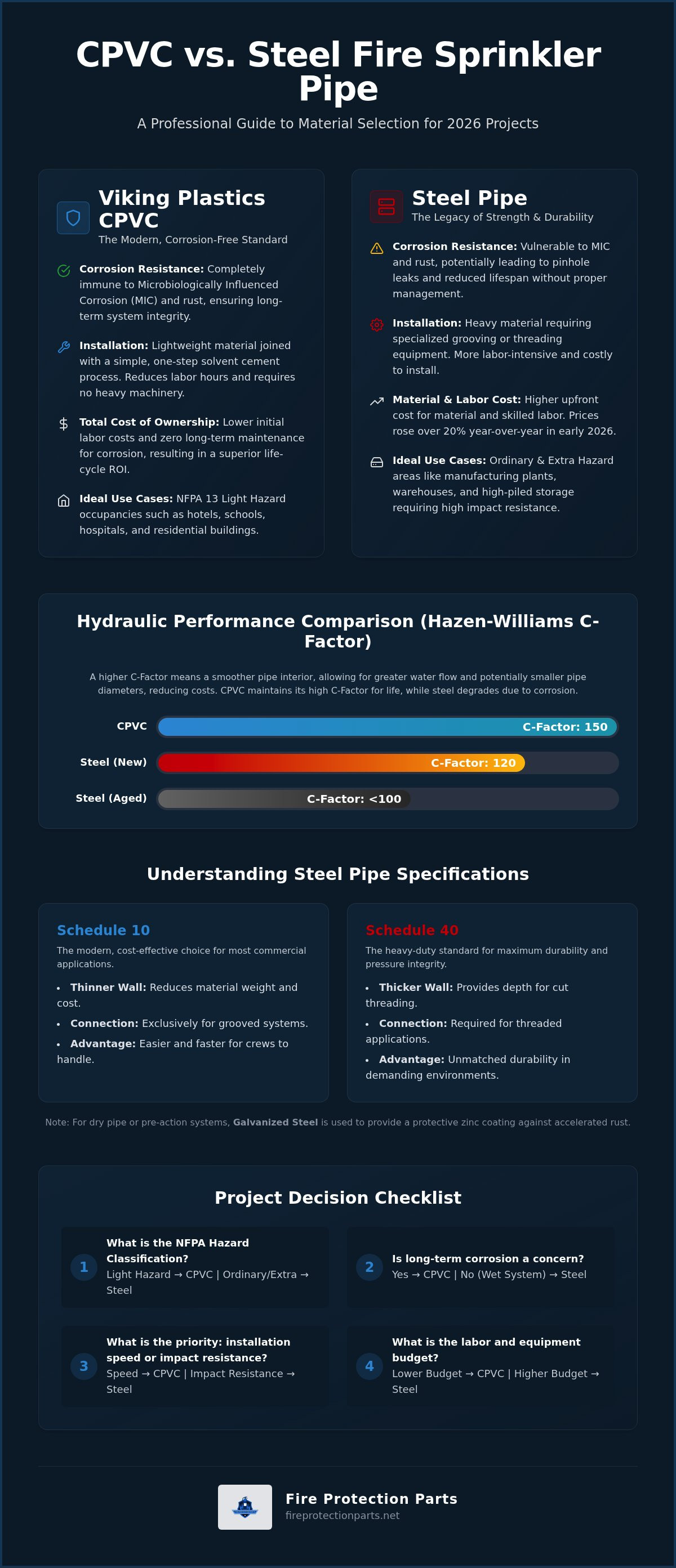
The choice between Schedule 10 and Schedule 40 depends on your connection method and budget. Schedule 10 is the modern go to for grooved systems. It features a thinner wall that reduces material weight and shipping costs without sacrificing the necessary pressure ratings for most commercial builds. For example, a 3" x 21' Schedule 10 Grooved Black Pipe is significantly easier for a crew to maneuver than its thicker counterparts. Schedule 40 remains the requirement for threaded applications. Its thicker walls provide the depth needed for cut threading while maintaining the pipe's pressure integrity. Choosing Schedule 40 is a commitment to maximum durability in the most demanding environments.
Galvanized Steel for Corrosion Resistance
Black steel is excellent for wet systems where water stays stagnant and oxygen is limited. However, dry pipe and pre action systems introduce oxygen and moisture, which accelerates rust. Galvanized steel solves this with a protective zinc coating. A NIST comparison of fire sprinkler piping confirms that while steel is rugged, its internal environment must be managed to prevent scaling. Using A53 PE Galvanized Schedule 40 Pipe ensures your system doesn't succumb to internal degradation in these high risk zones. It's a premium choice that balances the strength of metal with a higher defense against the elements.
Installation speed is often the deciding factor for modern contractors. Grooved connections on Schedule 10 pipe allow for much faster assembly than traditional threading. This method doesn't just save time; it provides a flexible joint that can better handle building vibrations. For a deeper look at how these materials fit into your overall system, consult our Sprinkler System Components Online: The 2026 Professional Sourcing Guide. Sourcing your fire sprinkler pipe and fittings from a single, reliable inventory helps you maintain code compliance while keeping your project on schedule.
Viking Plastics CPVC: The Modern Standard for Corrosion-Free Protection
Viking Plastics CPVC is not your standard plumbing PVC. It's a specialized, chlorinated material engineered specifically for fire suppression and is available in diameters from 3/4" to 3". When evaluating cpvc vs steel fire sprinkler pipe, the hydraulic advantages of CPVC are undeniable. It features a Hazen-Williams C-factor of 150, which is significantly higher than the 120 rating for new steel. This smoother interior surface reduces friction loss, often allowing engineers to specify smaller pipe diameters while maintaining the required flow rates. This efficiency is why CPVC has become the preferred choice for NFPA 13D residential installations and light hazard commercial environments.
The Science of CPVC Flame Resistance
A common misconception is that CPVC will simply melt during a fire. In reality, Viking Plastics CPVC is designed to form a protective char layer when exposed to extreme heat. This carbonaceous char acts as an insulator, protecting the pipe's interior and allowing it to maintain pressure while the sprinklers activate. It's fully compliant with the UL 1821 4th Edition standard, ensuring it meets the most current safety requirements as of 2026. However, installers must remain vigilant about chemical compatibility. You should only use approved thread sealants and avoid contact with incompatible oils or chemicals that can cause environmental stress cracking.
Viking CPVC for Retrofit Projects
Retrofitting an active building requires speed and minimal disruption. CPVC's lightweight nature makes it the ideal candidate for occupied spaces, attics, and crawlspaces where heavy steel threading equipment can't reach. Instead of grooving or threading, you'll use solvent welding. This chemical process creates a permanent, leak-proof bond that is often stronger than the pipe itself. Because it requires only basic hand tools, a smaller crew can complete a retrofit in a fraction of the time needed for metal systems. For a deeper dive into technical specifications, read our Viking CPVC Fire Sprinkler Pipe: The Professional Buyer’s Guide for 2026.
Choosing Viking Plastics CPVC means choosing a system that won't succumb to the internal scaling or pitting that often plagues metal. It provides a reliable, corrosion-free solution that simplifies the installation process for residential and light hazard projects. Whether you're working on a new multi-family complex or updating an aging office building, the hydraulic efficiency and ease of use make it a formidable competitor in the cpvc vs steel fire sprinkler pipe comparison.
Head-to-Head: Hydraulics, Installation Labor, and Long-Term ROI
Choosing between cpvc vs steel fire sprinkler pipe requires looking beyond the price per foot. Hydraulic efficiency is a major differentiator. Because Viking Plastics CPVC maintains a C-factor of 150, it stays smooth for its entire 50 year service life. Steel starts at 120 and degrades as internal scaling and pitting occur. This means you can often downsize CPVC lines where steel would require a larger diameter to overcome friction loss. This sizing advantage can lead to significant material savings across a large scale project.
Labor costs provide the most immediate ROI impact. For a standard 100-head system, a steel installation involves heavy threading machines and grooving tools. Estimating man-hours for steel often reveals a 40% to 60% increase compared to CPVC. A two-man crew can install CPVC quickly using solvent cement. In contrast, steel often requires more hands for positioning and securing heavy 21-foot lengths, which drives up the total project cost and extends the construction timeline.
The Corrosion Factor: MIC and Internal Scaling
Black steel is inherently vulnerable to oxygen-rich environments. In wet systems, trapped air pockets lead to Microbiologically Influenced Corrosion (MIC). This process creates localized pitting that can breach a pipe wall in just a few years. To combat this, steel systems often require expensive nitrogen inerting or chemical additives. CPVC is immune to MIC. It doesn't scale, rust, or require nitrogen, which significantly reduces the building's long-term maintenance budget and eliminates the risk of pinhole leaks.
Seismic Bracing and Support Requirements
The physical properties of these materials dictate their support needs. Steel is rigid and heavy, requiring robust hangers but allowing for wider spacing. CPVC is flexible and lightweight. While this flexibility is an advantage during an earthquake, it requires more frequent support to prevent sagging. Both materials must adhere to strict code requirements in high-risk zones. For a detailed breakdown of these standards, see our guide on Seismic Bracing for Sprinkler Systems: A Comprehensive Guide to Compliance and Safety.
Your choice in the cpvc vs steel fire sprinkler pipe debate ultimately impacts the total cost of ownership. While steel remains the standard for high-hazard zones, CPVC offers a maintenance-free future for light-hazard projects. You can source code-compliant pipe and fittings directly from our inventory to ensure your next project meets 2026 standards.
Buying Guide: Selecting Piping for Your Next Installation
Finalizing your choice in the cpvc vs steel fire sprinkler pipe debate requires a strict adherence to NFPA occupancy hazard classifications. You shouldn't settle for a material that only meets the minimum requirements. Instead, select the pipe that optimizes both safety and installation efficiency. For Light Hazard environments like residential units and office spaces, Viking Plastics CPVC is the engineered solution for long term reliability. For Ordinary or Extra Hazard zones, high strength steel remains the industry requirement. Making this distinction early prevents costly design revisions and ensures your project remains code-compliant from the start.
Efficiency on the job site often comes down to your inventory checklist. Sourcing 21-foot lengths is the standard for commercial projects because it reduces the number of joints and potential leak points. Beyond the pipe itself, your procurement must include compatible accessories. Steel systems require specific grooved couplings and heavy duty hangers, while CPVC systems depend on specialized solvent cement and compatible fittings. Avoid the common mistake of using plumbing-grade PVC for fire protection. Standard PVC cannot withstand the heat or pressure of a fire suppression event and will result in an immediate inspection failure.
Top Steel Pipe Choices from Our Collection
We maintain a robust inventory of steel piping to meet various industrial and commercial needs. When you need the heavy duty standard for wet systems, the 1" x 21' Schedule 40 Black Steel Pipe offers the wall thickness required for traditional threading. For dry systems or plumbing applications where moisture is a concern, the 1/2" x 21' A53 PE Galvanized Schedule 40 Pipe provides the necessary external protection. If you're managing high volume mains, the 3" x 21' Schedule 10 Grooved Black Pipe is the professional choice for faster assembly and reduced weight.
Sourcing Viking Plastics CPVC and Fittings
Viking Plastics CPVC is the contractor's choice for residential safety because it eliminates the risk of internal corrosion. It's a mission-driven solution for those who value longevity and ease of installation. A complete system is only as reliable as its weakest link, so don't forget to source code-compliant CPVC fittings and solvent cements that are specifically tested for fire protection use. Mixing incompatible thread sealants or oils can lead to environmental stress cracking, so always verify compatibility before application. You can browse our complete Fire Sprinkler Pipe collection here to find every component needed for a secure, verified installation.
Securing Your Project with Code-Compliant Piping Solutions
Your decision in the cpvc vs steel fire sprinkler pipe debate defines the safety and longevity of your building. Choosing the right material isn't just about meeting the minimum code requirements; it's about optimizing for hydraulic efficiency and installation speed. Viking Plastics CPVC provides a corrosion-free, lightweight solution for residential and light hazard projects. For heavy-duty industrial environments, our Schedule 10 and Schedule 40 steel pipes offer the mechanical strength and pressure ratings required for high-risk zones.
Eliminating the risk of system failure starts with sourcing verified, high-quality components. We provide a comprehensive inventory of code-compliant Viking Plastics CPVC and a full range of black and galvanized steel. With fast shipping on 21-foot pipe lengths, you can keep your project on schedule without compromising on protection. Take the next step toward a reliable fire suppression system by browsing our inventory today. Our team is ready to support your procurement needs with expert confidence and unwavering reliability.
Shop the Professional Fire Sprinkler Pipe Collection
Frequently Asked Questions
Is CPVC fire sprinkler pipe allowed in commercial buildings?
Yes, CPVC is permitted in commercial buildings classified as Light Hazard occupancies under NFPA 13. This includes spaces like offices, hotels, and schools where the fuel load is relatively low. It is not approved for Ordinary or Extra Hazard environments such as warehouses or chemical plants. When choosing between cpvc vs steel fire sprinkler pipe for a commercial project, always verify the occupancy hazard level before finalizing your material procurement.
What is the difference between Schedule 10 and Schedule 40 steel pipe?
The primary difference is wall thickness. Schedule 10 pipe has a thinner wall and is specifically designed for grooved connections, which reduces weight and material costs. Schedule 40 is thicker and provides the necessary depth for cut threads. While Schedule 10 is popular for large mains due to its efficiency, Schedule 40 remains the standard for threaded branch lines. Both options are available in 21-foot lengths to maximize installation speed.
Will CPVC pipe melt if a fire starts?
CPVC does not melt like standard plastics. Instead, it is engineered to form a protective carbonaceous char layer when exposed to fire. This char acts as a thermal insulator, allowing the pipe to maintain its structural integrity and internal pressure while the system activates. This performance is verified by the UL 1821 standard. It ensures that the water reaches the sprinkler heads effectively, providing reliable protection in residential and light hazard applications.
Why is black steel pipe used for fire sprinklers instead of galvanized?
Black steel is the standard for wet pipe systems because it is cost-effective and durable. In a wet system, the water remains stagnant and oxygen is depleted, which naturally slows down the corrosion process. Galvanized pipe is typically reserved for dry or pre-action systems where the presence of both oxygen and moisture would cause black steel to rust rapidly. Choosing black steel for wet systems provides a robust solution without the added expense of zinc coatings.
Can I mix CPVC and steel pipe in the same fire sprinkler system?
You can mix CPVC and steel in the same system by using specialized, listed transition fittings. This is common in retrofit projects where a new CPVC wing is added to a legacy steel main. You must ensure that any thread sealants or cutting oils used on the steel side are chemically compatible with the CPVC. Failure to verify compatibility can lead to environmental stress cracking, which compromises the entire fire suppression system's reliability and code compliance.
How long does steel fire sprinkler pipe last before it needs replacement?
Steel pipe generally lasts between 25 and 50 years, but this lifespan can be significantly shortened by Microbiologically Influenced Corrosion (MIC). In some oxygen-rich wet systems, internal pitting can cause pinhole leaks in less than 10 years. Regular maintenance and the use of corrosion inhibitors can help reach the upper end of the service life. When comparing cpvc vs steel fire sprinkler pipe, remember that CPVC is entirely immune to these specific corrosion issues.
Does CPVC fire sprinkler pipe require special glue?
Yes, CPVC requires a specific solvent cement that is chemically engineered for fire protection systems. This is not a typical glue; it is a solvent welding process that fuses the pipe and fitting into a single, continuous piece of material. You must use a cement that is listed for use with your specific pipe brand, such as Viking Plastics. Using unapproved plumbing adhesives will result in a failed inspection and potential system leaks under high pressure.
What is the Hazen-Williams C-factor and why does it matter for pipe selection?
The Hazen-Williams C-factor measures the internal smoothness of a pipe. A higher number indicates less friction. CPVC has a C-factor of 150, while new steel is rated at 120. This difference is critical because smoother pipes allow for better water flow with less pressure loss. Engineers can often specify smaller pipe diameters when using materials with a higher C-factor, leading to reduced material costs and easier installation without sacrificing the required hydraulic performance.

