



CPVC vs. Steel Fire Sprinkler Pipes: 2026 Comparison
The heavy structural rigidity of steel has long been the industry standard, but it might actually be the most vulnerable choice for your long-term fire suppression strategy. Choosing between cpvc vs steel pipe for fire sprinklers is no longer just about material cost. It's about defending your facility against microbiologically influenced corrosion (MIC) and skyrocketing labor rates for skilled pipe fitters. You likely feel the pressure to maintain absolute safety while managing tightening budgets and complex retrofit spaces.
We promise to help you make an informed, code-compliant decision by breaking down the critical performance, cost, and installation differences between CPVC and steel piping. This comparison utilizes the latest 2026 data to ensure your system meets updated NFPA 13 standards while eliminating the doubt surrounding material longevity. We will evaluate how Viking Plastics CPVC stacks up against traditional steel regarding hydraulic efficiency, installation speed in tight spaces, and the reduced maintenance requirements that lead to a lower total cost of ownership over a 20 year lifespan.
Key Takeaways
- Understand why modern fire protection is shifting toward high-limit thermoplastics and how these materials differ fundamentally from traditional black steel.
- Learn how to mitigate the threat of Microbiologically Influenced Corrosion (MIC) by evaluating the long-term hydraulic efficiency of cpvc vs steel pipe for fire sprinklers.
- Discover how to reduce the total cost of ownership by leveraging lighter materials that simplify installation through solvent welding instead of heavy threading equipment.
- Identify the specific NFPA 13 compliance requirements for Light Hazard systems to ensure your material choice is both safe and code-compliant for 2026 standards.
- Gain professional assurance by sourcing verified Viking Plastics CPVC components that provide the reliability required for insurance and rigorous building inspections.
Understanding the Shift: The Evolution of Fire Sprinkler Piping Materials
The Evolution of Fire Sprinkler Piping Materials has reached a critical juncture in 2026. For decades, black steel pipe was the undisputed standard for every fire suppression system. It offered unmatched structural strength but brought significant logistical challenges. Today, Chlorinated Polyvinyl Chloride (CPVC) has emerged as a high-limit thermoplastic that fundamentally changes the math for light hazard environments. This material isn't standard plumbing plastic. It's engineered specifically to handle the intense thermal stress of fire suppression while resisting the chemical degradation that ruins metal systems.
When comparing cpvc vs steel pipe for fire sprinklers, the primary difference lies in the molecular structure and physical weight. CPVC is inherently resistant to corrosion and scaling. It's also significantly lighter than its metallic counterparts. This weight reduction allows a single installer to handle pipe lengths that would require a two-person crew or mechanical lifts if using steel. The industry is pivoting toward these non-metallic solutions because they solve the two biggest headaches in modern construction: rising labor costs and long-term maintenance cycles.
The Rise of CPVC in Residential and Light Hazard Sectors
The shift began when NFPA 13D and 13R standards recognized the unique needs of residential and low-rise buildings. Modern material engineering has produced fire-rated plastics that don't just survive heat; they react to it by forming a protective char layer. This char acts as an insulator, keeping the interior of the pipe cool enough to maintain water pressure. Builders of multi-family housing projects now prioritize CPVC because it fits into tight ceiling joists and wall cavities where rigid steel simply can't go. It's the go-to solution for maximizing space without compromising safety.
Traditional Steel: When Strength is Non-Negotiable
Traditional steel remains essential for high-stakes applications where physical impact is a concern. Schedule 40 steel is the heavyweight champion of the industry, providing thick walls that withstand extreme physical abuse. Schedule 10 offers a lighter alternative while maintaining the structural integrity required by code for ordinary and extra hazard occupancies. You'll still find steel in warehouses and manufacturing plants where mechanical damage is a constant risk. However, this strength comes with a known trade-off. Steel is susceptible to rust and internal pitting. Without proper treatment, a steel system can begin to degrade from the moment water is introduced, leading to the corrosion issues that plague older facilities.
Performance Showdown: Heat Resistance, Corrosion, and Hydraulic Efficiency
Evaluating Performance Showdown: Heat Resistance, Corrosion, and Hydraulic Efficiency requires looking past initial appearances. When analyzing cpvc vs steel pipe for fire sprinklers, the hydraulic data tells a story of long-term reliability that steel struggles to match. It's not just about how the pipe looks on day one. It's about how it performs after 15 years of sitting stagnant. Choosing the wrong material can lead to catastrophic failure when the system is finally called into action.
Fire Resistance and Thermal Performance
CPVC is often misunderstood as a material that simply melts. In reality, it uses a unique charring mechanism to survive extreme conditions. The exterior of the pipe forms a carbonaceous char layer that acts as a thermal barrier for the core. Because these systems are water-filled, the water acts as a massive heat sink. It absorbs and carries away thermal energy, preventing the thermoplastic from reaching its structural failure temperature. Steel has a higher melting point, but it also conducts heat rapidly, which can sometimes damage surrounding building components before the sprinklers even activate.
Eliminating the Corrosion Factor
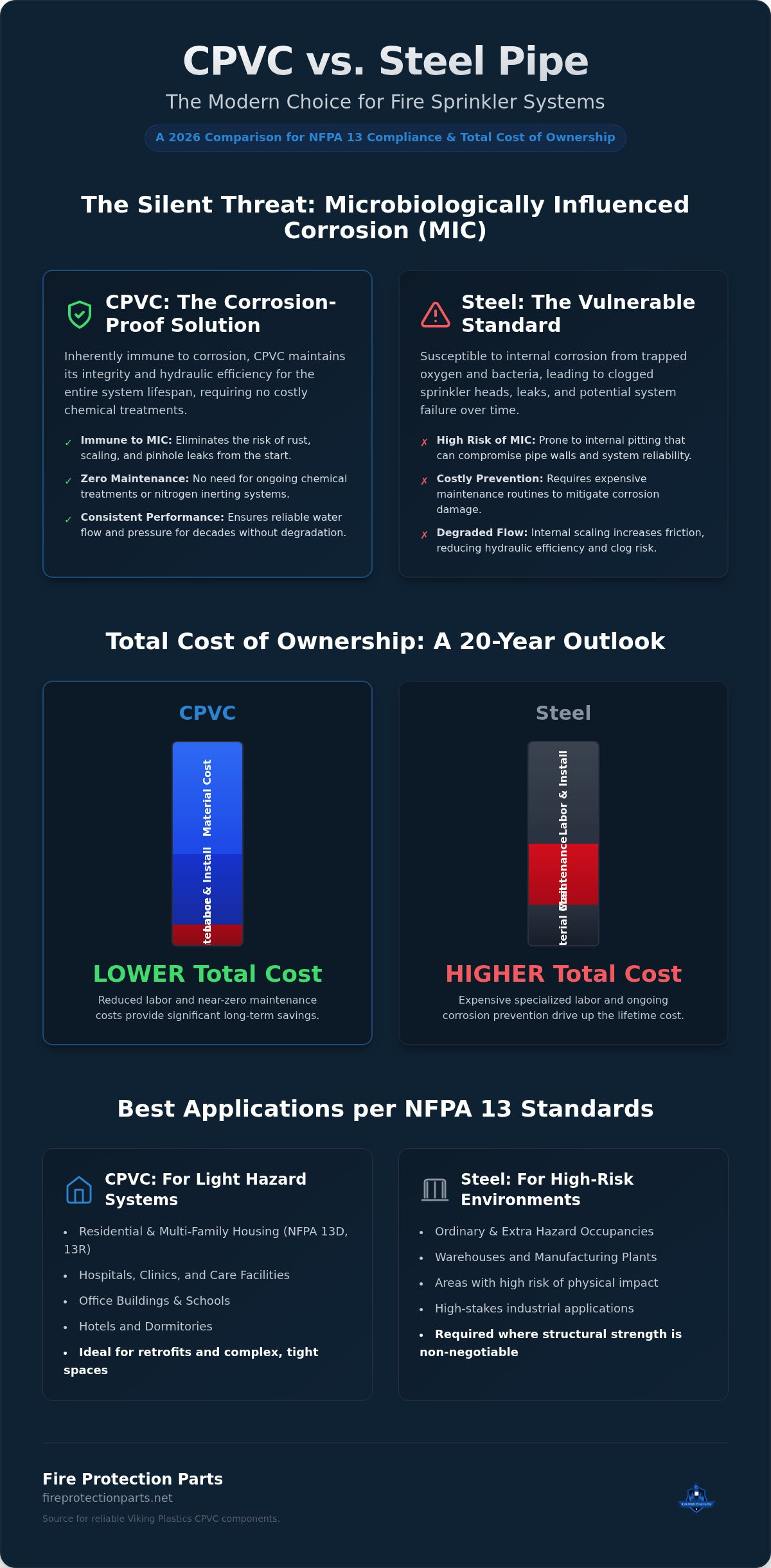
Steel systems face a silent enemy: Microbiologically Influenced Corrosion (MIC). Oxygen and bacteria trapped in the water eat through metal walls from the inside out. This leads to pinhole leaks and clogged sprinkler heads that can render a system useless. Protecting steel requires ongoing chemical treatments and nitrogen inerting, which adds significant lifetime costs to the facility. CPVC is inherently corrosion-proof. It won't scale, pit, or rust. This immunity ensures the internal diameter remains consistent and the water stays clean, providing peace of mind for the building owner.
Hydraulic Calculations and System Design
Hydraulic efficiency is where CPVC truly pulls ahead of metallic options. It boasts a Hazen-Williams C-factor of 150, compared to a starting point of 120 for new steel. Smoother internal walls mean less friction loss as water moves through the system. This efficiency directly impacts the sizing of residential fire pump systems. The debate over cpvc vs steel pipe for fire sprinklers often centers on these design advantages. You can often specify smaller pipe diameters and less powerful pumps while maintaining the required water pressure at the furthest head. This creates a leaner system that performs better under pressure while reducing equipment costs. If you're designing for a tight footprint, sourcing Viking CPVC components can help optimize your entire layout for maximum flow efficiency.
Total Cost of Ownership: Installation Labor vs. Material Expenses
The initial purchase price of pipe is only a fraction of your total investment. When you evaluate cpvc vs steel pipe for fire sprinklers, you're really looking at the cost of time and specialized skill. Steel requires a labor-intensive process involving heavy threading machines, grooving tools, and oil-slicked workspaces. CPVC uses a one-step solvent welding process that creates a molecular bond in minutes. This simplicity doesn't just save time; it lowers the barrier for entry in a market where skilled pipe fitters are increasingly expensive and difficult to find.
Weight is the most immediate logistical differentiator. A single worker can easily carry multiple 15-foot lengths of Viking Plastics CPVC without assistance or mechanical lifts. Steel pipe is heavy and dangerous to move by hand, often requiring specialized rigging or a larger crew just to get the material to the installation floor. These equipment rentals and additional man-hours quickly erode any perceived savings from lower steel material costs. A NIST comparison of fire sprinkler materials highlights that labor efficiency is the primary driver of cost-effectiveness in light hazard applications. By choosing a lighter material, you reduce the physical strain on your team and the financial strain on your project budget.
Labor Savings in Retrofit Applications
Retrofitting an occupied building presents unique challenges that favor non-metallic systems. Steel installation is loud and messy. It requires cutting and threading that produces metal shavings and oil runoff. CPVC installation is virtually silent and requires no heavy machinery. This allows work to proceed in offices or residential units without forcing a total shutdown of the facility. You'll see faster turnaround times and fewer complaints from tenants, which is a critical factor for commercial facility managers trying to minimize disruption.
Long-Term Maintenance and Repair Costs
The real savings appear 20 years down the road. Steel systems require frequent internal inspections and flushing to manage scale buildup and the corrosion mentioned previously. These service calls are expensive and invasive. CPVC doesn't scale or pit, meaning the hydraulic performance stays consistent for the life of the building. When repairs are necessary, sourcing fire protection parts online allows for rapid procurement of fittings that can be installed with basic hand tools. You'll spend less on maintenance and more on ensuring your facility remains protected without compromise.
Compliance and Application: NFPA 13 Requirements for Light Hazard Systems
Code compliance is the final authority in fire suppression design. When deciding between cpvc vs steel pipe for fire sprinklers, you must first classify the occupancy of your building. The National Fire Protection Association (NFPA) allows CPVC primarily in Light Hazard environments. These are locations where the quantity and combustibility of contents are low, such as offices, schools, and residential units. In these spaces, the material's fire-rated performance is proven and reliable. However, CPVC has strict limitations. It's not permitted in high-piled storage warehouses, commercial kitchens, or areas with flammable liquids. Steel remains the non-negotiable standard for Ordinary and Extra Hazard occupancies where fuel loads are significantly higher.
Verification of components is critical for passing inspections. Every piece of pipe and every fitting must carry a UL Listing or FM Global approval specifically for fire protection service. You cannot use standard plumbing CPVC in a sprinkler system. Sourcing a unified, listed system like Viking Plastics CPVC ensures that the solvent cement, fittings, and pipe are engineered to work together. This eliminates the risk of chemical incompatibility that can lead to system failure. If you are ready to secure code-compliant hardware, you can buy Viking Plastics CPVC components here to ensure your system meets every safety standard.
NFPA 13, 13R, and 13D: Which Standard Applies?
The specific installation standard dictates your material choices. NFPA 13 is the comprehensive standard for commercial buildings, while 13R covers low-rise residential structures up to four stories. NFPA 13D is dedicated to one- and two-family dwellings. CPVC is the dominant choice for 13R and 13D projects due to its flexibility in tight residential framing. In high-risk earthquake zones, both materials must adhere to strict requirements for seismic bracing for sprinkler systems. While steel is rigid and relies on flexible couplings to survive a tremor, CPVC is naturally more resilient to vibration but requires specific bracing to prevent excessive swaying from damaging the joints.
Hanger and Support Requirements
Support spacing differs significantly between rigid and thermoplastic materials. Steel is structurally self-supporting over longer distances, often allowing hangers to be spaced up to 15 feet apart. CPVC is a thermoplastic and requires more frequent support to prevent sagging, with spacing typically required every 5 to 10 feet depending on the pipe diameter. Installers must also account for thermal expansion. CPVC expands and contracts more than steel as temperatures change. Using expansion loops and ensuring hangers don't have sharp edges that could gouge the plastic is essential for long-term system integrity. Proper use of all-thread rod and listed hangers ensures the system remains secure for its entire 20 year lifespan.
Sourcing Reliable Components: Why Viking Plastics CPVC and Fire Protection Parts?
The decision in the cpvc vs steel pipe for fire sprinklers debate often concludes with a choice for modern efficiency, but the material is only half the battle. Reliability depends on the integrity of the manufacturer and the expertise of your supplier. Sourcing random components from multiple vendors introduces unnecessary risk. A single unlisted fitting or incompatible solvent cement can jeopardize an entire system's certification. Choosing a unified, brand-name system ensures that every component is engineered to work together under high-pressure conditions.
Fire Protection Parts serves as a specialized partner for contractors and facility managers who cannot afford compromise. We understand that procurement friction leads to project delays and increased costs. By providing a one-stop-shop for pipe, fittings, and pump systems, we eliminate the guesswork. You gain the professional assurance that your order is code-compliant and ready for immediate installation. This streamlined approach allows you to focus on the protection of your facility rather than the complexities of hardware sourcing.
The Viking Plastics Advantage
Viking Plastics CPVC Pipe for Fire Protection represents the pinnacle of material engineering. It undergoes strict quality control standards that exceed basic industry requirements, ensuring superior durability in demanding environments. This pipe is designed for total compatibility with Viking fire sprinkler heads and accessories, creating a seamless suppression network. Viking maintains a rigorous chemical compatibility program to ensure that ancillary construction products, like firestop sealants and lubricants, don't compromise the thermoplastic's integrity. This level of detail provides the peace of mind required for insurance approvals and rigorous building inspections.
Procuring a Complete System
A successful installation requires more than just the main runs of pipe. You must account for the specialized solvent cements, heavy-duty hangers, and specific fittings that complete the loop. Bundling your pipe with sprinkler system components online ensures that every part of the assembly meets the same high standard of reliability. We provide expert support for bulk orders and technical specifications to ensure your procurement process is as efficient as the material itself. Whether you're managing a multi-family residential project or a light hazard commercial retrofit, having the right hardware on-site and on time is non-negotiable. Our inventory is managed to support fast-paced construction schedules, helping you move from the design phase to a fully operational, code-compliant system without delay.
Future-Proof Your Fire Suppression Strategy
Choosing between cpvc vs steel pipe for fire sprinklers is a decision that impacts your facility for decades. While steel provides structural rigidity for heavy industrial use, CPVC offers a superior hydraulic C-factor of 150 and total immunity to the corrosion that destroys metallic systems. You've seen how the ease of solvent welding reduces labor costs and minimizes disruption during critical retrofits. For light hazard and residential applications, the shift toward high-limit thermoplastics is the safest way to ensure long-term reliability and code compliance.
Don't settle for hardware that compromises your project's timeline or safety standards. As an authorized distributor, we provide the expert technical support and code-compliant parts you need for NFPA 13, 13R, and 13D systems. You can Shop Viking Plastics CPVC Pipe and Fittings at Fire Protection Parts to secure the industry's most trusted components today. Our team is ready to help you navigate technical specs and bulk orders with professional assurance. Take the next step toward a maintenance-free, high-performance fire suppression system that protects your people and your property without compromise.
Frequently Asked Questions
Does CPVC pipe melt in a fire?
CPVC does not melt when exposed to fire. It is engineered to form a carbonaceous char layer on the exterior when it contacts flame. This layer acts as a thermal insulator, protecting the core of the pipe. Because fire sprinkler systems are water-filled, the internal fluid acts as a heat sink that absorbs thermal energy. This combination prevents the pipe from losing structural integrity during a fire event.
Can CPVC be used in commercial fire sprinkler systems?
NFPA 13 permits CPVC in Light Hazard commercial environments such as offices, schools, and nursing homes. However, you can't use it in Ordinary Hazard or Extra Hazard areas like warehouses or commercial kitchens. It's often the preferred choice for commercial retrofits due to its ease of handling and minimal mess. Always verify your building's hazard classification with a fire protection engineer before you select your piping materials.
Is CPVC cheaper than steel for fire sprinklers?
CPVC consistently offers lower total installed costs when you evaluate the full project. The raw material price of cpvc vs steel pipe for fire sprinklers fluctuates, but the labor savings are significant. CPVC requires fewer workers and doesn't need heavy threading machinery or specialized cutting oil. You'll save on labor hours and equipment rentals. Over a 20 year lifespan, the lack of corrosion repairs further increases the financial advantage.
What is the lifespan of CPVC vs. steel pipe?
CPVC often outlasts steel because it is immune to corrosion. Steel pipes can begin to fail within 10 to 15 years if they succumb to Microbiologically Influenced Corrosion (MIC) or internal scaling. CPVC is inherently resistant to rust and pitting, allowing it to maintain its full hydraulic capacity for over 50 years under proper conditions. This longevity reduces the need for expensive system flushes or premature replacements, providing long-term peace of mind.
Are there specific hangers required for CPVC fire sprinkler pipe?
You must use hangers and supports that are specifically listed for use with CPVC fire sprinkler piping. These supports must have broad bearing surfaces and no sharp edges that could gouge the thermoplastic material. Additionally, because CPVC expands and contracts more than steel, the hangers must allow for thermal movement without binding. Proper spacing is also tighter for CPVC to prevent sagging between support points.
Can I mix different brands of CPVC pipe and fittings?
It's critical to use pipe and fittings from the same manufacturer's listed system to ensure chemical and mechanical compatibility. Mixing brands can void the UL Listing and may lead to joint failure. For example, the solvent cement used for Viking Plastics CPVC is specifically engineered for those components. Sticking to a single brand ensures your system meets insurance requirements and passes building code inspections without any doubt.
Does steel pipe always require corrosion inhibitors?
Steel systems are highly susceptible to internal rot without chemical treatment or nitrogen inerting. Oxygen and bacteria in the water supply naturally attack the metal, leading to pinhole leaks. The debate of cpvc vs steel pipe for fire sprinklers often centers on this maintenance burden. If you choose steel, you'll likely need ongoing inspections and chemical additives to prevent the system from failing within its first two decades.

