



Viking CPVC Fittings Catalog: The 2026 Professional Sourcing Guide
A single incorrect part number can stall a major residential project and compromise life safety. You've likely spent hours sifting through the 300 plus page technical PDFs within the Viking CPVC fittings catalog just to verify compatibility between pipe brands and specialized adapters like InstaSeal. It's a tedious process that leaves no room for error when you're working to meet the 2025 edition of NFPA 13 standards.
We know that your priority is precision and speed. This professional sourcing guide helps you navigate the catalog with expert accuracy to identify, specify, and secure the exact BlazeMaster fittings needed for a code-compliant system. We'll break down specific part numbers for elbows, tees, and adapters while analyzing the friction loss data essential for your hydraulic calculations. You will also find a direct path to sourcing individual or bulk orders, allowing you to bypass the typical supply house wait times and keep your installation on schedule.
Key Takeaways
- Identify the specific Viking Plastics components required for NFPA 13, 13R, and 13D code-compliant fire suppression systems.
- Navigate the Viking CPVC fittings catalog to quickly locate part numbers for standard tees, elbows, and specialized reducing fittings.
- Evaluate the performance benefits of InstaSeal mechanical connections versus traditional one-step or two-step solvent welding.
- Access critical technical data, including friction loss tables and pressure ratings, to ensure accurate hydraulic calculations for every design.
- Streamline your sourcing strategy to secure reliable stock for bulk new construction projects or individual system repairs.
Understanding the Viking CPVC (BlazeMaster) Ecosystem
Viking doesn't just manufacture parts; they engineer systems. The foundation of this ecosystem is the partnership with BlazeMaster®, the premier brand for CPVC compounds. This collaboration ensures every component in the Viking CPVC fittings catalog meets rigorous safety thresholds for fire suppression. It's a mission-driven approach. This partnership eliminates the guesswork for contractors and engineers by providing a unified, tested material standard.
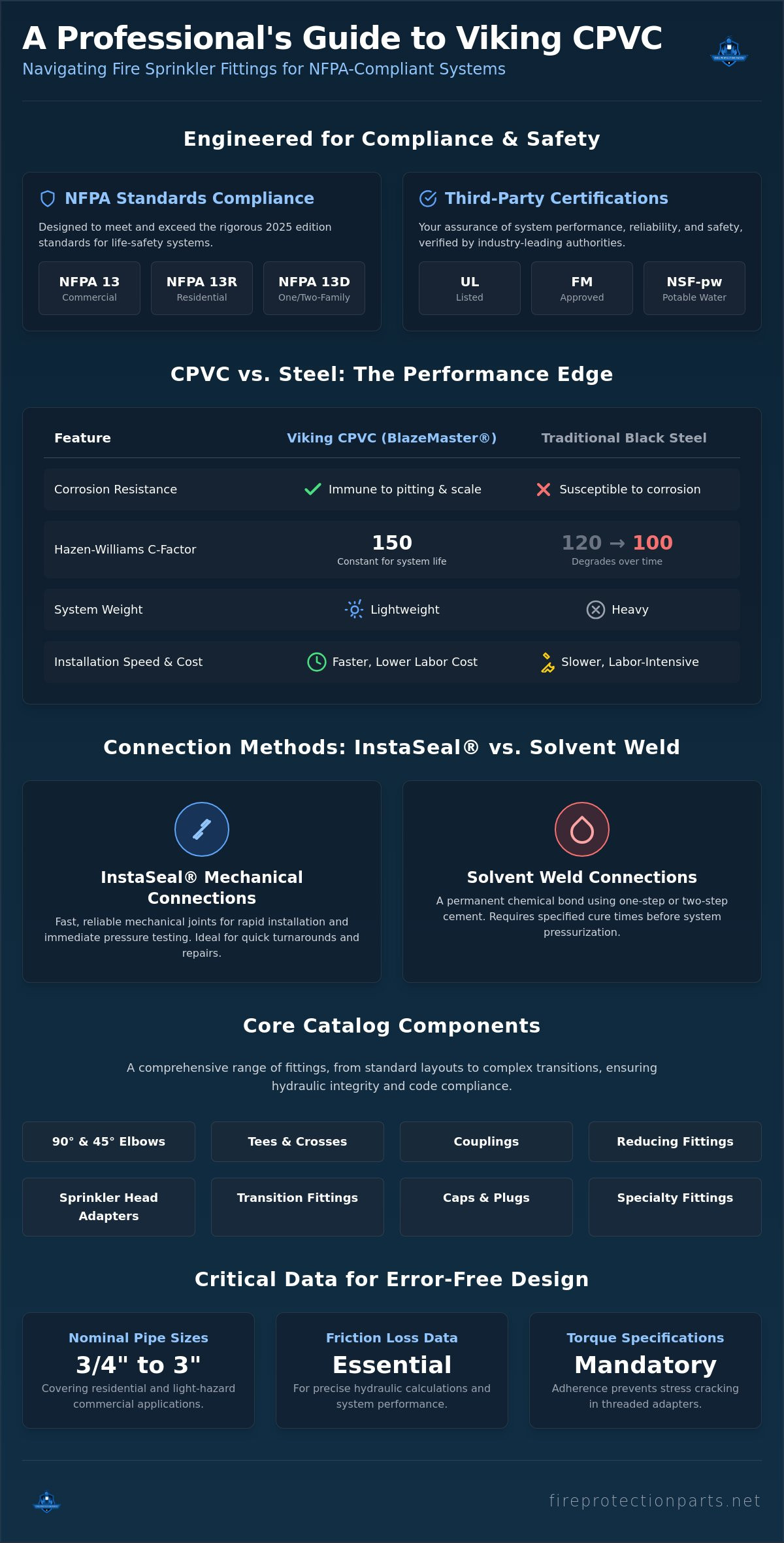
For those designing to the 2025 edition of NFPA 13, as well as 13R or 13D standards, Viking CPVC is the industry benchmark. It's specifically approved for light-hazard commercial and residential applications. Every fitting carries essential certifications, including UL Listing, FM Approval, and NSF-pw for potable water safety. These aren't just labels. They are your assurance that the system will perform exactly when it's needed most. Relying on these certifications removes the risk of code-compliance failures during final inspections.
Material Advantages in Fire Suppression
Chlorinated polyvinyl chloride (CPVC) offers distinct benefits over traditional black steel. It doesn't corrode, scale, or pit. This is vital for long-term reliability in life-safety systems. The Hazen-Williams C-factor remains a constant 150 throughout the system's life. This stability means you don't have to over-engineer pumps to account for future pipe degradation. CPVC is also significantly lighter than metal alternatives. This improves handling on the job site. It slashes labor costs, especially in multi-family residential developments where speed is critical.
Catalog Navigation 101
Finding the right part in a massive PDF is a common pain point for procurement officers. The Viking CPVC fittings catalog is organized logically by application and connection type to save you time. Understanding the SKU structure is the first step toward error-free ordering. Most part numbers are categorized by their nominal size, ranging from 3/4" to 3" in diameter. Residential-specific components are often grouped to align with NFPA 13D requirements, while larger commercial-grade fittings are listed under broader NFPA 13 sections. Always check the 'Design and Installation' supplements within the catalog. These sections provide the exact friction loss data and solvent cement cure times required for a code-compliant installation.
Core Components of the Viking CPVC Fittings Catalog
The Viking CPVC fittings catalog serves as more than a list of parts; it's a blueprint for hydraulic integrity. When you're managing a high-stakes fire suppression project, your choice of fitting dictates the system's overall performance. Standard components like 90-degree elbows, 45-degree elbows, and couplings form the skeleton of your layout. However, the catalog also provides precision-engineered reducing fittings. These are critical for managing flow transitions. They allow you to step down pipe sizes without creating the turbulent pressure drops often found in inferior systems.
Transitioning between materials requires verified hardware. Whether you're connecting to metallic risers or installing sprinkler heads, the performance advantages of CPVC over steel are most evident at these connection points. Viking offers robust adapters and transitions that ensure a leak-free interface between disparate materials. For those in the final stages of a build, the catalog includes specialized caps and plugs. These are essential for system pressure testing, ensuring every joint is secure before the system is commissioned.
Sprinkler Head Adapters
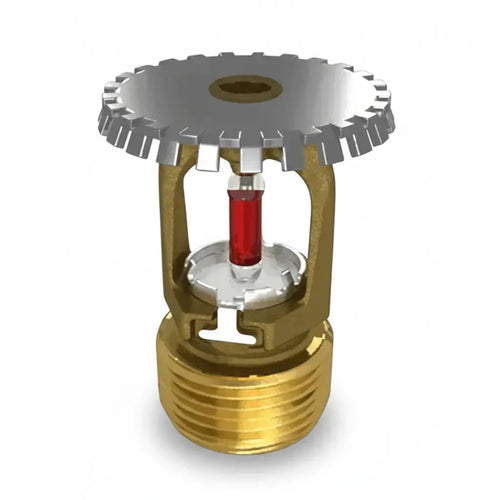
Choosing between brass-threaded and all-CPVC adapters isn't just about cost. It's about protecting the sprinkler's thermal sensitivity. Brass adapters provide a rugged, durable thread that resists cross-threading during head installation. All-CPVC options offer a lightweight, cost-effective alternative for standard residential layouts. Regardless of the material, you must adhere to the 2026 torque specifications. Over-tightening is a common cause of stress cracking. Always consult the catalog to ensure you're using the correct foot-pounds for each diameter to maintain the listing's integrity.
Specialty Tees and Crosses
Complex residential layouts often demand non-standard solutions to save space. Specialty crosses allow for four-way distribution from a single point, reducing the number of joints and potential leak points in tight ceiling cavities. Bullhead tees are another vital component, though they require careful hydraulic consideration due to their unique flow characteristics. To ensure your fittings match your main lines, check the compatibility of your Viking CPVC fire sprinkler pipe sizes before finalizing your order. If you need to verify specific dimensions, you can browse the full catalog online to find the exact part numbers you need for immediate dispatch.
InstaSeal® vs. Solvent Weld: Choosing Your Connection Method
Choosing between InstaSeal and solvent welding isn't just a matter of preference. It's a strategic decision that impacts your project's timeline and long-term reliability. The Viking CPVC fittings catalog outlines the technical requirements for both methods, but the right choice depends on your specific site constraints and environmental conditions. Solvent welding remains the industry standard for creating permanent, chemically bonded joints. However, Viking's InstaSeal technology offers a mechanical alternative that addresses the most common installation bottleneck: cure time.
Installation environments are rarely perfect. High humidity or temperatures below 40°F can significantly extend the time required for solvent cement to reach full strength. If you're working in these conditions, ignoring the cure time tables in the Viking CPVC fittings catalog is a safety risk. You need the right tools in your kit for either path. This includes high-quality tubing cutters and deburring tools to ensure a clean, square cut that facilitates a proper bond or seal. Proper preparation prevents the leaks that stall final inspections.
The InstaSeal Advantage
InstaSeal technology represents a "welded outlet" revolution in the fire protection industry. By utilizing a mechanical connection that provides the integrity of a traditional weld, it eliminates the need for solvent cement and the associated wait times. This is a massive advantage in tight construction schedules where other trades are waiting on the sprinkler system's completion. It's most effective in residential and light-hazard commercial applications where speed and a "no-leak" promise are priorities. It's important to recognize its limits, as it may not be suitable for every complex fitting transition found in the catalog.
Solvent Cement Best Practices
Traditional solvent welding relies on an "interference fit" where the pipe and fitting are chemically fused together. You must match the right cement to the fitting. Whether you're using Viking-branded cement or an approved alternative like Oatey, the chemical compatibility is non-negotiable. Proper pipe prep is the foundation of a successful weld. You must remove all burrs and bevel the pipe end to prevent the cement from being wiped away during insertion. You can find essential prep tools and other sprinkler system components online to ensure your team is equipped for a code-compliant installation every time.
Technical Specs: Pressure, Temperature, and Friction Loss
Precision engineering requires precise data. The Viking CPVC fittings catalog provides the specific performance metrics required to ensure your system survives the rigors of a fire event. Every BlazeMaster fitting in the catalog is rated for a maximum working pressure of 175 PSI at 150°F. This standard is the bedrock of your design. Operating outside these parameters risks material fatigue and system failure. You must verify that your pump discharge and ambient environment stay within these verified limits to maintain your UL listing and FM approval.
Thermal expansion is a physical reality for all thermoplastic systems. CPVC expands more than steel when temperatures rise, requiring the use of expansion loops or offsets in long runs. The Viking CPVC fittings catalog includes the exact formulas needed to calculate these requirements based on your specific temperature differential. Proper hanger and support spacing is equally vital, especially around fitting clusters. Concentrated weight from multiple valves or heavy fittings can create stress points. Adhering to the catalog's spacing tables ensures the piping remains stable and secure throughout its service life.
Hydraulic Calculation Accuracy
Generic hydraulic data is the enemy of a precise fire suppression design. Using "standard" CPVC friction loss values instead of the data specific to Viking fittings can lead to significant calculation errors. The catalog lists the equivalent length of pipe for every elbow, tee, and coupling. This allows you to account for the exact pressure drop across every junction. The K-factor represents the flow coefficient of a fitting, where a higher value indicates lower friction loss and greater hydraulic efficiency. Relying on these verified numbers ensures your hydraulic calculations reflect the real-world performance of the installed system.
Environmental Limitations
While CPVC is exceptionally durable, it has specific environmental vulnerabilities. Long-term exposure to direct sunlight can lead to UV degradation, so any piping stored on-site or installed in exposed areas must be protected. Chemical compatibility is another critical factor. You must only use products verified through the FGG/BM System Compatible Program to avoid stress cracking. This includes everything from thread sealants to firestop materials. If you are performing a system upgrade or fix, you can find the correct fire protection parts online to ensure every component is compatible with your existing Viking infrastructure. Order code-compliant Viking CPVC fittings today to guarantee your project meets the highest technical standards.
Sourcing Viking CPVC Fittings for Your 2026 Projects
Sourcing the right components is the final hurdle in any fire protection project. While the Viking CPVC fittings catalog provides the technical foundation, the actual procurement process requires strict attention to detail to avoid costly site delays. You must verify every part number against your hydraulic calculations and local AHJ (Authority Having Jurisdiction) requirements before finalizing an order. A single mismatched reducing tee can halt a residential installation for days. Buying from an authorized Viking retailer ensures you receive genuine BlazeMaster products that carry the necessary UL and FM listings.
Shipping compliance is another factor often overlooked by general contractors. Solvent cements and primers are classified as hazardous materials. This classification means they have specific ground shipping requirements and cannot be rushed via standard air freight. If you're ordering individual parts for a system repair, confirm that your supplier can handle these logistical hurdles efficiently. For new construction, bulk ordering is the most reliable path. It ensures you have a consistent batch of fittings and pipe that meet the same manufacturing tolerances throughout the system.
Checklist for a Complete Order
A successful installation depends on more than just the pipe and fittings. Use this checklist to ensure your order is project-ready:
- Calculate fitting ratios: Ensure you have enough 90s and couplings to account for field adjustments.
- Include accessories: Source the correct hangers, escutcheons, and Viking-approved solvent cement.
- Verify head compatibility: Reference fire sprinkler head temperature ratings to ensure your sprinkler head is compatible with the adapter you've selected.
- Confirm tool availability: Ensure your team has the deburring and cutting tools required for CPVC prep.
Why Fire Protection Parts is Your Sourcing Partner
We provide direct access to the Viking CPVC fittings catalog inventory, allowing you to source everything from standard elbows to specialty InstaSeal adapters in one place. Our team offers expert support to help you identify legacy parts or navigate complex transitions between disparate materials. We act as your mission-driven partner, ensuring you have the code-compliant hardware needed to protect lives and property without the typical supply house wait times. Browse the full collection of Viking CPVC Fittings at Fire Protection Parts to secure the reliable components your 2026 projects demand.
Future-Proof Your Fire Suppression Infrastructure
Designing a system that meets the 2025 edition of NFPA 13 requires more than just high-quality parts. It demands a deep understanding of the Viking CPVC fittings catalog to ensure every hydraulic calculation and material transition is accurate. Whether you're optimizing for speed with InstaSeal technology or relying on the proven chemical bond of solvent welding, your choice directly impacts the safety and longevity of the building. You've now seen how the right technical data and connection methods eliminate the guesswork that leads to failed inspections.
As an authorized Viking Plastics retailer, we specialize in providing the UL Listed and FM Approved components your projects demand. We offer fast shipping for critical repairs and bulk inventory for new construction, ensuring you never have to compromise on quality or schedule. You can trust our expertise to guide you through complex procurement with professional assurance and zero compromise on safety standards.
Secure Your Code-Compliant Viking CPVC Fittings Today and build with the confidence that only precision-engineered protection can provide. Your next successful installation starts with the right partner.
Frequently Asked Questions
Can I use Viking CPVC fittings with other brands of BlazeMaster pipe?
Yes, you can mix these components as long as both the pipe and fittings are made from BlazeMaster® CPVC compound. BlazeMaster is a standardized material, so compatibility is maintained across different manufacturers. You must verify that all parts are UL Listed for fire protection and compatible with your chosen solvent cement. Always refer to the Viking CPVC fittings catalog to ensure the specific part meets your system's design requirements.
What is the cure time for Viking CPVC solvent cement in 2026?
Cure times depend on the pipe diameter, ambient temperature, and humidity levels at the site. For a 1" pipe at temperatures between 60°F and 100°F, the minimum cure time is typically one hour before pressure testing at 225 PSI. If the temperature drops below 40°F, this requirement can extend to 48 hours or more. You shouldn't guess these times. Always follow the specific charts in the catalog to ensure joint integrity.
Are Viking CPVC fittings suitable for outdoor fire protection systems?
Viking CPVC is designed primarily for indoor applications where it's protected from environmental extremes. The material shouldn't be exposed to direct sunlight because UV radiation can cause degradation over time. If an outdoor installation is necessary, you must protect the fittings with a reflective coating or shielding. It's also vital to ensure the ambient temperature stays below the maximum 150°F rating to prevent material softening.
How do I identify a genuine Viking CPVC fitting vs. a generic one?
Genuine fittings are easily identified by the specific embossed markings on the part's body. Look for the BlazeMaster® logo, the manufacturer's name, and the UL or FM approval stamps. These fittings are also a distinctive bright orange color. Sourcing your parts from an authorized retailer is the only way to guarantee you aren't using generic, non-compliant components that could fail under pressure during a fire.
What is the maximum pressure rating for a Viking InstaSeal adapter?
The maximum working pressure for an InstaSeal adapter is 175 PSI at 150°F. This rating aligns with the rest of the Viking CPVC product line and meets the standard requirements for residential and light-hazard commercial systems. While the mechanical connection speeds up installation, it doesn't increase the hydraulic limits of the system. It's critical to ensure your fire pump settings don't exceed these verified pressure parameters.
Do Viking CPVC fittings require special hangers or supports?
Yes, you must use hangers that are chemically compatible with CPVC material to prevent stress cracking. Many standard steel hangers have oils or coatings that can damage the plastic over time. You should select hangers listed for use with CPVC or those verified through the FGG/BM System Compatible Program. Proper spacing for these supports is found in the Viking CPVC fittings catalog to prevent sagging in the lines.
Can I transition from Viking CPVC to copper piping using the catalog's adapters?
You can transition to copper using specific Viking transition adapters, which typically feature a brass-threaded or flanged connection. You should never attempt to solvent weld CPVC directly to a copper pipe or fitting. Using the correct adapter ensures a leak-free interface that accounts for the different expansion rates of plastic and metal. This keeps the system compliant with NFPA standards while maintaining the necessary 175 PSI pressure rating.
What happens if I use the wrong solvent cement on a Viking fitting?
Using unapproved solvent cement can cause a catastrophic failure of the joint during a fire event. Fire protection systems require a specific chemical bond that only BlazeMaster-approved cements can provide. Standard PVC or plumbing-grade CPVC cements don't create the same level of interference fit and can actually weaken the material. This compromise leads to leaks or blowouts that will prevent the sprinkler system from functioning when it's needed most.

