



Buy Fire Sprinkler Control Valves: The 2026 Professional Procurement Guide
The part number is the easy part. What trips up even experienced contractors when they decide to buy fire sprinkler control valves is everything that comes after: verifying UL/FM listings, matching valve type to system design, and confirming hardware will arrive before a job deadline turns critical. Choose the wrong valve for the application, and you're not just looking at a failed inspection. You're looking at a system that won't perform when it matters most.
You already know the stakes. A control valve is the single point of authority over water supply to an entire sprinkler system. Getting that component wrong isn't a minor procurement error; it's a liability that sits in the wall for decades.
This guide cuts through the confusion. Whether you're weighing an OS&Y gate valve against a butterfly valve for a commercial riser, sourcing a compliant replacement for a residential NFPA 13D system, or trying to avoid the lead-time delays that derail project schedules, you'll find clear, actionable answers here. We'll cover valve types, listing requirements, material compatibility, and what to verify before you place a single order in 2026.
Key Takeaways
- Control valve selection is a code compliance issue, not just a hardware decision — NFPA 13, 13R, and 13D each impose specific supervision and accessibility requirements that determine which valve type is legally acceptable for your system.
- OS&Y and butterfly valves serve different installation contexts: understanding the structural and operational differences between them prevents costly riser room redesigns and failed inspections.
- When you buy fire sprinkler control valves online, verifying UL/FM listings and confirming material compatibility — especially at CPVC-to-metal transitions — is non-negotiable before any order is placed.
- Wet, dry, and deluge systems require fundamentally different valve assemblies; specifying the wrong valve for your system type is one of the most common and expensive procurement errors in fire protection.
- A complete procurement strategy goes beyond the valve itself — tamper switches, trim kits, and seismic bracing are code-required accessories that must be sourced and confirmed before your project schedule locks in.
The Critical Role of Fire Sprinkler Control Valves in System Compliance
Strip a fire sprinkler system down to its essential logic, and the control valve is the single component that determines whether water reaches the sprinkler heads or doesn't. It's the system's on/off authority. When it's open and supervised, the system is ready. When it's closed without authorization, the building is unprotected. That binary reality is exactly why code bodies treat control valve compliance as a non-negotiable baseline, not a best practice.
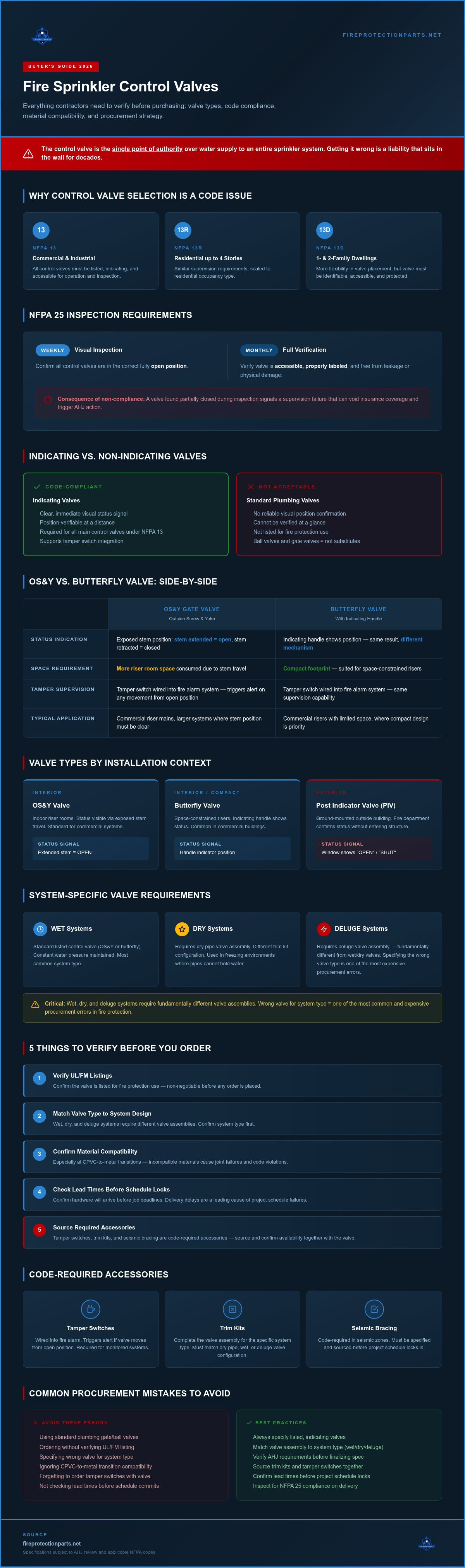
NFPA 13, 13R, and 13D each establish specific requirements for how control valves must be positioned, supervised, and accessed. NFPA 13 governs commercial and industrial occupancies and demands that all control valves be listed, indicating, and accessible for operation and inspection. NFPA 13R applies to residential buildings up to four stories and carries similar supervision requirements scaled to the occupancy type. NFPA 13D, which covers one- and two-family dwellings, allows more flexibility in valve placement, but the core requirement remains: the valve must be identifiable, accessible, and protected against inadvertent closure.
Understanding NFPA Standards for Control Valves
NFPA 25, the standard for inspection, testing, and maintenance of water-based fire protection systems, mandates weekly visual inspections of control valves to confirm they're in the correct open position. Monthly inspections require verification that the valve is accessible, properly labeled, and free from leakage or physical damage. These aren't administrative formalities. A valve found in a partially closed position during an inspection has real consequences: it signals a supervision failure that could void insurance coverage and trigger authority-having-jurisdiction (AHJ) action.
Electronic supervision is the enforcement mechanism that makes NFPA 25's inspection requirements enforceable in real time. Tamper switches wired into a building's fire alarm system trigger an alert the moment a control valve moves from its fully open position. For any system connected to a central monitoring station, this isn't optional. An indicated control valve is one that provides a clear, immediate visual signal of its open or closed status, a requirement for all main control valves under NFPA 13 to prevent accidental or unauthorized shut-offs from going undetected.
Indicating vs. Non-Indicating Valves
Standard plumbing gate valves and ball valves are not acceptable substitutes for listed fire protection control valves. The reason is straightforward: a plumbing valve gives no reliable visual confirmation of its position from a distance. You can't verify system status at a glance. That's a critical operational failure in an emergency scenario where seconds matter.
Indicating valves solve this directly. An OS&Y (outside screw and yoke) gate valve shows its status through the position of the exposed stem: stem extended means open, stem retracted means closed. A butterfly valve with an indicating handle achieves the same result with a different mechanical approach. For exterior applications where the control valve is located outside the building, the Post Indicator Valve (PIV) serves this function. A PIV is a vertically mounted valve assembly installed in the ground with a visible window that displays "OPEN" or "SHUT" as the valve position changes. This allows fire department personnel to confirm system status from a safe distance without entering the structure.
When you decide to buy fire sprinkler control valves for any system type, the indicating requirement isn't a feature upgrade. It's a code mandate that determines whether the valve is legally installable in a fire protection application at all.
Primary Types of Fire Sprinkler Control Valves: OS&Y vs. Butterfly
Not all control valves are interchangeable. The valve type you specify determines how much riser room space you'll consume, how tamper supervision gets wired, and whether your installation passes inspection the first time. Before you buy fire sprinkler control valves for any project, you need a clear picture of what each valve type actually does and where it belongs.
The OS&Y Valve: Reliability and Visual Assurance
The OS&Y gate valve is the industry's workhorse for a reason. Its defining feature is the rising stem: when the valve is fully open, the threaded stem extends visibly above the yoke. When it's closed, the stem retracts. That mechanical indication is immediate and unambiguous from across a riser room, which is exactly what NFPA 13 demands of an indicating valve.
The trade-off is physical footprint. An OS&Y valve requires clearance above and below the handwheel for full stem travel, which becomes a real constraint in tight mechanical rooms. On the maintenance side, the packing gland around the stem needs periodic adjustment to prevent drip leaks, and the exposed stem threads benefit from light lubrication to prevent corrosion and binding. Neither task is complicated, but both require access space that compact riser rooms often don't offer.
Where OS&Y valves excel: large commercial risers, industrial occupancies, and any installation where long-term serviceability outweighs space efficiency.
The Butterfly Valve: Space Efficiency and Integrated Monitoring
For modern fire riser room layouts, the butterfly valve has become the dominant choice. Its wafer or lug body design installs between flanges with minimal face-to-face dimension, making it the practical solution when a riser room is too tight for an OS&Y assembly.
Supervision wiring is simpler too. Many listed butterfly valves come with integrated tamper switches built directly into the valve body, eliminating the need for a separate external switch assembly. Some models offer external tamper switches for installations where the monitoring wiring run dictates a different connection point. Either configuration satisfies the electronic supervision requirement when properly wired to the building's fire alarm system.
One technical consideration that often gets overlooked: friction loss. A butterfly valve's disc remains partially in the flow path even when fully open, creating slightly higher friction loss compared to a full-port OS&Y gate valve. For most commercial systems, this difference is negligible when the hydraulic calculations account for it. It's only a concern if the valve is being substituted late in design without recalculating the system's hydraulic demand.
Ball valves and check valves round out the control valve category. Ball valves are common in residential NFPA 13D systems and small-scale trim applications where compact size and low operating torque matter. Check valves serve a different function entirely: they're not isolation devices. Their job is preventing backflow into the potable water supply and maintaining system pressure in wet-pipe configurations. Every system type needs them; none of them replace an indicating control valve.
Matching the right valve type to your system design is a decision that affects every inspection and maintenance cycle for the life of the installation. Sourcing from a supplier that stocks compliant components across all these categories keeps that decision straightforward.
System-Specific Requirements: Wet, Dry, and Deluge Valve Selection
The valve type that works perfectly on a wet-pipe commercial riser will fail inspection on a dry-pipe system. That's not a technicality. It's a fundamental mismatch between hardware and system logic. Before you buy fire sprinkler control valves for any project, the first question isn't which brand or which size. It's which system type you're serving.
Wet-pipe systems are the most common configuration, and their control valve assembly is relatively straightforward. The main control valve, typically an OS&Y or butterfly valve, works in conjunction with an alarm check valve that prevents backflow while triggering a water motor alarm or pressure switch when flow occurs. Floor control assemblies on multi-story buildings add an isolation valve, drain, and inspector's test connection at each level, giving maintenance personnel the ability to test or isolate individual floors without shutting down the entire riser. Specifying these as complete assemblies rather than piecemeal components reduces installation time and eliminates compatibility guesswork.
Dry-pipe systems introduce a critical variable: the dry pipe valve itself. This differential valve holds back water using air or nitrogen pressure on the system side. When a sprinkler activates, pressure drops, the clapper opens, and water fills the pipes. The air compressor maintaining that supervisory pressure is a load-bearing component of the system, not an accessory. Undersizing it, or sourcing one that isn't rated for fire protection use, creates chronic low-pressure conditions that can trigger false alarms or slow system response. The dry pipe valve, air supply, and accelerator need to be sourced and specified together.
Deluge and Preaction Solutions
Deluge systems protect high-hazard environments: aircraft hangars, chemical storage, transformer vaults. Every sprinkler head is open, and the deluge valve holds back water until a detection system commands it to release. Speed and reliability of that release mechanism are non-negotiable. The PTR Electric Deluge VXD addresses this directly. Electric actuation eliminates the pneumatic or hydraulic release tubing that adds complexity, failure points, and maintenance overhead to traditional deluge trim. For industrial environments where detection systems are already integrated into a building management or fire alarm platform, electric actuation is the cleaner, more reliable path. Pneumatic and hydraulic release mechanisms still have valid applications in environments where electrical reliability is a concern, but the trend in modern high-hazard installations is clearly toward electric actuation for its reduced trim complexity and faster diagnostic capability.
Residential Fire Sprinkler Control (NFPA 13D)
Residential systems under NFPA 13D have a different set of constraints. Space is tight, the water supply often shares the potable system, and the valve assembly needs to be simple enough for a homeowner to understand in an emergency. Compact riser assemblies with integrated test-and-drain valves are the practical solution here. They consolidate the control valve, flow switch, and drain into a single footprint that fits in a utility closet without requiring a dedicated riser room.
Two requirements that can't be overlooked on residential installations:
- Lead-free brass construction. Any valve in contact with a potable water supply must meet lead-free standards under the Safe Drinking Water Act. Verify the listing before ordering, not after the valve is on-site.
- Pressure compatibility with the residential fire pump system. If the municipal supply can't maintain minimum design pressure, a booster pump enters the picture. The control valve assembly must be rated for the pump's output pressure, or you'll face a pressure rating mismatch that no field adjustment can fix.
Each system type demands a different procurement checklist. Treating them as interchangeable is how projects end up with the wrong hardware on a deadline.
Technical Sizing and Material Compatibility (CPVC vs. Metal)
Sizing a fire sprinkler control valve isn't complicated until you get it wrong. Standard configurations run from 1-inch ball valves on residential branch lines up to 8-inch butterfly valves on large commercial main headers. The size you need flows directly from your hydraulic calculations. What trips up experienced contractors isn't the sizing itself; it's what happens at the transition point between metal valve bodies and CPVC distribution piping.
That transition is where most material compatibility failures originate. And it's a gap that most procurement guides don't address with any specificity.
Integrating Valves with CPVC Systems
Metal control valves and Viking CPVC fire sprinkler pipe don't connect directly. You need the right transition hardware, and you need to verify chemical compatibility at every point of contact. Get either wrong, and you're looking at joint failure that won't announce itself until it's too late.
Grooved adapters and threaded couplings are the two standard transition methods. Grooved connections require a listed mechanical coupling rated for fire service pressure; don't substitute standard plumbing couplings here. Threaded transitions need CPVC-rated thread sealant only. Standard pipe dope compounds frequently contain petroleum-based carriers that actively degrade CPVC over time, softening the material and compromising joint integrity. The same warning applies to valve lubricants: any petroleum-based grease used on stems or seats near a CPVC connection is a long-term liability.
When sourcing CPVC fire protection fittings, confirm that the fitting's inlet and outlet dimensions match the valve's end connections exactly. A nominal size match isn't always a dimensional match across manufacturers. Verify actual bore dimensions before ordering, not after delivery.
Verification of UL Listings and FM Approvals
When you buy fire sprinkler control valves for any listed system, the listing mark on the valve body isn't a quality badge. It's a legal requirement. A non-listed valve installed in a fire suppression system creates an uncertified assembly that no AHJ is obligated to approve and no insurer is obligated to cover.
UL listing confirms the valve has been tested to fire protection performance standards under controlled conditions. FM Global approval adds a second layer of independent verification specifically relevant to industrial and high-hazard occupancies, where FM-insured properties often require FM-approved components as a policy condition. These aren't interchangeable designations; some applications require both.
Finding the listing mark is straightforward: it appears on the valve body casting or the nameplate tag. If it's not visible on the physical valve, request the manufacturer's listing documentation before accepting the shipment. Pressure ratings require the same scrutiny. Standard commercial systems specify 175 PSI working pressure. High-rise buildings, where static pressure at lower floors can be significantly elevated, often require valves rated to 300 PSI. Installing a 175 PSI valve in a 300 PSI application isn't a marginal risk; it's a structural failure waiting to happen.
Verify listings, confirm pressure ratings, and source transition hardware that's chemically compatible with your pipe system before any order is placed. Browse listed fire protection components built to meet these specifications across residential and commercial applications.
Procurement Strategy: Buying Fire Sprinkler Control Valves Online
A valve on a loading dock two weeks after your rough-in deadline isn't a delivery. It's a problem. When you buy fire sprinkler control valves online, the procurement strategy matters as much as the product selection. Getting hardware right means confirming every component in the assembly before checkout, not after the truck arrives.
Heavy control valves, particularly flanged butterfly valves in larger diameters, ship as freight, not parcel. That distinction affects lead times, delivery coordination, and job site logistics in ways that a standard parts order doesn't. Confirm freight class and delivery requirements with your supplier before placing the order. A valve sitting at a freight terminal because no one scheduled a liftgate isn't anyone's fault but yours.
Seismic bracing is the accessory most contractors remember last and need first. In seismic design categories C through F, NFPA 13 mandates that sprinkler piping and associated riser components be braced against lateral and longitudinal movement. The control valve assembly sits at the top of that riser. If the bracing isn't specified and sourced before installation begins, you're either retrofitting under pressure or leaving a code deficiency for the inspector to find. ASC Seismic Bracing components address this requirement directly, and sourcing them in the same order as the valve keeps the installation schedule intact.
The Contractor's Buying Checklist
Before any order is placed, verify these items against your project drawings:
- End connections. Grooved, flanged, and threaded connections are not interchangeable in the field. Confirm the valve's end connection type matches your riser piping exactly. A grooved valve on a flanged riser requires an adapter that should be in the same order, not sourced separately after the fact.
- Trim components. Gauges, drain valves, and inspector's test connections are code-required elements of a complete riser assembly. Ordering the control valve without confirming trim availability from the same supplier creates a parts-matching problem at installation.
- Gaskets and bolts. Flanged assemblies require listed gaskets and appropriately rated hardware. These are small-dollar items that cause large delays when they're missing on installation day.
- Anti-freeze compatibility. Wet-pipe systems in unheated spaces require an approved anti-freeze solution. Verify the solution is listed for fire protection use and compatible with your valve seat materials before filling the system.
- Tamper switch wiring. Confirm the tamper switch configuration matches your fire alarm panel's input requirements before the valve ships.
Why Source from Fire Protection Parts?
Most online suppliers stock commodity hardware. Sourcing from Fire Protection Parts means access to professional-grade components, including Viking Plastics CPVC pipe, PTR Electric Deluge VXD assemblies, ASC Seismic Bracing, and residential fire pump systems, from a single supplier that understands how these components interact in a compliant installation.
Legacy system replacements are where generalist suppliers fall short. Identifying a listed replacement valve for an older riser assembly requires product knowledge that a standard search bar doesn't provide. That's where expert support changes the outcome.
When you're ready to buy fire sprinkler control valves alongside the full complement of system hardware, from fire sprinkler head temperature ratings to seismic restraint components, one supplier with verified inventory and fire protection expertise keeps your project moving without the parts-chasing that derails schedules.
Make the Right Call Before the Order Ships
Every decision covered in this guide connects to a single outcome: a system that performs when it's needed and passes inspection the first time. Valve type, listing verification, material compatibility at CPVC transitions, and complete trim sourcing aren't separate checkboxes. They're a chain. One weak link creates a problem that's expensive to fix after installation.
When you buy fire sprinkler control valves for your next project, the supplier you choose matters as much as the product you select. Fire Protection Parts is an authorized distributor of Viking CPVC and PTR Electric Deluge solutions, stocks ASC Seismic Bracing, and carries the full range of UL/FM listed hardware your system requires. Technical support from fire safety experts means you're not guessing on compatibility or lead times.
Don't let the wrong component or a delayed shipment put your project timeline at risk. Shop code-compliant fire sprinkler control valves at Fire Protection Parts and get the right hardware, backed by the right expertise, before your deadline locks in.
Frequently Asked Questions About Fire Sprinkler Control Valves
What is the difference between an OS&Y valve and a butterfly valve?
The core difference is mechanical design and physical footprint. An OS&Y (outside screw and yoke) gate valve uses a rising threaded stem to indicate position: stem extended means open, stem retracted means closed. A butterfly valve uses a disc and quarter-turn handle inside a compact wafer or lug body. OS&Y valves need vertical clearance for stem travel; butterfly valves install between flanges with minimal face-to-face dimension.
For tight riser rooms, butterfly valves are the practical choice. For large commercial risers where long-term serviceability is the priority, OS&Y valves remain the industry standard. Both satisfy NFPA 13's indicating valve requirement when properly listed.
Can I buy fire sprinkler control valves online for residential systems?
Yes, and it's a straightforward process when you know what to verify first. Residential NFPA 13D systems require compact riser assemblies with lead-free brass construction, since any valve contacting a potable water supply must meet Safe Drinking Water Act standards. Confirm the lead-free listing before ordering, not after the valve arrives on-site.
When you buy fire sprinkler control valves for residential applications, also confirm pressure compatibility with your water supply. If a booster pump is in the system, the valve must be rated for the pump's output pressure. Sourcing both components from the same supplier eliminates compatibility guesswork.
How do I know if a control valve is UL listed and FM approved?
The listing mark appears on the valve body casting or the nameplate tag attached to the valve. UL listing and FM approval are separate designations: UL confirms the valve has been tested to fire protection performance standards, while FM approval is an independent verification relevant to industrial occupancies and FM-insured properties. Some applications require both; they're not interchangeable.
If the listing mark isn't visible on the physical valve, request the manufacturer's listing documentation before accepting the shipment. Don't rely on distributor claims alone. Verify the actual certification against the valve body you receive.
What size control valve do I need for my 2-inch riser?
The control valve must match the nominal pipe size of the riser it serves, so a 2-inch riser requires a 2-inch listed control valve. That said, the sizing decision should always be confirmed against your hydraulic calculations, not assumed from pipe diameter alone. A valve that's nominally correct but creates excessive friction loss can compromise system performance at design flow rates.
Also confirm end connection type before ordering. A 2-inch grooved valve and a 2-inch threaded valve are both 2-inch, but they're not interchangeable in the field. Mismatched end connections require adapters that should be sourced in the same order, not discovered as a gap during installation.
Why is a tamper switch required on my fire sprinkler valve?
A tamper switch is the enforcement mechanism that makes unauthorized valve closure detectable in real time. When a control valve moves from its fully open position, the tamper switch triggers an alert at the building's fire alarm panel and, for monitored systems, at the central monitoring station. Without it, a valve closed accidentally or deliberately could leave a building unprotected with no immediate notification.
NFPA 13 requires electronic supervision for all control valves in systems connected to a fire alarm system. Many listed butterfly valves include integrated tamper switches built into the valve body. For OS&Y valves, an external tamper switch assembly is added separately. Either configuration satisfies the requirement when properly wired to the alarm panel.
Can I use a standard gate valve for my fire sprinkler system?
No. A standard plumbing gate valve isn't acceptable as a fire protection control valve for two reasons: it's not listed for fire service use, and it doesn't provide reliable visual indication of its open or closed position. NFPA 13 requires indicating valves precisely because system status must be verifiable at a glance, especially during an emergency response when seconds matter.
Installing a non-listed valve creates an uncertified assembly that no AHJ is obligated to approve and no insurer is obligated to cover. The cost difference between a listed OS&Y or butterfly valve and a plumbing gate valve doesn't justify the liability or the failed inspection.
How often should fire sprinkler control valves be tested according to NFPA 25?
NFPA 25 establishes a tiered inspection schedule. Weekly visual inspections confirm the valve is in the correct open position. Monthly inspections verify accessibility, proper labeling, and the absence of leakage or physical damage. Annually, the valve must be operated through its full range of motion and returned to the open position to confirm it operates freely and reseats properly.
Tamper switch function is also tested on an annual basis to confirm the supervisory signal transmits correctly to the fire alarm panel. These aren't optional maintenance intervals. A valve found out of compliance during an inspection can trigger AHJ action and affect insurance coverage.
Are butterfly valves compatible with CPVC fire protection systems?
Butterfly valves themselves are compatible, but the transition between a metal valve body and CPVC piping requires specific hardware and chemical awareness. Grooved adapters and threaded couplings are the two standard connection methods. Threaded transitions require CPVC-rated thread sealant only; standard petroleum-based pipe dope compounds degrade CPVC over time and compromise joint integrity.
The same caution applies to valve lubricants used near CPVC connections. Verify that any grease or sealant used on the valve stem or seats is petroleum-free before application. Confirm actual bore dimensions match between the valve's end connections and your CPVC fittings; a nominal size match doesn't always mean a dimensional match across manufacturers.

